Эволюция образа дьявола и демонического в творчестве Альбрехта Дюрера
Concept
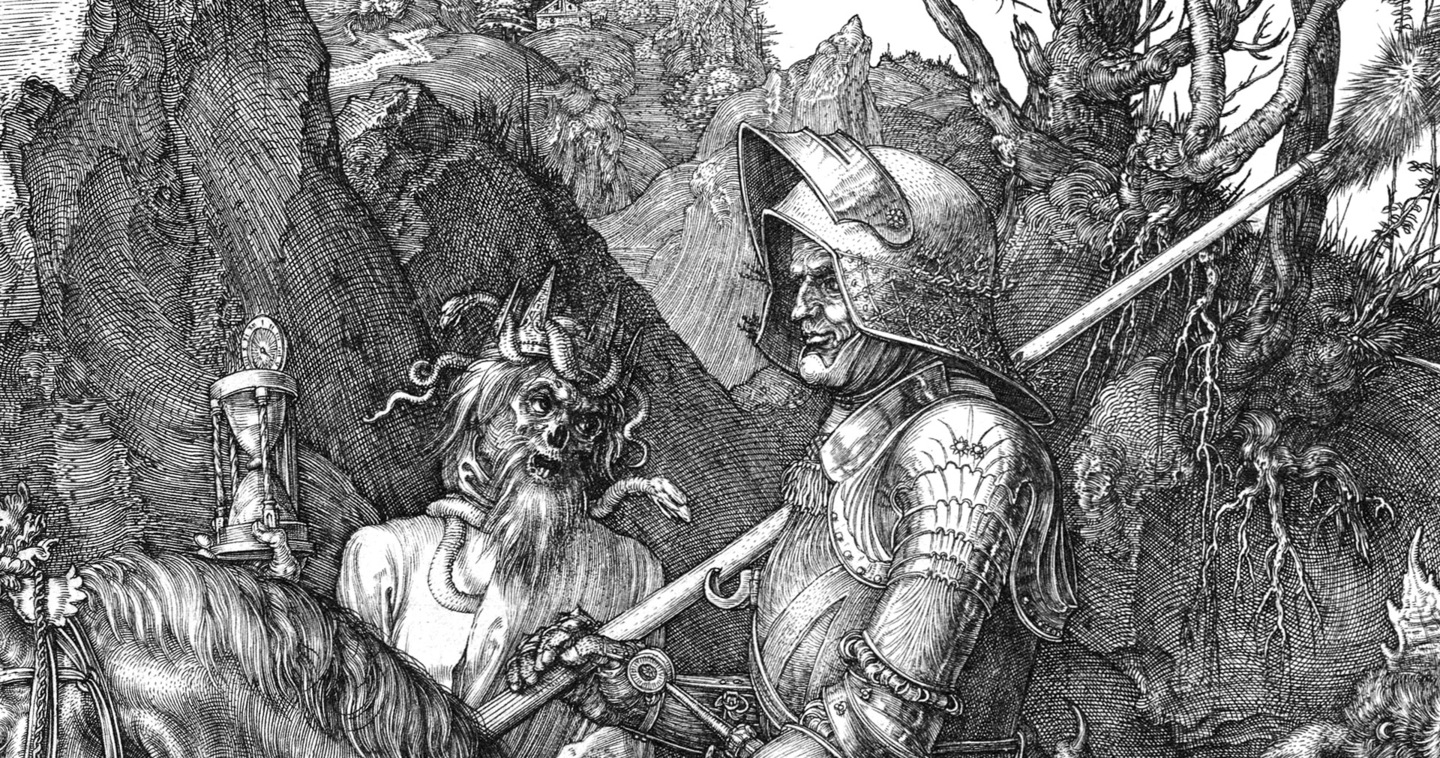
Dürer’s creativity stands at the intersection of two eras—the fading Middle Ages and the dawning Renaissance. With the turn of the centuries, the human self-perception inevitably evolves. Analyzing Albrecht Dürer’s depiction of the demonic allows one to clearly trace how the image of evil in his work shifted from portraying unclean spirits with animalistic features to becoming a metaphorical reflection of internal struggle. Do these depictions gradually become more corporeal, realistic, and convincing? The demonic as part of the real world. My hypothesis is that Dürer moved hell from an external cosmological space into the inner world of man, transforming the medieval horned devil into a psychological metaphor. Direct depictions of demons give way to subtle, allegorical images of the demonic influence on the human soul. towards an internal psychological conflict overcome by the strength of spirit and reason. One can arrive at the idea that the image of the devil wasn’t simply becoming «more realistic.» As art developed, the very concept of evil changed: from a conventional sign existing in a symbolic space—to a physical, convincing, and almost material presence. It first fills the world as apocalyptic chaos, and then becomes a concrete being that literally appears near the human. the journey from the medieval grotesque monster to the symbol of internal temptation.
Late Gothic (late 1480s–1490s)
Transitional Phase: Synthesis of Gothic and Renaissance (1500–1506)
The Northern Renaissance (1507–1528)
Conclusion
Bagrovnikov Nikolay Adrianovich, Fedorova Marina Vladimirovna «APOCALYPSE» BY ALBRECHT DÜRER: AN ATTEMPT AT A PHILOSOPHICAL INTERPRETATION OF THE SPATIO-TEMPORAL ISSUES IN THE CYCLE OF ENGRAVURES // Philosophy and Culture. 2023. No. 6. URL: https://cyberleninka.ru/article/n/apokalipsis-a-dyurera-popytka-filosofskoy-interpretatsii-prostranstvenno-vremennoy-problematiki-tsikla-gravyur (Accessed: 11/14/2026).
Ivanova Svetlana Valerievna The Image of «The Descent into Hell» in Western European Engravings of the 15th–17th Centuries // Vestnik PSTGU. Series 5: Issues in the History and Theory of Christian Art. 2015. No. 1 (17). URL: https://cyberleninka.ru/article/n/obraz-soshestvie-vo-ad-v-zapadnoevropeyskoy-gravyure-xv-xvii-vv (Accessed: 11/14/2026).
Bagrovnikov Nikolay Adrianovich, Fedorova Marina Vladimirovna THE EVOLUTION OF AESTHETIC VIEWPOINTS OF ALBRECHT DÜRER IN THE CONTEXT OF RENAISSANCE PHILOSOPHY // Philosophy and Culture. 2022. No. 6. URL: https://cyberleninka.ru/article/n/evolyutsiya-esteticheskih-vzglyadov-a-dyurera-v-kontekste-filosofii-renessansa (Accessed: 11/14/2026).
https://magisteria.ru/albrecht-durer/knight-death-and-the-devil-saint-jerome (Accessed: 11/14/2026).
Yuzhakova, Elizaveta Vladimirovna. «Melancholy I» by Albrecht Dürer: A History of Interpretations / E. V. Yuzhakova // Izvestiya Uralskogo Gosudarstvennogo Universiteta. Series 2, Humanities. — 2010. — No. 4 (82). — pp. 206–217. https://elar.urfu.ru/handle/10995/18674 (Accessed: 11/14/2026).