Structure
I. Concept II. Greek Sculpture III. Influence on the Renaissance Canon IV. The Emergence of the Myth of the «White Greece» V. The «Polychrome Wars» VI. Conclusion
Concept
Rationale for Topic Selection
The topic of Ancient Greece’s influence on the Renaissance is considered a classic in art history. However, it is often treated superficially—focusing solely on the borrowing of forms, subjects, and techniques from ancient authors and their subsequent development by artists of that era. Masters did not reference the original statues, but rather their altered versions, which had lost their original polychrome finish due to exposure to the elements. The choice of this theme is motivated by a desire to examine it from a new perspective: not merely as a «revival of antiquity, ” but as the inheritance of lost knowledge.
Relevance of the Topic
The relevance of this chosen topic lies in an interesting paradox: the lack of knowledge regarding color on ancient statues fostered the myth of a «White Greece, ” which subsequently became the basis for the establishment of the Renaissance sculpture canon. This topic was not widely discussed among art historians until recent technological advancements allowed for the detection of traces of faded pigment on the statues. This discovery initiated the so-called „Polychrome Wars”—intense debates among art historians and archaeologists that only recently concluded. Specifically, thanks to the scientific reconstructions by Vincenzo Brinkmann, we now know precisely that ancient sculpture was brightly colored. Analyzing Renaissance sculpture through the lens of lost color helps us understand how the environmental factor evolved into an undisputed aesthetic norm, shaping the development of European art for centuries to come.
Research Questions
This visual investigation raises the following questions: How did the loss of color in Greek sculpture influence the visual perception of antiquity during the Renaissance? What artistic strategies did Renaissance masters use when interpreting «desaturated» ancient prototypes? How was the myth of the «White Greece» debunked?
Hypothesis
The hypothesis is that the Renaissance canon of white marble did not naturally follow the ancient tradition. On the contrary, it was an ideological and aesthetic construct shaped by historical contingency and the limited knowledge of artists at the time. The loss of color prompted masters to create a new tradition based on an incomplete understanding of the culture of the ancient world. In this context, the whiteness was not a conscious rejection of color, but rather a consequence of their unfamiliarity with its original presence.
Material Selection Principle
The material was selected based on the principle of comparative juxtaposition. The main body of the visual set is constructed from pairs: on one side, ancient monuments; on the other, Renaissance works. The second part is built upon scientific reconstructions of polychromy, which serve as visual evidence of the statues' original colors.
Greek Sculpture
Contrary to popular belief, Greek sculpture is not defined by a single style or canon. In reality, it is divided into three main periods: Archaic, Classical, and Hellenistic.
Archaic period (c. 650–480 BCE) — is characterized by the frontal presentation of the image, stylization of the human body, and the distinctive «archaic smile.»
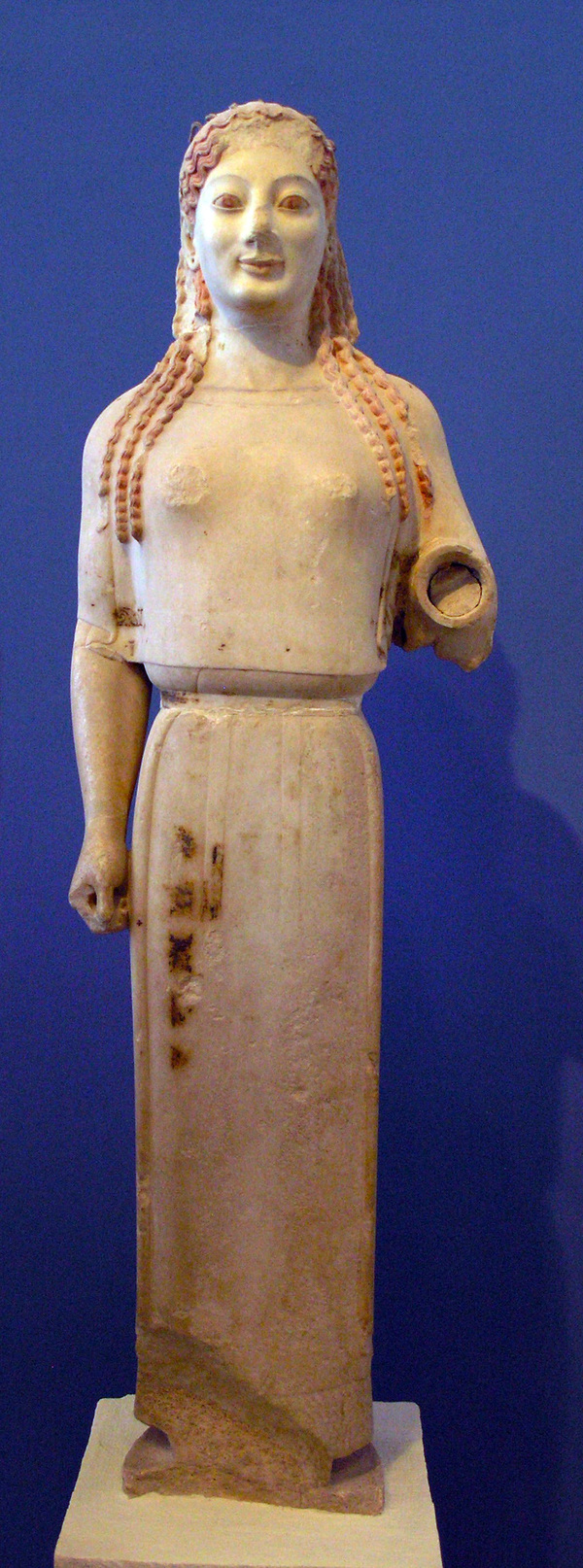
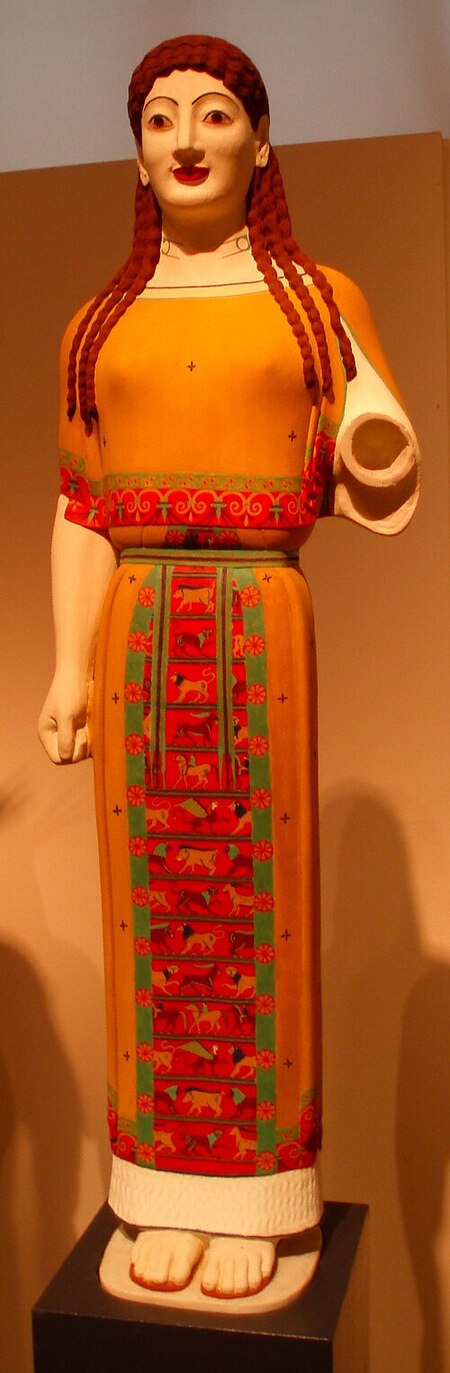
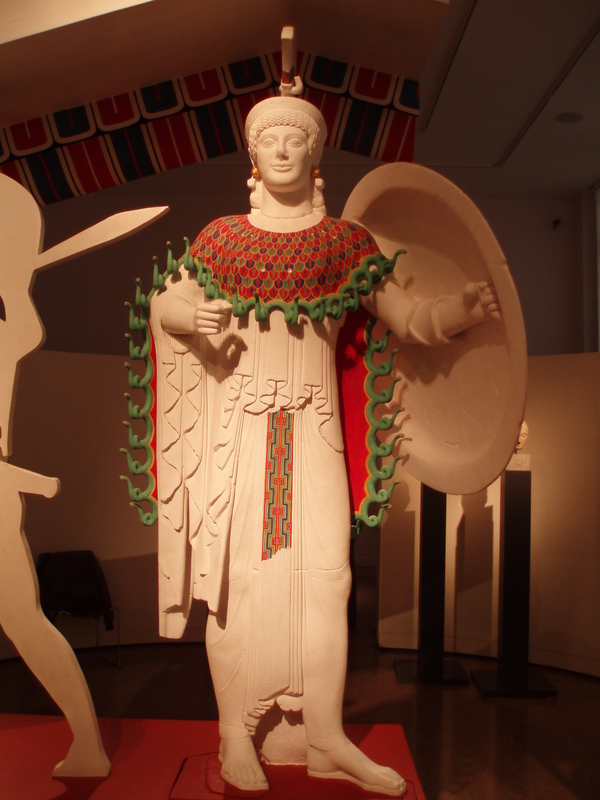
Unknown Sculptor. Peplos-Kora (Kora No. 679). Circa 530 BCE. Paros marble, height 120 cm. Acropolis Museum, Athens (left). Reconstructed by Vincenz Brinkmann, painted by Ulrike Koch-Brinkmann. Color reconstruction of Peplos-Kora (Variant B). Plaster, wood, gilding, natural pigments. Staatliche Antikensammlungen und Glyptothek, Munich — copy for the «Bunte Götter» exhibition.
If one looks at the reconstructions, it can be noted that Greek sculpture was not «white»: bright colors covered the clothing, hair, and facial features. Brinkman’s reconstructions [1] are based on the scientific analysis of pigment traces and represent a well-founded hypothesis. However, for the Renaissance viewer, this polychromy was unavailable—they only saw white marble.
Classicism (c. 480–323 BCE) — during this period, naturalism emerged, contrapposto was introduced, and the idealization of the human body and proportions began.
Polykleitos (original); unknown Roman sculptor (copy). Dorphoros (Spear Bearer). c. 440 BCE (Roman copy). Marble, 212 cm high. National Archaeological Museum, Naples.
The material also played a key role. The Greeks worked in marble and bronze, but almost all of the bronze originals were lost through recycling. Therefore, Renaissance figures could judge the Greeks based on Roman copies, which were also most often made of marble, which reinforced the perception of white antiquity. Furthermore, the very technique of marble carving in the Renaissance was modeled on ancient examples, but without accounting for their original polychromy.
Unknown sculptor (possibly Pythagoras of Regium). The Delphic Charioteer. c. 478–474 BCE. Bronze, 184 cm in height. Delphic Archaeological Museum, Delphi.
Hellenism (c. 323–31 BCE)—during this period, sculptors began to emphasize dramaticism, dynamism, and expression in their works.
Unknown Sculptor. Nika Samofrakidai. c. 200–175 BCE. Paros marble. Louvre, Paris.
For the Renaissance canon, the classical ideal became central, yet knowledge of this ideal was mediated through Roman copies. It is important to emphasize that polychromy was an intrinsic quality of Greek sculpture: the marble was painted, and color was part of the original concept, not a later addition. Evidence of this includes pigment traces discovered via ultraviolet fluorescence and ancient written sources [1][2].
Influence on the Renaissance Canon
Renaissance artists did not have direct access to Greek originals from the 5th–4th centuries BCE. Their knowledge of antiquity was shaped through Roman copies, which were often fragmented, restored, and lacked color due to environmental factors.
A foundational catalog of such works and their Renaissance borrowings is Phyllis Pray Bober and Ruth Rubinstein’s «Renaissance Artists & Antique Sculpture: A Handbook of Sources» [3]. It compiles 500 illustrations comparing ancient sculpture with the works of Renaissance masters. Based on these comparisons, one can conclude that primarily formal techniques were borrowed: contrapposto, proportional canons, the conveyance of anatomical tension, and the motif of «heroic nudity.» In other words, the sculptors did not initially intend to depict Greece as white—this emerged incidentally through copying existing Roman copies.
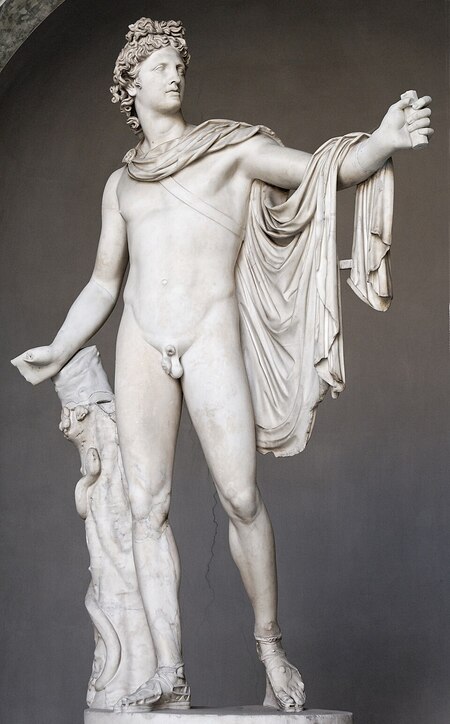
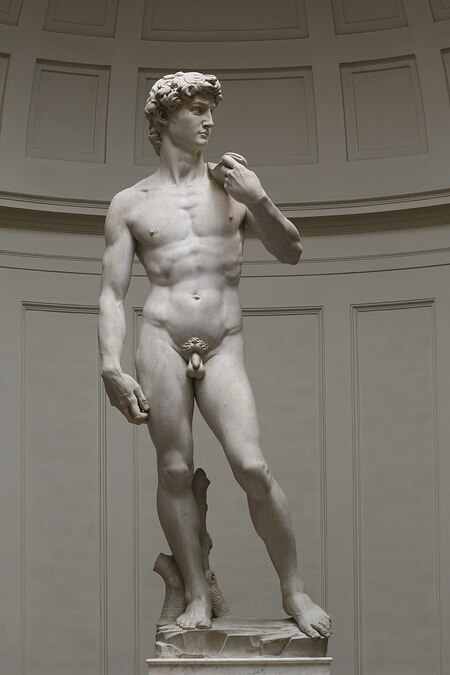
Apollo Belvedere. Roman copy of a Greek original by Leocharis (c. 330–320 BCE). Marble. Vatican Museums (left). Michelangelo. David. 1501–1504. Marble. Accademia Gallery, Florence (right).
A striking example of this comparison is between the statues «Apollo Belvedere» and «David.» The most noticeable similarity in the stance of their feet is the contrapposto, a technique used in ancient sculpture to give the pose vitality. Furthermore, the sculptures share similarities in the twist of the torso and proportional harmony. However, there are also differences. «Apollo» represents an idealized, detached beauty of the human form, whereas Michelangelo’s «David» is a heroic, tense body brimming with inner energy. Michelangelo did not copy the ancient model—he interpreted it.