Medieval art is often perceived through recognizable motifs: depictions of Christ, saints, Biblical narratives, and grand architectural compositions. However, beneath this general impression, small artistic details often go unnoticed. Upon closer inspection, these very details can unlock additional layers of meaning, clarify the artwork’s historical context, and alter the initial perception.
Navigation
I. Introduction II. Perceiving the Unseen III. Reading the Image IV. Seeing Connections V. Conclusion VI. Sources
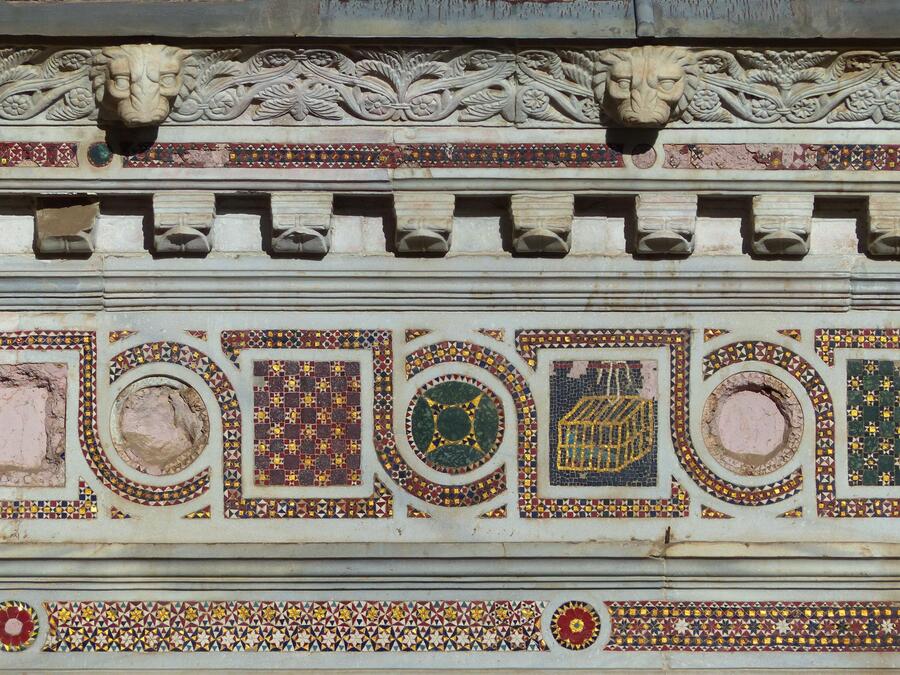
Vassaletto Workshop. Decorative detailing of the cloister of St. John Lateran Basilica. 13th century. Rome. Fragment.
Research Concept, Hypothesis, and Methodology.
The core idea of the research is that a «second look» is not simply zooming in on an image to find hidden meaning or secret messages, but rather a transformation in how one reads the artwork and the additional meanings that are not always apparent upon first encounter with the piece.
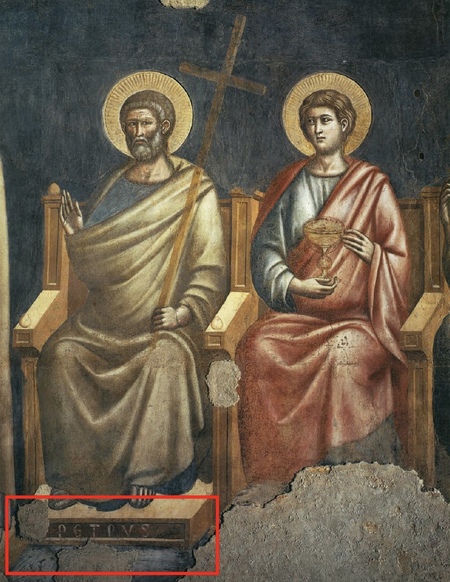
Sometimes the viewer needs to recognize a symbol, other times—to read a inscription, compare several figures, or examine how an image interacts with its architectural space. In this way, an artistic detail becomes not only a carrier of information but also a tool that directs the viewer’s attention.
The primary research method selected is comparative visual analysis. Each piece is examined sequentially: first as a cohesive composition, then through individual details, and finally through its interaction with the surrounding elements. Particular attention is paid to scale, placement, color, plasticity, rhythm, inscriptions, and methods of spatial organization.
This topic is highly relevant given the unique characteristics of contemporary image perception. In the 21st century, information is often consumed rapidly, with attention fixating on the most expressive and recognizable elements. Studying medieval works allows us to engage with a contrasting mode of observation—a slow, sequential, and detail-oriented approach.
Map showing the locations of medieval Rome monuments under study. Original visualization created using generative AI. 2026.
The geographical scope of this research is limited to Rome because the city is a site of profound artistic history, where medieval masters worked in close proximity to ancient and early Christian monuments. This context allows for the examination of artistic details not only within individual works but also in the context of the interaction between diverse traditions.
The primary chronological range covers the 9th–14th centuries. During this period, monumental mosaics, fresco cycles, sculptural, and architectural ensembles were created in Rome, with details serving various compositional, narrative, and symbolic functions.
The research is built on a typological principle based on different ways of perceiving artistic detail. It is divided into three research parts:
I. Seeing the Unseen — how scale, contrast, form, and placement make a detail less or more noticeable II. Reading the Image — how inscriptions, attributes, and seemingly secondary scenes convey additional information III. Seeing Connections — how the meaning of a detail is revealed through the prism of historical context
The core question is how artistic details in medieval Roman works create additional layers of meaning, and how their placement, form, and interaction with the composition influence the perception of the artwork.
Hypothesis:
The semantic significance of an artistic detail does not always correspond to its visual prominence; even a small, seemingly secondary element can play a vital role in interpreting a work.
Scientific research on medieval Roman art, publications concerning mosaic iconography, the interplay between text and image, as well as works dedicated to 13th-century Roman sculpture and architecture, are used to substantiate the interpretations.
Chapter 1. Seeing the Unseen
We will examine how the form, size, and placement of a detail determine its visibility and semantic role.
Unknown Masters. Mosaic decoration of the apse and apse arch of the Basilica di Sant’Apollinare in Classe. Circa 822. Rome.
Let’s consider the mosaic above the apse of the basilica. Christ occupies the central position in the composition. Saints are arranged on either side of him, and the remaining figures adhere to the mosaic’s overall structure. At first glance, attention is drawn to the large figures and the solemn character of the scene.
Unknown Masters. Mosaic decoration of the apse and apse arch of the Basilica di Sant’Apollinare in Classe. Circa 822. Rome.
Set apart from the central grouping is a small bird. Its scale and placement make it easily missed among the many other elements.
Apse mosaic of the Basilica of Santa Prassede. Fragment: phoenix on a palm
The bird on the palm is traditionally identified as a phoenix—an image associated with rebirth and triumph over death. In Christian art, this motif could be used as a symbol of resurrection. Therefore, the figure complements the main subject matter of the apse mosaic and reinforces the theme of eternal life [6; 7].
Phoenix does not occupy a central position nor does it participate directly in the main action. However, its symbolic meaning is connected to the work’s overarching theme. This example demonstrates that visual prominence and semantic significance are not always aligned.
Artist unknown. Apse mosaic of the Basilica of Santa Maria in Domnica. Circa 817–824. Mosaic. Rome.
We will examine the apse mosaic of the Basilica di Santa Maria in Dominica. At the center, the Virgin Mary with the Child is depicted, surrounded by numerous angels. At her feet is the kneeling figure of Pope Paschal I.
Unknown Masters. Apse Mosaic of the Basilica of Santa Maria in Trastevere. 817–824. Rome.
In the Santa Maria in Domnica mosaic, there is a subtle geometric feature; the composition features different types of halos adjacent to one another.
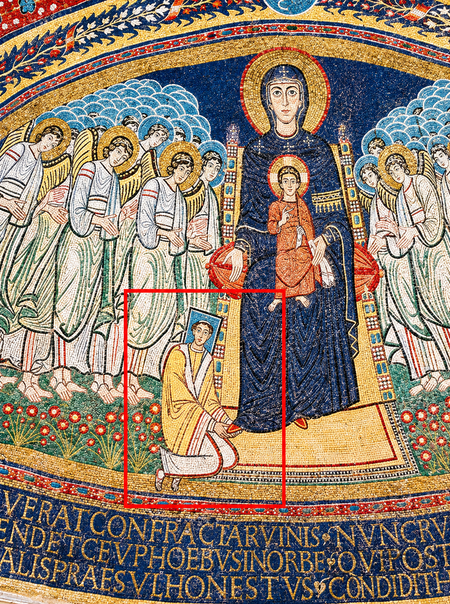
Historian Gerhard Ladner confirmed the thesis that the square shape was predominantly used to denote living historical figures—distinguished donors, Roman popes, emperors, or high-ranking church officials. This allowed artists to differentiate still-living individuals from canonized saints in monumental frescoes and mosaics [1]. In this case, the square halo helps distinguish Pope Paschalis I from the saints. When the mosaic was created, Paschalis I was alive, and this characteristic of the depiction emphasizes his status as a living historical figure and patron.