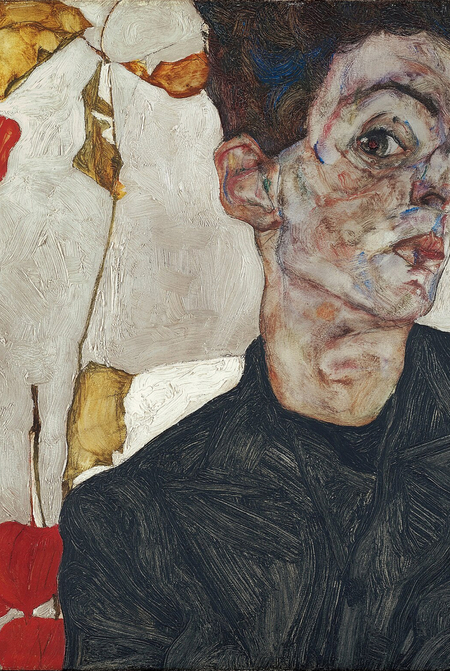
I need to see something new and explore it. I want to try dark water, see crackling trees, and feel the gusty wind.
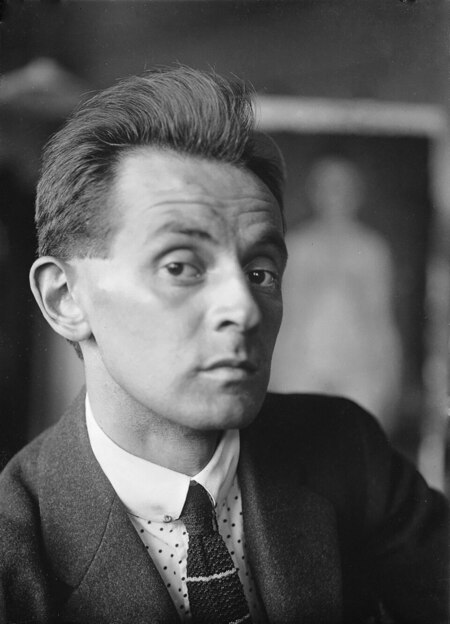
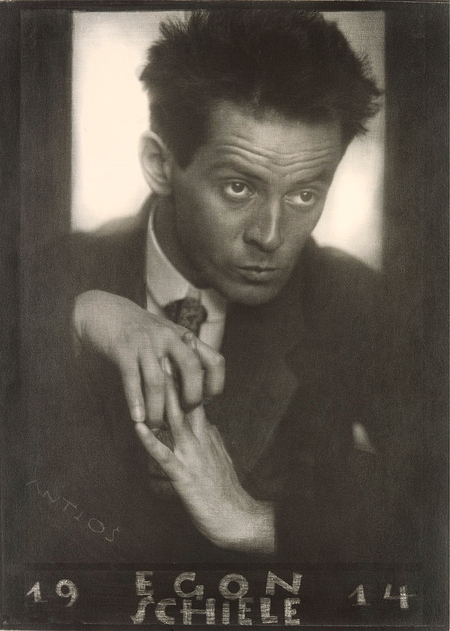
Photos of Egon Schiele
Navigation Menu
Navigation
Concept
ANALYSIS BLOCK</font color= 726C80>
Methodological Framework
Creative Individual Creative Product Creative Process Strategies · Stages · Scenarios Creative Environment
SYNTHESIS BLOCK</font color= 726C80>
Semantic Synthesis Reflection
Concept
Shiele was chosen because he represents an extreme case. He was a man who drew in prison, in the army, on days without food—from the sheer inability to stop. Egon Schiele lived only twenty-eight years, yet he left behind more than three thousand works. This makes him an almost ideal subject for studying creativity in its purest form. Furthermore, he possesses a rich and diverse visual archive—self-portraits, nudes, landscapes, portraits, prison watercolors—which is crucial for the scope of a visual study due to its sheer volume.
The research material was selected based on two criteria. The first was documentary verifiability. This refers to data confirmed by letters, diaries, the Jane Gallier catalogue, or museum sources. Where facts are disputed or sources are absent, this is noted. The second criterion was visual representativeness. Every thesis is supported by a specific artwork, which is subsequently presented in the study. The mythologized image of Schiele as a martyr-genius and an incomprehensible provocateur is deliberately pushed into the background, as it obscures the real individual.
The structure of the research follows Rogers' 4P model, which divides creativity into four components: personality, product, process, and environment. In Schiele’s case, these four components are literally interwoven in his biography. His father’s death from syphilis shaped his personality; his personality defined his method; his method generated his product; and the environment—Viennese censorship, prison, war, the Spanish Flu—pressured all these spheres simultaneously. The four analytical blocks conclude with a synthesis, where all components are assembled into a single model. Within the personality block, Hilgard’s triad—cognitive, conative, and emotional—is used as a descriptive tool, but without including a biographical section.
Textual sources are divided into two types. Primary sources include Schiele’s own letters and diaries, his court statements, and the prison diary from April 1912. These are used as direct testimony regarding his process and motivation. Secondary sources are biographical and art historical studies: the Gallier catalogue raisonné, materials from the Leopold Museum and Belvedere Palace, Simonton’s historiometric works, as well as large archives of the artist’s works. Journalistic and popular sources are only utilized for context.
Key Research Question: Does Shile’s work possess a stable internal logic—a code that explains simultaneously his method, his output, and his conflict with his environment? Hypothesis: Shile’s creative code is a systematic violation of boundaries—the sole means by which a creative individual can exist within rigid social norms.
The body within this logic becomes simultaneously the method, the content, and the territory. The unedited line functions as his worldview. Provocation operates as his instrument of knowing.
ANALYSIS BLOCK
Methodological Framework
The research is based on Rhodes’s 4P model. This model divides creativity into four components: person, product, process, and environment. Rhodes gathered dozens of definitions of creativity and found that they all say essentially the same thing, just from different angles. He suggested not choosing a single perspective, but considering all four simultaneously. For Schiele, this works particularly well: his personality shaped his working method, the method determined the character of his work, and his life’s environment and events either pressured all of this or, conversely, provided it with necessary space.
Within the 'Person' section, Hilgard’s triad is utilized—specifically, the division of psychological life into cognitive, conative, and emotional components. This is not a rigid classification, but rather three different viewpoints on one individual. The cognitive aspect refers to how Schiele perceived and processed reality—how his thinking fundamentally operated. The conative refers to what motivated him, where the will to produce three thousand works in ten years originated. The emotional aspect relates to what he experienced and how those experiences manifested in his imagery.
The biographical material is analyzed through Simonton’s historiometric approach. He developed a method for studying outstanding individuals using archival data: biographies, letters, a body of work, and historical context.
It is this combination of tools that fits the study of Egon Schiele’s personality so effectively. The 4P framework prevents becoming trapped in biography while neglecting the actual artwork; Hilgard’s triad allows for a precise—rather than merely descriptive—discussion of his personality; and Simonton’s historiometry keeps the interpretations grounded. Schiele’s image is easily transformed into a myth—my task is to figure out how his creativity was structured in reality.
Creative Individual
Adolf, with his wife Maria and children (from left to right) — Egon, Melanie, and Elvira
In the Shiele family history, death began to loom earlier than in other families. Before Egon’s birth, his mother survived three miscarriages, presumably due to syphilis, which Adolf Schiele, his father, contracted during his wedding and honeymoon. His older sister, Elvira, died at the age of ten from congenital syphilis when Egon was three. The father, who was a station manager in Tula, suffered from progressive paralysis and episodes of madness due to the illness. He entered the terminal stage in 1902, and in bouts of delirium, he burned the family’s railway bonds before dying on December 31, 1904 (the family officially registered his passing on January 1, 1905, to receive an extra year’s pension). At that time, Egon was fourteen. Due to these factors, Schiele was a withdrawn and painfully self-absorbed teenager. His classmates and teachers considered him a «peculiar child»: «Shy and introverted, he performed poorly in all subjects except physical education and drawing.»
This is precisely why Thanatos appears in his work as a form of childhood memory. In a letter to his stepbrother in 1913, Schiele confesses: «Few others probably remember my noble father with the same sorrow as I do… That is why there is so much grief in my paintings. It continues to live inside me.»
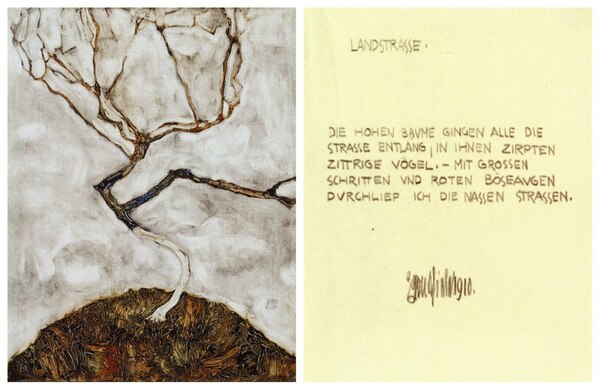
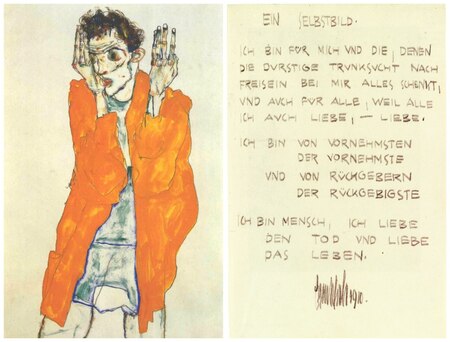
Egon Schiele. Book: «Poems and Letters.» 1910–1912
As a child, Schiele was obsessed with the railway and constantly drew it. His father, irritated by the endless sketchbooks, destroyed his son’s early drawing notebooks. Teachers at the Krems and Klosterneuburg high schools complained that Schiele disrupted lessons with drawings, but the art teacher, Strauch, was the only one who supported him. From the beginning, drawing functioned not as a hobby, but as a means to manage anxiety.
Through the depiction of distorted bodily forms and expressive lines characteristic of his painting and graphics, Schiele was noted as an early representative of Expressionism. Schiele thought in lines—and however metaphoric that may sound, it was a description of the actual method he employed in his work: the first line on the paper was final, without preliminary light touches or corrections. He explored the body as if encountering it for the first time. About one hundred self-portraits (from the early 1910s to posthumous sketches by Edith in 1918) form a continuous diary of self-discovery.
Schiele himself articulates the cognitive optics even more precisely: «For the viewer to more deeply understand the other’s corporeality, the hero’s body in the painting must appear more expressive—as if it were being gazed upon by a lover. It is the sharpened hunger of a predator that has spotted its prey and is already devouring it with its eyes.»
View from a painting studio, Klosterneuburg, Egon Schiele, 1905
Schiele was an incredibly prolific artist, creating nearly three thousand drawings during his short career. His primary artistic medium was drawing, which he valued for its spontaneous expression. Schiele lived in poverty, sleeping in studios with leaking roofs and subsisting on bread while making pornographic postcards distributed by street vendors, yet his style never changed. In 1909, following a conflict with the conservative Christian Gripenkeller at the Vienna Academy, he left it and, on June 17, 1909, he founded the «Group of New Art» at Gustav Piscot’s gallery on Lothringerstrasse 14, becoming its president and secretary. Among the fifteen founders were Anton Fassauer, Anton Pescha, Erwin Osen, Franz Wegeler, and Rudolf Kalwatz. His own manifesto contains the phrase: «There are few new artists—very few. Chosen ones. The new artist must be absolutely themselves; he must be a creator; he must rely solely on the foundation within himself, without using anything past or established.»
Schiele asserts himself so forcefully that a screen of excessive imagery stands between the viewer and his vulnerability. The paradox of the hypertrophied «self» is documented by the artist himself in a letter (according to Mitsch, 1988): «All beautiful and noble qualities are united in me… I will be the fruit that leaves behind eternal vitality even after my decay. How great must your joy be that you gave birth to me.» Simultaneously, there is openness and pain: «I must live in my own excrement, inhaling my own toxic, sticky vapors. And yet I am a human being! I remain one. Does no one think of this?» The matter is not so much about narcissism or schizophrenia as it is about the «struggle for identity.»
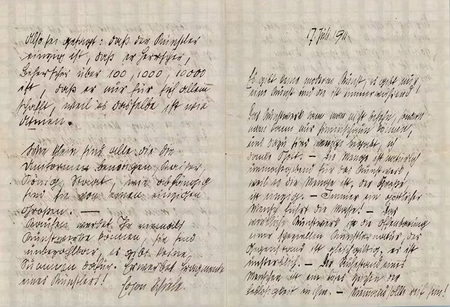
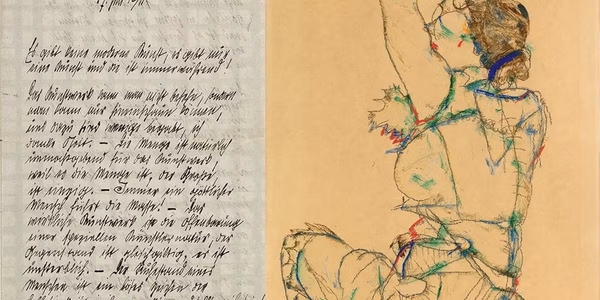
Egon Schiele (1890 Tula — 1918 Vienna), signed manuscript from July 17, 1911.
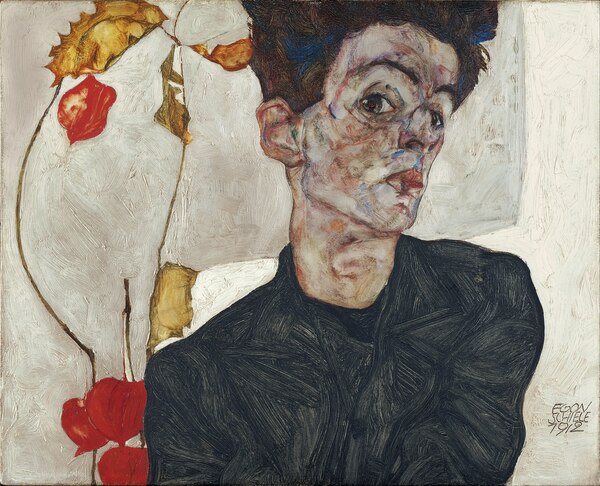
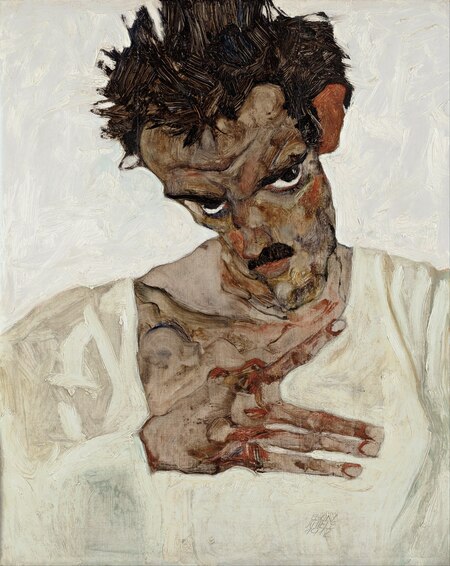
Self-Portrait with Phala, Egon Schiele, 1912 / Self-Portrait with Dropped Head, Egon Schiele, 1912
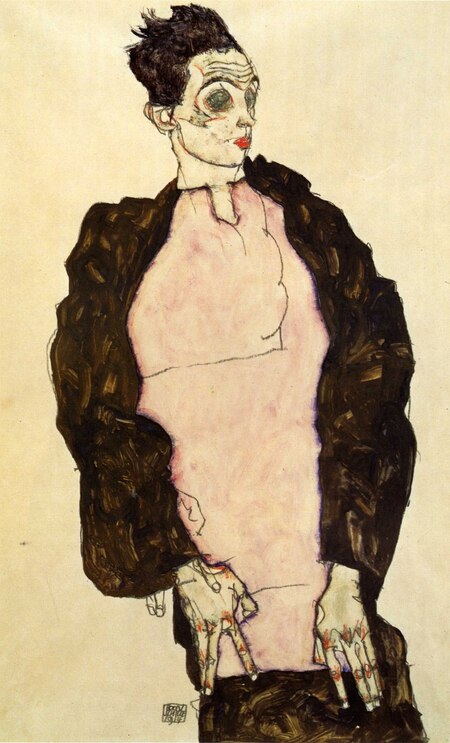
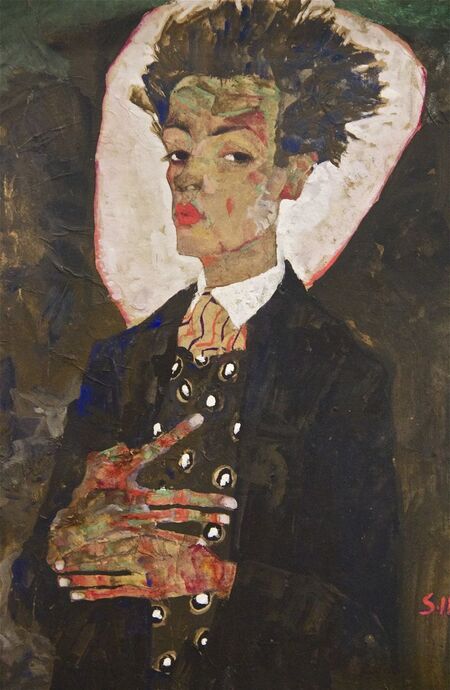
Self-Portrait in Lilac Shirt, Egon Schiele, 1914 / Self-Portrait with Peacock Vest, Egon Schiele, 1911
Shile first encountered Gustav Klimt around 1907 when Klimt brought him drawings while Shile was still a student at the Academy. When asked if he had talent, Klimt supposedly replied, «Too much.» Klimt purchased his works, exchanged sketches, provided models, and invited him to exhibit in the 1909 exhibition alongside Van Gogh, Munch, Toorop, Bonnard, and Gauguin. Shile adopted three elements from Klimt: decorative eroticism, flatness, ornamental line, and the golden background. All of this is visible in the works from 1908–1909, especially in Shile’s Danaë (1909)—a direct reinterpretation of Klimt’s Danaë (1907)—and Young Man Kneeling Before God the Father (1908).
In March 1910, he articulated this shift himself: «Until March I walked in Klimt’s footsteps. Today, I feel I am someone completely different.» In the double portrait Hermits (Die Eremiten, 1912, Leopold Museum, Vienna), Shile and Klimt merge into one dark figure. In a letter to collector Karl Ringhauser, Shile explains: «This is not a gray sky, but a sorrowful world in which two bodies move.» The psychological separation from his mentor was not a severance of the relationship—they respected each other until Klimt’s death on February 6, 1918—but rather a separation of language.
Gustav Klimt
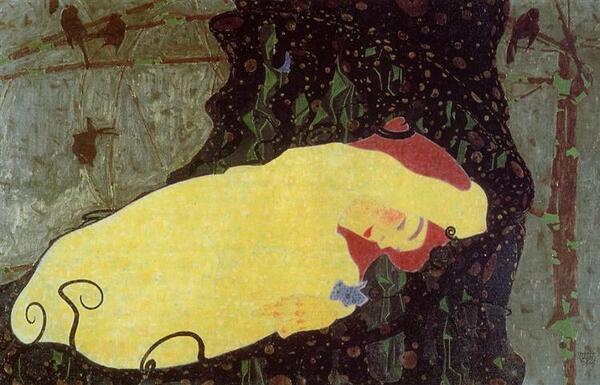
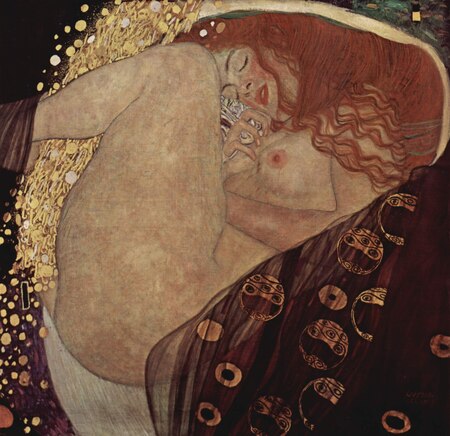
Dana, Egon Schiele, 1909 / Dana, Gustav Klimt, 1907–1908
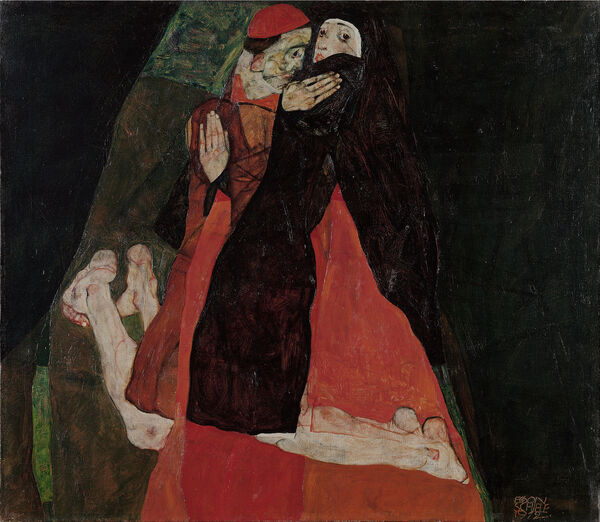
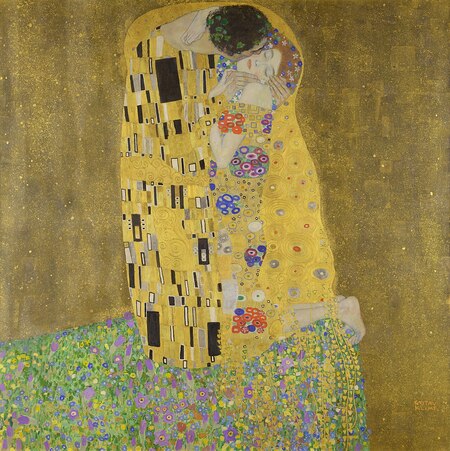
Cardinal and Nun, Egon Schiele, 1912 / The Kiss, Gustav Klimt, 1908–1909
Hermits, Egon Schiele, 1912
In 1911, seventeen-year-old Wally Neuzil, formerly a Klimt model, began living with Schiele. For four years, she was a model, companion, and accomplice, and over the next four years, she regularly posed for him. «Portrait of Wally» (Bildnis Wally Neuzil, 1912, Leopold Museum) is her most famous portrait, painted as a pair to «Self-Portrait with Physalis»; «Cardinal and Nun» (1912) shows her as a nun; «Wally in a Red Blouse with Knees Raised» (1913); and «Lovers—Self-Portrait with Wally» (1914–15). «Portrait of Wally» became the subject of a 12-year legal battle in the United States: on July 20, 2010, the Leopold Museum paid $19 million to the heirs of Leila Bondi Harris, whose painting was confiscated by the Nazi Friedrich Welz in 1939. When Schiele decided to marry Edith Harms in February 1915—the daughter of a machinist from the house opposite his studio—he wrote to Arthur Rosslers: «I intend to marry, advantageously. Not Wally.» Wally left immediately and forever; she died in 1917 from scarlet fever while working as a Red Cross nurse. «Death and Girl» (Tod und Mädchen, Österreichische Galerie Belvedere) was painted as a farewell: the figure of death is Schiele, and the girl is Wally. Schiele married Edith Harms on June 17, 1915, on the anniversary of his parents' wedding. The artistic response was «Death and Maiden» (1915, Belvedere).
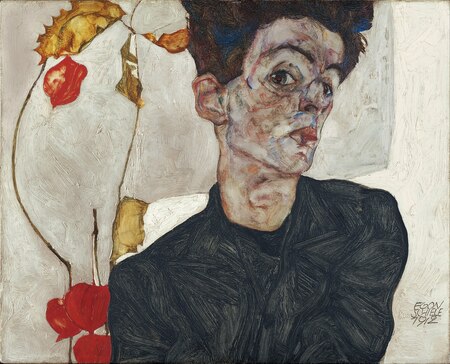
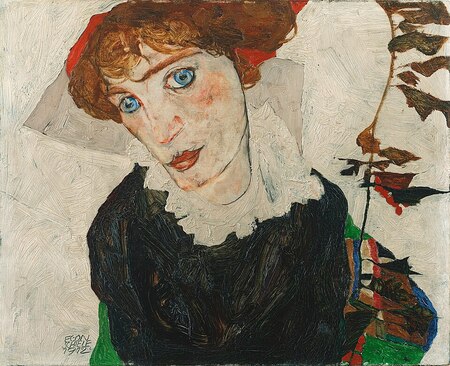
Self-Portrait with Physalis, Egon Schiele, 1912 / Portrait of Wally, Egon Schiele, 1912
Cardinal and Nun, Egon Schiele, 1912
Wally in a red blouse, Egon Schiele, 1913
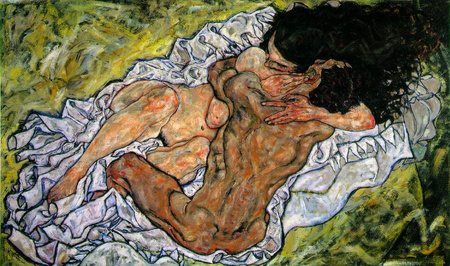
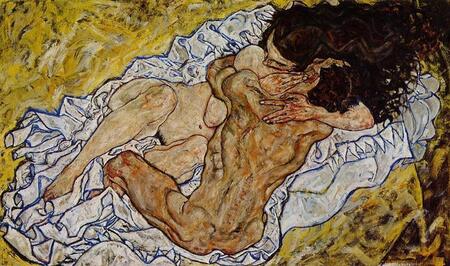
Embrace (Lovers), Egon Schiele, 1917