In the history of European art, still life as a genre takes shape by the 17th century, but its roots trace back to religious paintings of the 14th–15th centuries. In altarpieces, everyday objects—pitchers, candles, books, and flowers—cease to be random details and become carriers of hidden meaning.
Key research question: How does an everyday object in altarpiece painting transition from being a conventional symbol to a bearer of hidden symbolism, and what is the difference between the Italian and Dutch schools? Hypothesis: The Italians integrated the object into a unified linear perspective (tectonics), whereas the early Dutch treated the object as a carrier of optical veracity and subtle theological subtext.
Research Concept
Selection Criteria and Structure of the Work:
The chronological scope of the research covers the period from the early 14th century through 1450. The focus is exclusively on easel and altarpiece painting. The work is divided into four typological chapters:
1. Water and Vessels (Ritual Purification and Purity).
2. Light and Flame (The Optics of Sacred Presence).
3. Book and Text (The Materialization of the Divine Word).
4. Flora and Vessel (The Botanical Code in Interior Design).
The visual material is constructed based on the principle of direct comparison between Italian and Netherlandish works to substantiate the author’s hypothesis.
Introduction (From Sign to Thing). To understand the revolution of the 14th–15th centuries, one must establish the starting point. In 13th-century painting, the world of objects is entirely conventional: things are flat, lacking volume and shadow, existing merely as abstract signs on a gold background. This screen serves as the starting point, contrasting with the future appearance of the proto-still life.
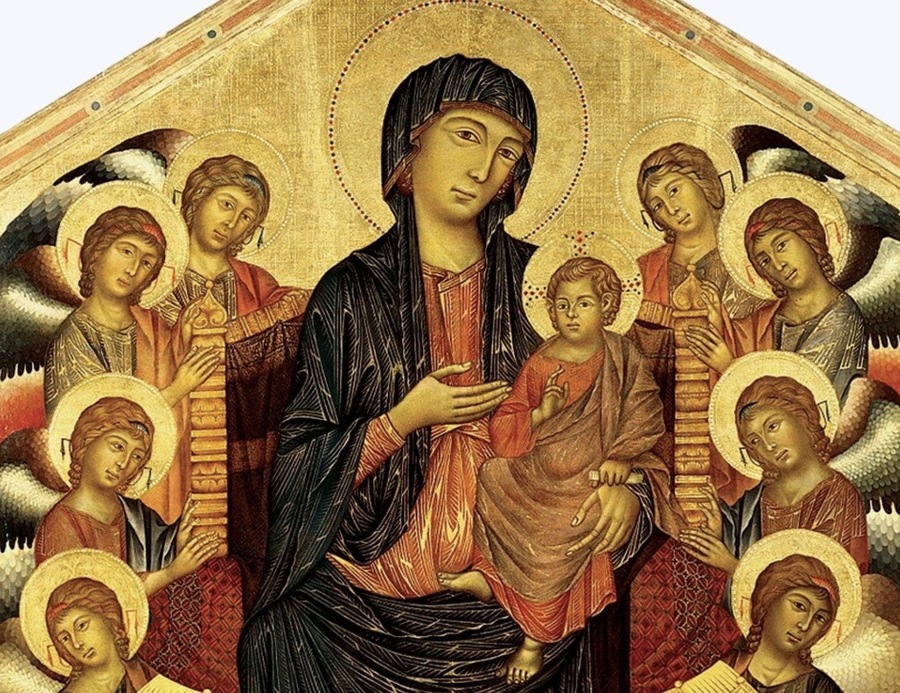
Chimamvu. Maestro. Circa 1280.
The early fourteenth century was chosen deliberately. It is precisely in the Italian Trecento that the attempt to transcend the Byzantine flat canon begins. The work starts to take on tentative contours of volume, allowing us to trace its subsequent evolution toward independent artistic value.
Water and Vessels: A Metaphor for Purity and Ritual Cleansing
Italian Trecento—the masters brilliantly organize the checkered floor and architectural perspective, subordinating space without isolating the object into a standalone still life.
Ambrogio Lorenzetti. The Annunciation. 1344.
The Dutch breakthrough—the transposition of the sacred scene into the interior of a bourgeois room. On the wall hangs a basin and a towel; primarily, these signify the virginity and purity of the Virgin. The sacred event has been moved into an ordinary Flemish living room. The bourgeois interior is filled with objects, each of which becomes an encoded quotation. Dutch artists mask divine dogmas beneath familiar everyday reality, turning every object into a carrier of deep religious subtext.
Robert Kempen. Altar of Merode. Circa 1427–1432.
The brass fountain, with its jet of water, symbolizes the «Fountain of Life» and the virginity of the Mother of God. The reflections of light on the metal transform a utilitarian object into a subject of sublime optical contemplation. The finest layers of paint allow Van Eyck to render the transparency of the water and the gleam of the metal with photographic precision, giving rise to a precursor of the pure still life.
Jan van Eyck. Madonna by the Fountain. 1439
Conclusion: If Italian masters incorporated the vessel and water into architectural perspective as a symbol, the Dutch transformed it into a palpable optical focus, merging everyday realism with theological purity.
Light and Flame: The Optics of Sacral Presence
From the metaphysical golden background to the physical ray and the candle’s flame.
Directional light models the volume of figures. Giotto uses chiaroscuro as a plastic tool to create the weight of bodies in the Trecento space. Here, light is subservient to the plasticity of the human body and architecture, functioning as a tool for volumetric form-building rather than an independent source.
Giotto di Bondone. The Nativity of Christ. 1304–1306.
A recently extinguished candle with rising smoke—an iconographic code. The smoke symbolizes the human nature of Christ, dimming before the divine light at the moment of incarnation. The physical fading of earthly fire becomes a precise visual marker of the mystery: earthly light yields to the true spiritual light of God.
Robert Campin. The Mérode Altarpiece. c. 1427–1432.
The single lit candle in the daylight chandelier symbolizes the «All-Seeing Eye of God» during the sacrament of marriage. The convex mirror is a metaphor for the «mirror without blemish, ” reflecting the world. The reflections of light on the brass of the chandelier and the curved space of the mirror demonstrate the victory of the Dutch school in fixing the physical laws of optics within a sacred interior.
Jan van Eyck. Portrait of the Arnolfini夫妇. 1434.
The jeweler’s shop is filled with shimmering vessels, precious stones, and a mirror. The objects showcase the triumph of materiality and serve as a moral sign of honest craftsmanship. The birth of the tangible world: The gleam of light on metal transforms the artisan’s shop into an autonomous catalog of things, anticipating the classic still life.
Petrus Christus. Saint Eligius in the Workshop. 1449.
Conclusion: The physical flame of the candle and the light refractions displace the medieval metaphysics of the gold background, becoming a new language of pictorial verisimilitude.
Book and Text: The Materialization of the Word
From the conventional scroll sign to the heavy codex with brass clasps.
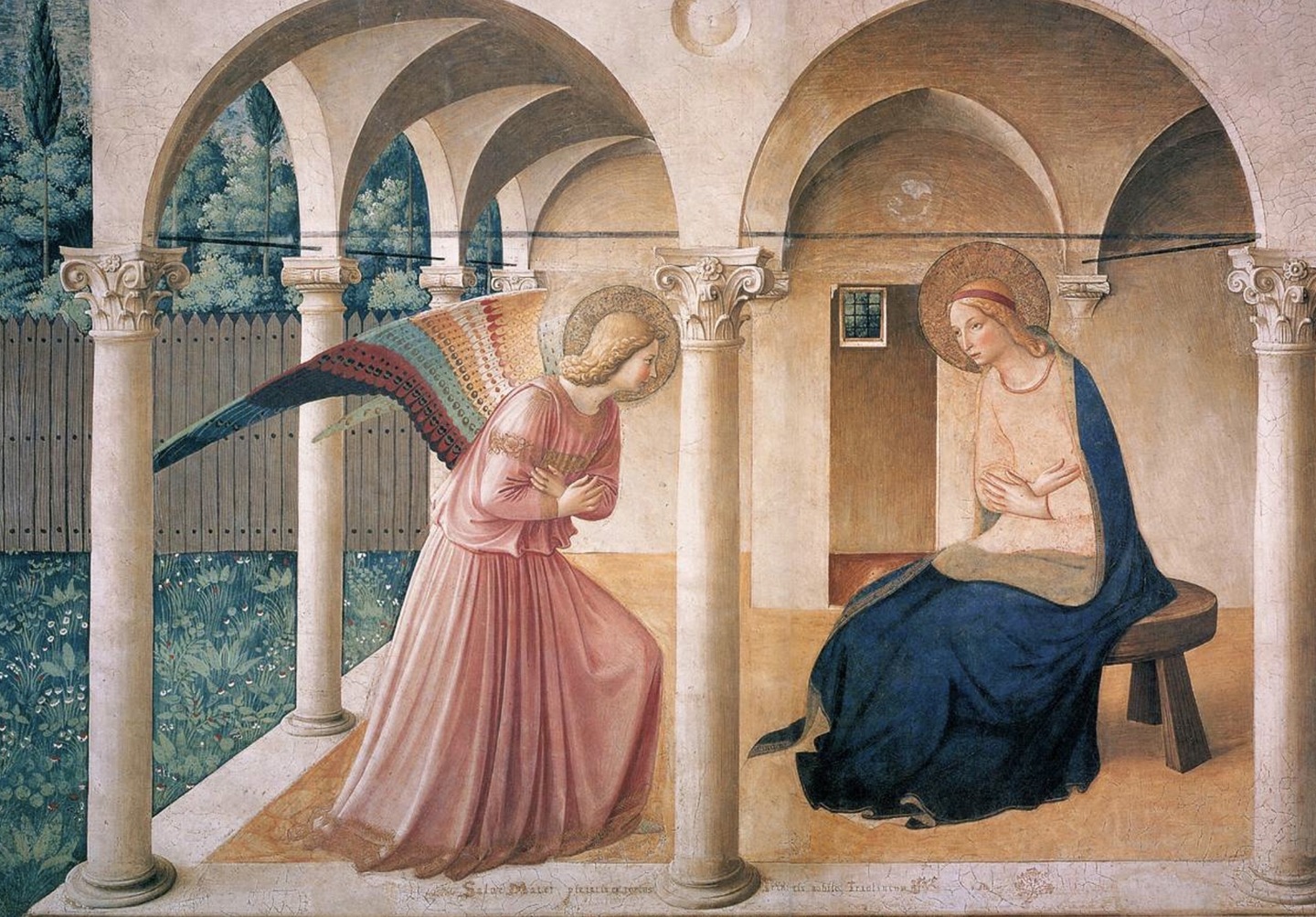
Deva Maria is caught reading a book. In the Italian quattrocento, the open book in Maria’s hands is a symbol of fulfilled prophecy, signifying her scholarship and deep concentration at the moment of the archangel’s appearance. The book is set within the bright, softly dawn-lit space of the cell, serving as an elevated attribute of spiritual focus.
Fra Angelico. The Annunciation. c. 1440.
The first cabinet still life: the intellectual and spiritual labor of the learned church father is visualized through a dense accumulation of folios and manuscripts. Here, text ceases to be an abstract symbol and becomes a material environment filling the entire space of the cell. Stacks of leather-bound books, fastened with metal clasps and hanging bookmarks, present the Divine Word as a tangible, heavy, material object of culture. The meticulous rendering of the texture of leather, parchment, and metal clasps proves that Dutch masters treated the book as a complex sculptural micro-object.
Jan van Eyck. Saint Jerome in his cell. c. 1442