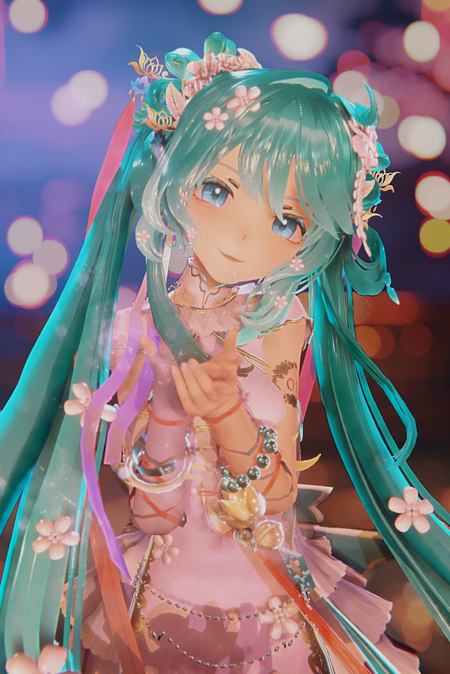
Concept
This visual exploration focuses on a topic that captivated me during my early teenage years and eventually led me to animation—no longer just as a hobby. MikuMikuDance (or MMD for short) is free 3D software that has existed on the global network since 2008. What began as a program for a small number of enthusiasts quickly transformed into a tool connecting creators around the world.
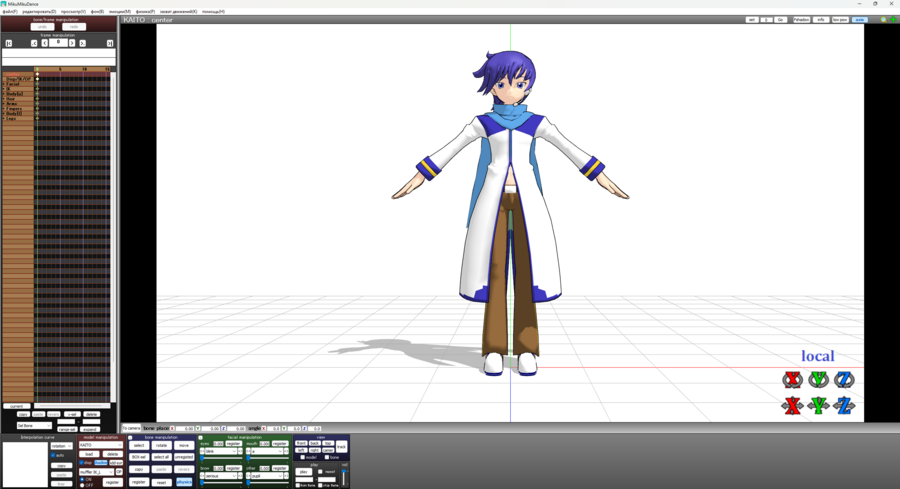
MikuMikuDanceE v926
The phenomenon of this program is impressive: the MMD community, which began in 2008, continues to actively develop to this day. It is hard to even imagine the amount of digital content that has already been created, but in this research, I want to examine the main directions within the community and how we have transitioned from videos made in rather low quality to works with quite high graphics—entirely thanks to the efforts of numerous creators scattered around the world. Furthermore, I want to show how MMD is featured in the popular music videos and VTubers of certain musicians.
The relevance of this study stems from the fact that MMD is a unique example of a self-organizing creative community that has maintained its own culture, technical standards, and aesthetic for over a decade and a half.
Unlike commercial 3D packages, MMD was originally developed as an accessible tool for fan creativity, and it was this accessibility that catalyzed its global spread. It is important to trace how amateur animation gradually took on the characteristics of a full-fledged artistic discipline, and how its creators gained recognition within professional circles.
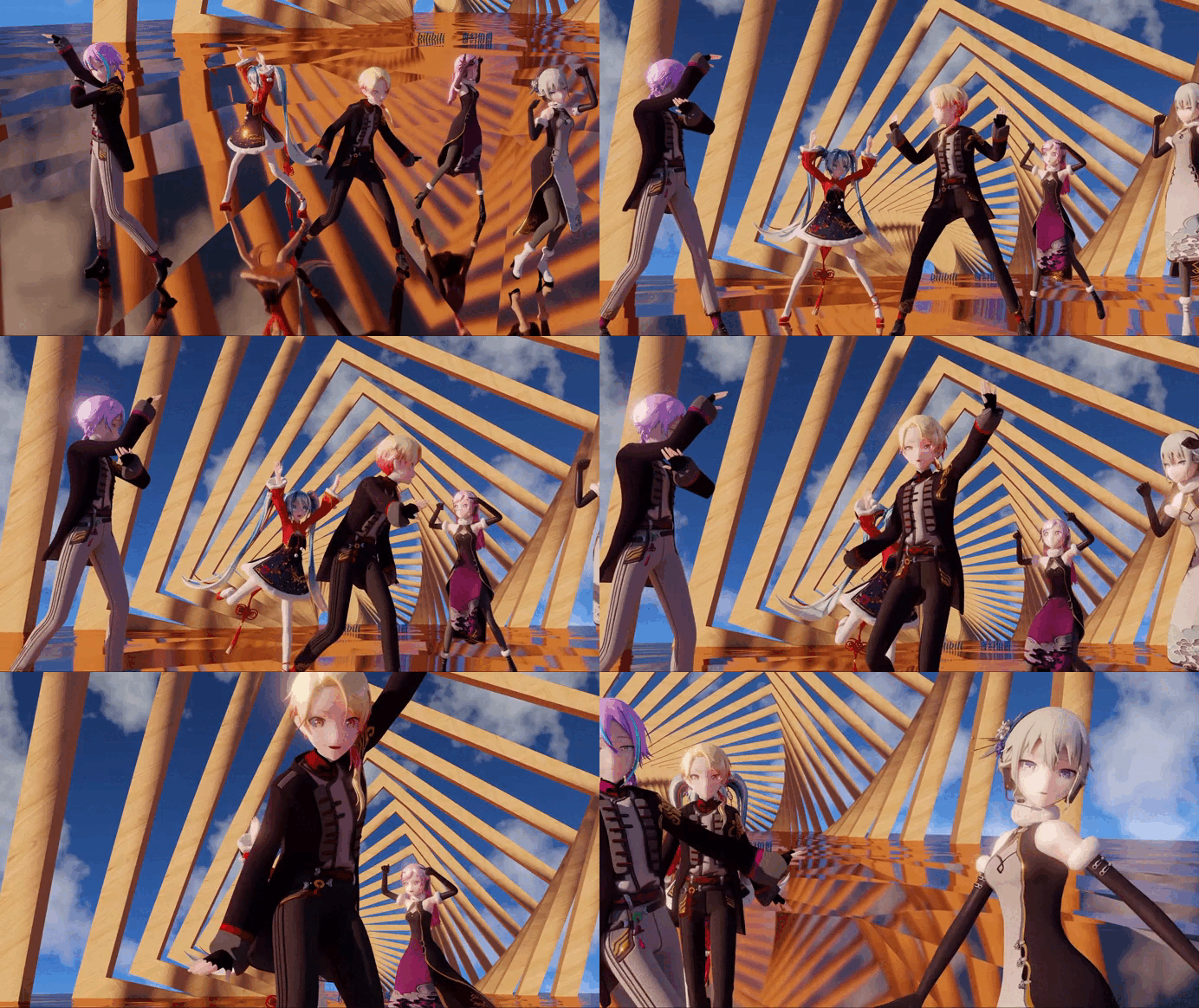
【MMD/Miku, Wonderlands×Showtime】Kami no Manimani (Ray tracing) — Kano Mi
The objective of this work is to systematize observations on the development of the MMD community and identify key stages in the evolution of content visual quality. The research aims to: first, provide a brief overview of the program’s history and its role in shaping the international community of creators; second, analyze the main creative directions within MMD; and third, examine how technical and artistic techniques have changed—from early experiments with the engine’s limitations to contemporary works that approach the quality of professional animation. Special attention in the research is given to how MMD has integrated into popular culture: today, videos created with its use can be found in music videos and VTuber content, which indicates the program’s expansion beyond a niche fanbase. Thus, this study intends to showcase MMD not only as a technical tool but also as a sociocultural phenomenon that unites creative people around the world and continues to influence the development of digital animation.
The History of MMD’s Creation
MMD (MikuMikuDance) was created by the Japanese independent developer Yu Higuchi (HiguchiM) and was first published for free on February 24, 2008. The initial goal was extremely simple: to allow the 3D model of Hatsune Miku to dance freely on the screen. This is not a commercial product released as part of the VPVP (Vocaloid Promotion Video Project).
animasa miku — by taiyo-p
Higuchi was not a professional programmer; in his own words, the early version of the system took about seventy hours to write. The program is extremely small—it takes up only a few megabytes after unpacking, is written in Visual C++ 2005 and DirectX 7 SDK. The 3D model of Miku was based on materials created by Animaso, and later, other Vocaloids were added to the base program.
【MMD】Heart Beats【all VOCALOID cover】- koshitsukiP
The adoption spread rapidly: approximately two weeks after publication (by March 10, 2008), the number of downloads surpassed 110,000; by October of the same year, Nico Nico Douga hosted over 2,300 videos tagged with «MikuMikuDance.» Subsequent versions introduced new features: in August 2008, «RinRinDance» was integrated with the Kagamine Rin model; in July 2009, version 5.00 added physics (hair and skirts began calculating automatically); and in September 2010, a community developer released MikuMikuEffect (MME), allowing MMD to achieve spectacular rendering effects.
[MMD] Pure Land / Gokuraku Jodo — YYB Orient Blossom Miku Hatsune Miku — MeteorGod
Higuchi announced his departure from development in May 2011; the version stopped at 7.39. He resumed updates in June 2013, and the final version, 9.32, was released in December 2019. After that, the community tools continued to support the ecosystem (MikuMikuMoving, PMXEditor, mmd_tools, and others).
MikuMikuMoving (MMM)
The logic behind MMD’s creation stands in opposition to commercial 3D software—it does not strive for functional completeness but rather lowers the barrier to entry for a specific doujin subject (Hatsune Miku). This «production born of love» directly defined the character of the subsequent ecosystem: exchange, modularity, and a low barrier to entry were more important than professionalism.
Distinction from classical 3D animation
When compared to Maya, Blender, and other professional tools, the difference with MMD is not in the «number of features, ” but in its place within the production pipeline. A full cycle of classical 3D animation includes: modeling → rigging → animation → rendering, with each stage being executable in a single package or a combination of several. Maya and Blender are „multi-toolboxes“: within them, you can model, rig, animate, and render. The animator works with an object that is built from scratch. MMD, however, deals exclusively with animation. It does not create models; it only imports 3D models created externally and manipulates them. This means that the starting point for a MMD user is not „to create a character, ” but „to find a suitable model and make it move.“ This results in several structural differences.
【MMD】Barbie Girl feat. KAITO & GUMI【PV】- anonymous ∙ 666K views ∙ 3 seconds ago
First, authorship shifts from the «full-cycle creator» to the «assembler and director.» The primary work of an MMD user is not modeling or rigging, but rather model selection, applying motion data (.vmd), camera setup, applying MME effects, selecting music, and exporting. The motion data itself can also be sourced externally—the .vmd files are imported, exported, and freely distributed. The «authorship» of an MMD video manifests in material selection, composition, camera work, and atmosphere, rather than in creating every element from scratch.
【MMD MV】Gimme×Gimme — Hatsune Miku ・Kagamine Rin (English / Romaji Sub) — Fina-chan Daisuki
Secondly, the asset ecosystem replaces the personal technical barrier. In classic 3D animation, the key hurdle is modeling and rigging skills. In the MMD ecosystem, models, movements, scenes, and effects are shared by the community, and each model comes with its own readme file detailing usage guidelines. Higuchi himself stated that he gives no guarantees regarding the use of user-created models and disclaims responsibility. This means that the «technical threshold» in MMD shifts toward the ability to acquire and integrate resources, rather than mastering the software itself.
【MMD】 Ai no Uta / Song of Love 【LamazeP feat. Kasane Teto】- kreifish
Thirdly, the ceiling of animation quality is tied to the «limit of modules.» Because MMD does not afford complete control over rigging and modeling, the subtlety of movement is constrained by the quality of the imported data. A common critique of MMD within the community concerns the stiffness of the shoulders, forearms, and head. This is not a program bug, but an inherent characteristic of modular production: when motion data is designed to be universal across different models, the space for individualized fine-tuning shrinks. The key takeaway for this study is that the difference between MMD and classical 3D animation is essentially the difference between a «production tool» and a «composition platform.» MMD transforms 3D animation from a process of «creation» to one of «curation and staging.» This is precisely its uniqueness as a form of network art—the value of the work lies not in the technical creation from scratch, but in the selection, combination, and recontextualization within a general pool of resources.
Ecosystem Formation
Modularity is the foundational structure of the ecosystem. Key types of MMD assets have always been separable and exchangeable: models (.pmd/.pmx), movements (.vmd), poses (.vpd), and project files (.pmm) exist independently. Modelers create the models in Blender or Metasequoia, then convert them via PMD Editor / PMX Editor into a format usable by MMD. Movement creators focus on producing dance or performance data. Effect developers, using MME, extend rendering capabilities. Each component can be created by different individuals, and the output enters a common circulation. This division of labor was not centrally planned—it spontaneously organized itself under the pressure of file formats and community needs.
mmd bangs by prestonthecat
The usage guidelines for the carrier are provided by the «readme, ” not a legal contract. Most MMD models come with a readme (txt, pdf, or web page) detailing terms and usage restrictions. The rules vary widely—from „free for all use“ to „no commercial use allowed, ” „modification prohibited, ” or „attribution required.“ The community relies on reputation mechanisms and peer pressure rather than a coercive legal framework. Higuchi effectively delegated the enforcement of these norms to the community itself. This informal governance structure is key to the viability and low barrier to entry of the MMD ecosystem: it is flexible enough, yet delicate.