Navigator
- Concept
- Deception and Seduction
- Care and Sacrifice
- Order and Self-Discipline
- Conclusion
- References
Concept
In my research, I want to explore how animal depictions in medieval bestiaries taught people to assess their own behavior. In these books, stories about beasts, birds, and fantastical creatures are juxtaposed with Christian interpretations of their habits. I am interested in how a familiar or invented narrative transforms into an example that the reader can relate to their own life.
I am paying particular attention to 12th–13th-century English bestiaries: the Aberdeen, Worcester, Ashmolean, Rochester, and Northumberland collections. The same motifs appear in them, yet the artists choose different moments from the narrative and arrange its participants in varied ways. With this material, I want to trace which details help to interpret the animal’s actions and how the image guides the viewer toward their judgment.A crucial part of the research involves examining the structure of the miniatures themselves. I am looking at poses, gestures, directions of gaze, distances between figures, and the sequence of episodes. For example, in a scene where birds approach a still animal, they have not yet recognized the danger. A viewer familiar with the tale already knows about the trap. I am interested in how the artist utilizes this difference in knowledge to convey deceit even before the attack occurs.
I address three themes: deception and temptation, care and sacrifice, and order and self-discipline. The stories of the fox, the siren, the pelican, the dodo, the bees, and the ants offer various examples of relationships with others. However, the animal does not always fit into a single, definitive characteristic. The tigress becomes a victim of deception because of her desire to recover her cub. This plot compels us to differentiate between the guilt of the deceiver and the vulnerability of the one whose trust was exploited.
I am also considering the connection between the miniature and the accompanying text. Without the narrative, some actions can be understood differently than the Christian interpretation suggested. The allure of the siren is linked to the death of sailors, while the fragrance of the panther, likened to Christ, draws animals to it. Therefore, I will analyze the images separately and only compare them where the comparison helps to reveal differences. It is important to understand what the scene itself communicates, and what only becomes clear through reading.
My goal is to investigate how a bestiary, through its narratives about animals, shapes the perception of a dignified human life. I want to demonstrate which actions it suggests approving or condemning and the role that imagery plays in this process. The research will focus on how the reader is prompted to recognize cunning, understand care, and judge the consequences of actions by observing the relationships between the characters.
Deception and Temptation
In bestiaries, the deception often begins with the promise of something desirable. Birds find accessible food, a tigress spots a lost cub, sailors hear beautiful singing. Danger arises at the moment the character trusts what they see or hear. However, the reasons for this trust differ. One is drawn by prey, another by affection. Comparing the miniatures helps us understand whether the narrative judges those who fall into the trap equally.
Fox: danger disguised as prey
According to the bestiary, a hungry fox becomes covered in red earth, lies on its back, and holds its breath. Birds mistake it for dead and descend to peck at its body. Then the animal catches them. The Aberdeen bestiary follows the description of this trick with a direct comparison to the devil: he too appears powerless until he captures those who believe in him.
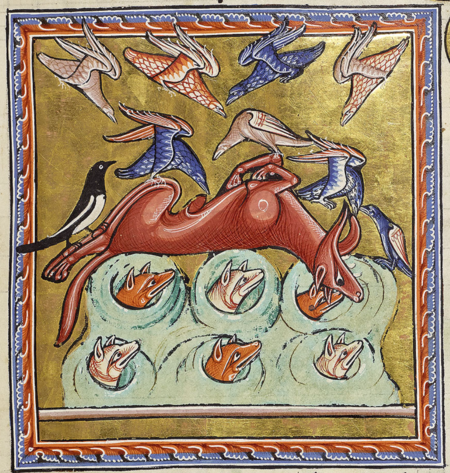
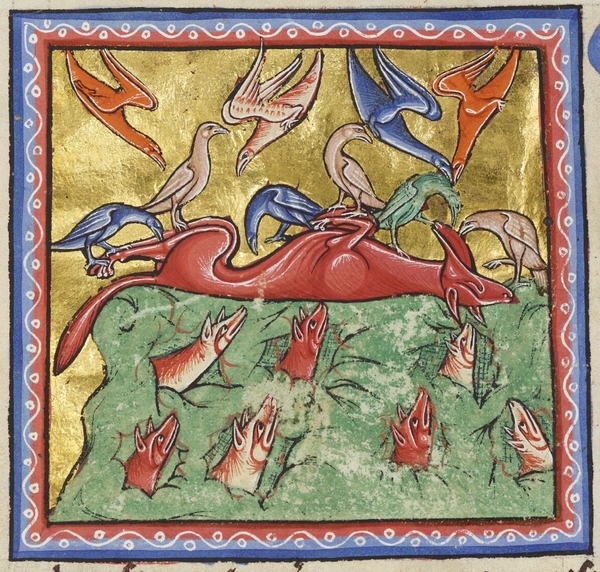
1 2 1. Fox playing dead. Aberdeen bestiaries. England, circa 1200. 2. Fox playing dead. Ashmolean bestiary. England, circa 1210–1220.
In the Aberdeen and Eshmolov miniatures, the stretched body of the fox occupies almost the entire width of the scene. Around it, the movements of the birds converge: some are still flying, while others have already landed on the animal. For the birds, stillness signifies safety. A reader familiar with the story understands that this is part of the ruse. Thus, the same posture evokes trust in the scene’s participants, but anticipation of an attack in the viewer.
Under the adult animal, the artists place kits peeking out of their burrows. Their presence links the hunt with the feeding of the offspring. The image gives a mundane reason for this action, although the text retains its condemnation of cunning. Here, the care for one’s own and the violence against others are contained within a single scene.
3. The fox lures and catches the bird. Rochester Bestiary. England, circa 1230.
The Rochester Bestiary depicts the narrative across two registers. At the top, a fox lies on its back while birds approach it; below, it already holds a bird in its jaws. The repetition of the figure reveals a trick of time. What in the two preceding miniatures had to be anticipated is shown here as a concluded event. Between the anticipation of easy prey and the bird’s demise lies only one boundary within the frame.
Tigress: Deceived Care
The tigress’s story does not allow us to deem any victim of deception responsible for their own misfortune. The hunter kidnaps the cub and escapes on horseback. When the mother catches up to him, he throws a glass sphere. In the miniature reflection, the tigress recognizes her cub and ceases the pursuit. The Aberdeen text explains her behavior as maternal attachment: even having experienced deception, she responds again to the supposed presence of her baby.
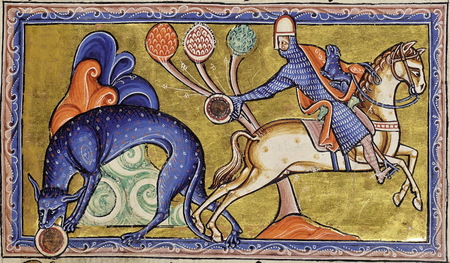
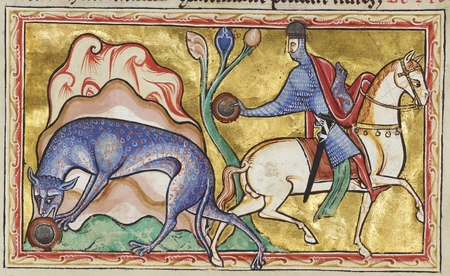
4. The Tigress Deceived by a Reflection. The Aberdeenshire Bestiary. England, circa 1200. 5. The Tigress Deceived by a Reflection. The Ashmolean Bestiary. England, circa 1210–1220.
The Aberdeen and Eshmolov artists build the scene almost identically. On the left, a tigress bends toward a ball; on the right, a rider takes away a real cub. He turns and holds another ball, ready to repeat the trick. The audience is simultaneously shown the cause of the mistake and what remains outside the mother’s attention.
6. The Kidnapping of a Tiger Cub. Northumberland Bestiary. England, circa 1250–1260.
In the Northumberland bestiary, the deception is made especially clear: inside the sphere, a small animal head is visible. This echoes the head of the cub in the kidnapper’s hands. The real and the imagined appear side-by-side, allowing the viewer to immediately compare them. The tigress is deprived of such an opportunity. Her hope of recovering her cub holds her back; the hunter exploits this hope to travel further. This scene provides a basis for sympathy for the deceived animal.
Sirens: Attractiveness Without Apparent Threat
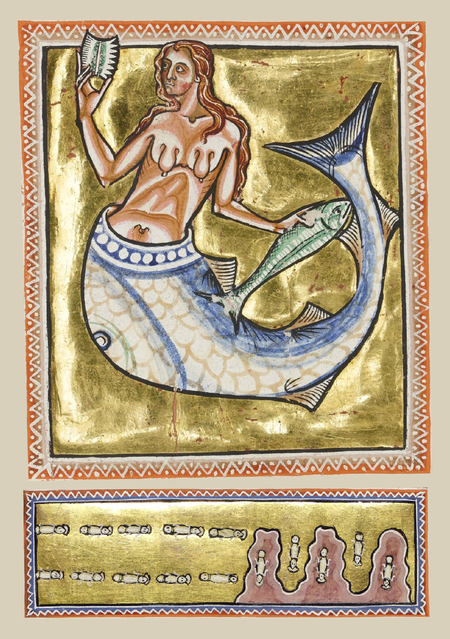
Sirens lure sailors to their doom with their beautiful song: having lulled their listeners into a slumber, they attack them. In Christian interpretation, this tale serves as a warning against carnal temptation. For example, Morgan’s library provides such an explanation in its commentary on the Worcester bestiary. However, the miniatures selected below do not depict a ship, sleeping people, or the assault itself. The artists portray creatures whose danger the reader learns about from the text.
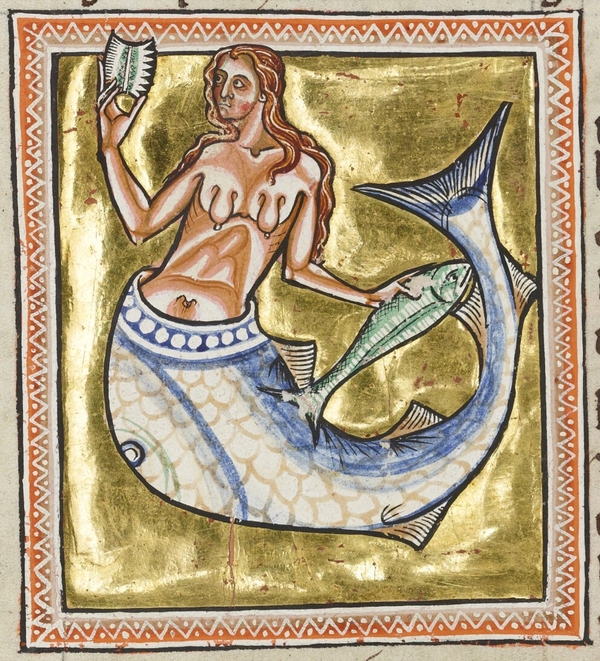
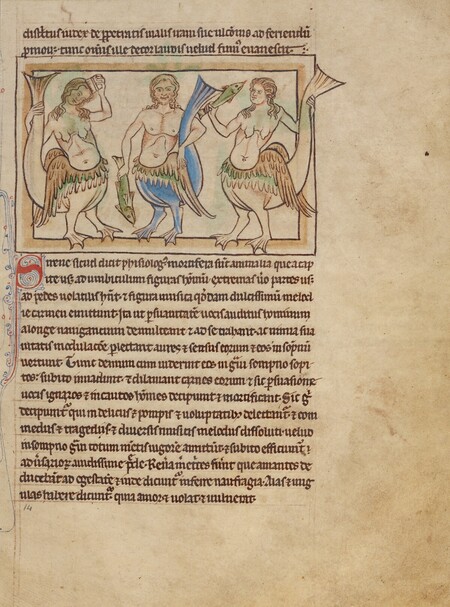
7 8 7. Siren with a crest and fish. Ashmolov Besiary. England, circa 1210–1220. 8. Sirens. Northumberland Bestiary. England, circa 1250–1260.
In the Ashmolov bestiary, the siren holds a comb and a fish. Her human torso is connected to a long fish tail, the curve of which fills nearly the entire frame. The Northumberland bestiary features three figures with human torsos, wings, bird feet, and fish tails. The middle character is bearded—here, the siren’s depiction is not limited to a female figure.Both miniatures allow us to examine the unusual body, but they do not show the consequences of encountering it. Therefore, the image is particularly dependent on the accompanying narrative. With this context, the reader notices the threat behind the attractive appearance. Without this knowledge, they are presented with a strange creature that, in itself, does not explain what the moral warning entails.
Aspid: Refusal to listen
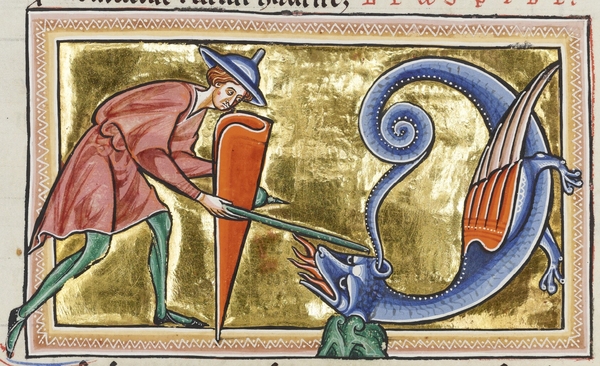
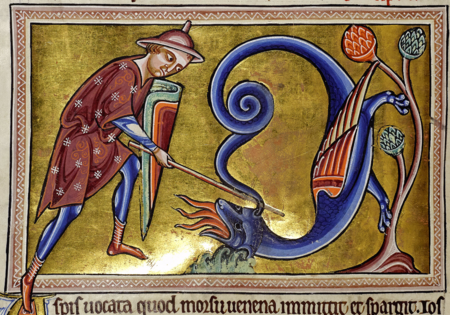
The history of the asp complicates the notion that salvation always requires distrust. According to the text, the snake evades the sorcerer: one ear is pressed to the ground, the other is covered by its tail. In the Aberdeen Bestiary, its behavior is compared to the actions of people consumed by earthly desires who refuse to hear the word of God.
9 10
9. Aspid and Enchanter. Aberdinese Bestiary. England, circa 1200. 10. Aspid and Enchanter. Ashmolov Bestiary. England, circa 1210–1220.
In both miniatures, a figure holding a shield and a scepter leans toward the serpent. The viper’s long tail coils in a spiral and draws near the head. This curve makes the refusal to listen a visible action. However, by itself, it does not offer a definitive judgment on what is happening; the animal could be interpreted as someone successfully defending against external influence.Comparing this to the Sirens reveals a significant distinction. In one narrative, it is dangerous to yield to a voice, while in the other, one resolutely refuses to listen. The moral judgment depends on whose call the figure accepts or rejects. This cannot be determined solely by the character’s posture.