Concept
During my Art History classes, I became interested in how people in prehistoric times created animation. I was drawn to the idea of researching how this challenge was addressed in prehistoric art. Rock paintings of animals and humans are found in many countries, not only in Europe but also in Asia and Africa. Furthermore, the artists depicted not only static images on cave walls but also scenes of running animals, hunting, and chases. Ancient people employed various methods of conveying motion, some of which were not always tied to realistic anatomical representation.
For this research, I want to examine rock paintings and engravings from various countries across Europe, Asia, and Africa. This will allow me to compare images created by different cultures across different centuries and to assess how each culture, independently, solved the problem of conveying movement.
Conveying motion is difficult even in the modern world because in real life, an animal is constantly changing its posture—running, jumping, turning, or interacting with other animals. The artist must choose and depict only one moment and pose that will help convey the sense of movement.
To begin, I want to focus on several methods of depicting movement that will be discussed further. One of the most popular ways to illustrate motion is by layering poses onto the same drawing. Movement can also be shown through the posture of a person or animal, the positioning of the legs, or the curve of the back.
In European art, special attention will be paid to the Lascaux and Chauvet caves, as they are among the most famous. Primarily, I will draw upon the work of Marc Azem, who researched the depiction of movement in Paleolithic animal drawings. He compared the poses of the depicted animals to their actual movements and examined how artists conveyed individual phases of running. In Africa, I intend to focus on the rock art of South Africa and the Sahara. The Sahara caves offer an interesting look at how ancient people depicted motion through «flying» poses. Scenes of hunting are also compelling, as movement can be traced through the interaction of multiple figures. In Asia, I plan to examine the rock art from Mongolia and Indonesia. In Mongolia, there are studies that analyze late hunting scenes of deer, where animals and humans interact with each other. In Indonesia, on the island of Sulawesi, the oldest compositions from the Leang-Bulu-Sipong cave are particularly interesting. They allow for an examination of how movement was conveyed not just through an individual pose, but through an entire scene.
Chapter 1: Europe
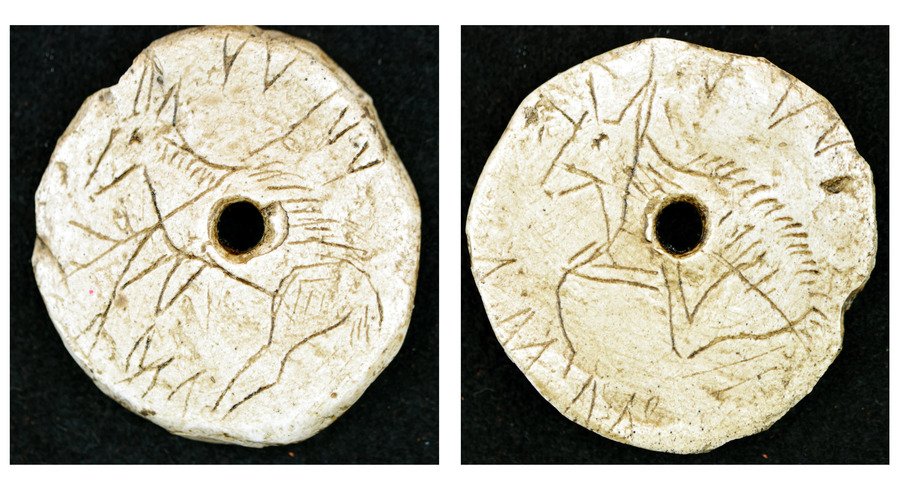
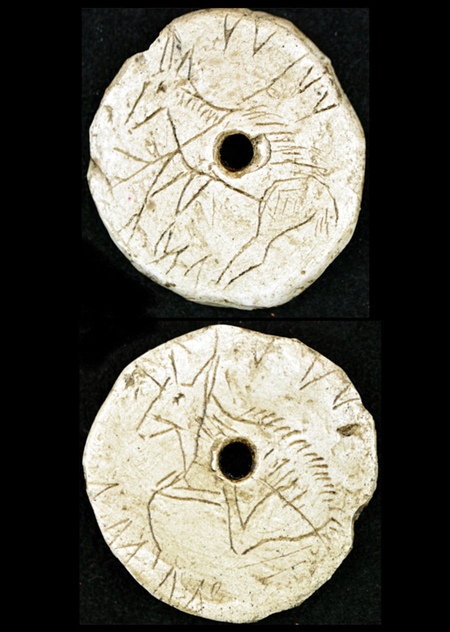
Boney disc from Ložeri-Bas, «Paleolithic Automatron, ” Diameter: 31 mm
«Paleolithic Taumatrope» Drawing: A. Rousseau
The Paleolithic taumatrope, discovered in 1868 in the rock overhang of Laugerie-Basse in southwestern France, was considered a common button, pendant, or spindle whorl for over 140 years. Its true function was only proven in 2012 by archaeologist Marc Azéma and artist Florent River in a study published in the journal Antiquity. «In order to mentally superimpose two spatially separated images, you must quickly rotate the object (by 180 degrees, making sharp movements with the hand holding the base)» (Azéma, 1991). This artifact represents one of the fascinating methods of transmitting motion, based on creating an optical illusion through the rapid rotation of an object.
Chauvet Cave
«Grand Panneau» in the «Salle du Fond» of the Chauvet Cave (photograph: J. Clot, Chauvet Cave scientific team).
«Grand Panneau» in the «Salle du Fond» of the Chauvet Cave (photo: J. Clottes, Chauvet Cave Scientific Group).
«Grand Panneau» in the Salle du Fond of the Chauvet Cave (photo: J. Clottes, Chauvet Cave scientific team).
«The Large Frieze» is a frieze over 10 meters long, featuring most types of animals: cave lions, horses, bison, mammoths, and woolly rhinos. It likely depicts a hunting scene composed of two main episodes unfolding from left to right along the decorated wall. The left end of the frieze shows several lions—more precisely, their heads and front portions of their backs—sneaking up on prey: their ears are flattened, and their heads are lowered so as to remain undetected. The second episode unfolds in the right part of «The Large Frieze»: a pride of lions attacks a herd of bison fleeing for their lives.
The second and most notable category of animation in Paleolithic art—"split-action animation"—is (Azéma, 1992; Azéma & Rivière, 2012). In this case, the animal’s movement is broken down into several stages, or frames, which presages modern cinema by several millennia.
Image of the eight-horned bison in the Chauvet Cave
Image of an eight-horned bison in the Chauvet cave. Drawing by K. Fritz and J. Toussello.
The Chauvet Cave Octopus Bison (France) is a famous Paleolithic drawing over 30,000 years old, where an ancient artist utilized the overlapping phases of movement to create an effect of primitive animation. The animal has one head and one torso, but eight legs are clearly depicted (two pairs of forelimbs and two pairs of hind limbs).
La Marche Cave
Comparison of images from the Middle Magdalenian period in La Mars (1 and 2; Lussac-les-Châteaux, Vienne department) and the Roc-aux-Sorcières rock shelter (3 and 4; Angl-sur-l’Anglon, Vienne department).
The upper drawing is a compilation of all lines on the stone (by Léon Pales, 1981). Below is a storyboard detailing individual phases of movement.
The engraving of a horse from the French La Marche cave, dating back approximately 15,000 years, is considered one of the earliest examples of proto-animation in human history. The artist from the Magdalenian period depicted the animal in motion by overlaying several contours onto one another. The outline of the horse is drawn on a limestone slab. Under the flickering light of a torch or a tallow lamp, the viewer’s eye caught different contours sequentially.
Thus, images from European prehistoric art show that people were already using various methods of conveying motion. To achieve this, artists layered several poses on top of each other, utilized perspective, and took advantage of the cave’s relief. A specific example is the thaumatrope from Lojerie-Basse, where the sensation of movement arises from an optical illusion when the object is rotated.
Chapter 2: Africa
Tassilint-Adger
Petroglyph from the Tassili n’Ajjer Plateau in the Sahara (Algeria)
A copy of rock carvings from the Tassili n’Ajjer plateau (Algeria), executed by the French artist and researcher Georges Le Poëtvron.
On the rock paintings of the Tassili n’Ajjer Plateau (Algeria), human movement and daily life are depicted using dynamic poses. The figures are rendered quickly and schematically, emphasizing motion—running, throwing a spear, or shooting an arrow. The legs of the runners are widely spaced, sometimes nearly at a 180-degree angle. This creates the sensation that the person is literally suspended above the ground mid-leap.
«The Floating Cow» (or «The Floating Bull») in the Tassili n’Ajjer Plateau (Sahara, Algeria)
Flying Bull (Photo by Lucas Smiths)
A herd of animals in a flying/running posture
The animal’s body in the photo is highly elongated horizontally with a slight downward lean. The forelimbs and hindlimbs are maximally extended, creating the impression of a rapid dash or jump.