Section Index
[0] Concept
[1] Appearance
[2] Gesture and Expression
[3] Cultural References
[4] Image Evolution
[5] Conclusion

[0] Concept
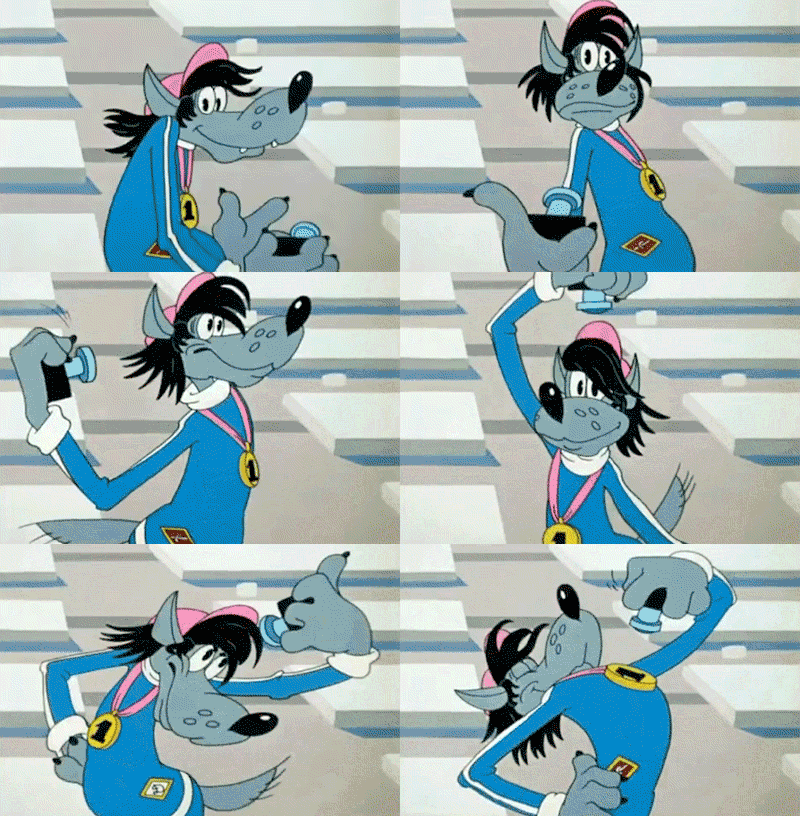
«On the Stadium, ” „Nu, Pogodi!“, 4th installment, 1971
The Wolf from «Nu, Pogodi!» is a figure that has long transcended the boundaries of the cartoon to become a carrier of the cultural code for several generations of viewers. The paradox lies in the fact that a character conceived as a hooligan and antisocial element is visually designed in a way that elicits more sympathy than the «proper» Hare, who embodies the ideal citizen. This contradiction forms the foundation of the research. The choice of this topic stems from a desire to analyze this image not at the level of plot or dialogue, but at the level of its visual construction—its costume, movement, details, and cultural references—which transforms the «villain» into an «insider.»
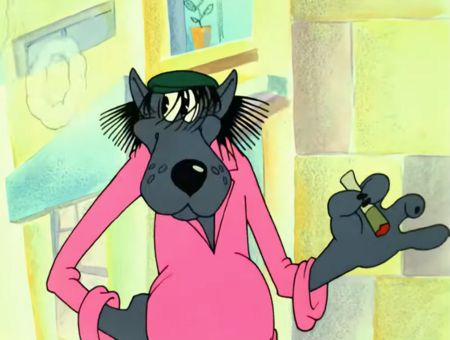
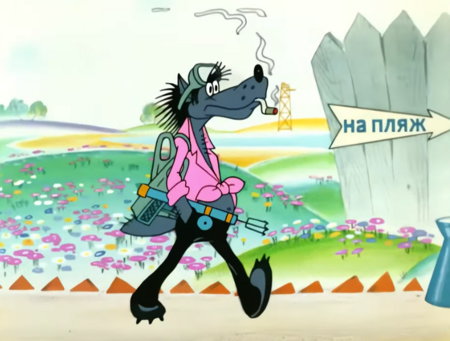
«In the City and on the Beach, ” the first episode of „Nu, Pogodi! ,“ 1969
Wolf is dressed in a loose-fitting pink shirt and dark bell-bottom pants, and his gait doesn’t resemble a predatory stalk—it’s more cocky and relaxed. For the viewer of the 1960s–1970s, this code was instantly recognizable: before them was a hoodlum, a type from the city outskirts, not a fairytale wolf. Over time, this signal fades. A modern child is more likely to see a «goof in a pink shirt, ” whereas for an older generation, it was a sign of dangerous, yet charming, street freedom. Examining Wolf’s visual image allows us to see how animation captures a social type and how that type dissolves along with the era.
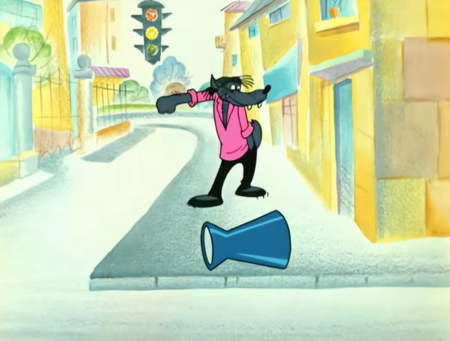
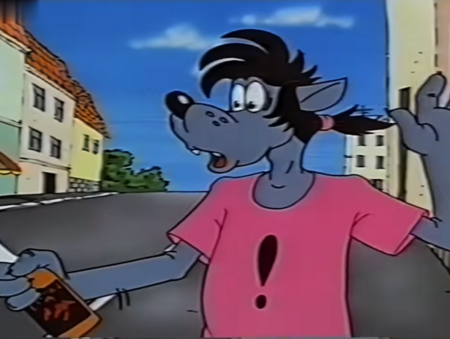
A Comparison of Wolf’s Design in Early Scenes «In the City and on the Beach, ” Episode 1 of „Nu, Pogodi! , ” 1969 „Supermarket, ” Episode 18 of „Nu, Pogodi! , ” 1993
The research material consists of episodes of «Nu, Pogodi!», created from 1969 to 1993, using the pilot episode in the film magazine «Vesyolaya Karusel» (1969) as the starting point—a time when the Wolf’s image existed in a darker, almost caricature-criminal variation.The work is divided into several conceptual blocks, each examining a distinct layer of the anti-hero’s visual construction.→ The first block focuses on costume and social typecasting: how the pink shirt, flared trousers, and cigarette construct the recognizable image of a «backyard hooligan.»→ The second block analyzes movement and facial expressions: the gait, gestures, and comedic scenarios that portray the Wolf as vulnerable and human.→ The third block examines cultural references—long hair, flared trousers, a guitar—which connect the image to Western rock culture, making the Wolf a carrier of the «free spirit.»→ Finally, the fourth block compares early and late episodes, illustrating how the detailing and context changed while the core of the visual image remained constant.Thus, the key question of the research is defined as follows:
Through which visual tools in the series «Nu, Pogodi!» is the anti-hero’s image created, making him feel «one of us» to the viewer, and why is this image visually more appealing than the «proper» Hare?
The hypothesis of this work is that Wolf’s charisma is built not on justifying his actions, but on a visual system underpinned by three principles.→ The first is the recognizable social archetype: the costume and physicality reference a specific cultural code, instantly making the character «comprehensible» and, in a way, «our own.»→ The second is comic vulnerability: the animation regularly subjects Wolf to absurd situations, and this weakness elicits sympathy rather than repulsion.→ The third is cultural «informality»: rock attire and loose physicality mark him as a bearer of an inconvenient yet vital freedom, standing in opposition to the Rabbit’s excessive propriety.By demonstrating the systematic nature of these devices, we can assert that Wolf’s visual persona is not a random stroke of animation fortune, but a conscious construction where the antihero is visually «closer» and more convincing than the protagonist.
[1] Appearance
Wolf Sketch for the «Nu, Pogodi!» Cartoon, 1960s
The appearance of the Wolf in «Nu, Pogodi!» is a rare instance in animation where the character’s clothing is more significant than his «animalistic» nature. The Wolf remains a wolf, but he is dressed as a person from a specific era and social class. It is this human clothing that transforms the mythical predator into a recognizable «rascal.»
The basic image of the Wolf is stable and easily described: a pink shirt, a cap, a cigarette, and bell-bottom pants. All of this contains a specific cultural code that represents a collective image of the urban style thug—the antisocial type of that era.
This is where the first contradiction arises. The «stylaga» and the hoodlum are not similar archetypes, yet Volc combines both codes: the bright shirt and flared pants come from the stylaga, while the cap, cigarette, and reckless posture come from the hoodlum. This combination broadens the character’s image—he is read as an «outcast from the margins,» a person who, while departing from societal dress codes and norms, has not yet fully entered the criminal world. It is this «in-betweenness» that lends charm to the character: Volc violates norms, but he does not cross the line beyond which sympathy becomes impossible.
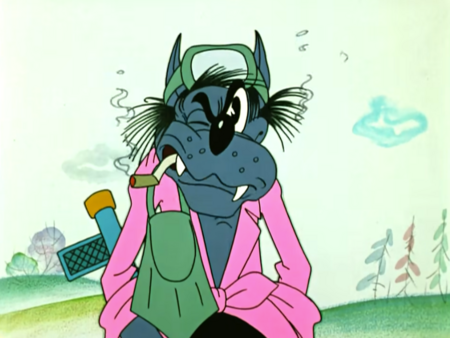
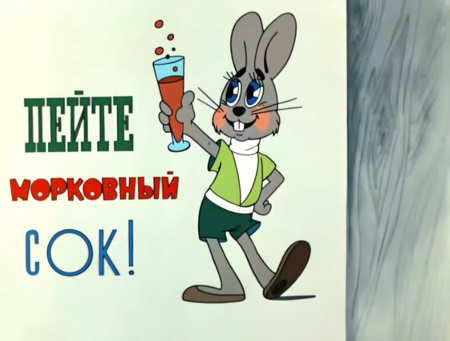
«In the City and at the Beach, ” Issue 1 of „Nu, Pogodi!“, 1969
The visual power of the Wolf figure becomes especially evident when compared to the Rabbit. In this duo, the Rabbit is a model of emulation, whereas the Wolf is a loud and unpredictable disruptor of order. This contrast does not make the Rabbit visually superior; its appearance does not reference any subculture—it is «neutral”—and therefore fails to create emotional attachment or leave the viewer room for interpretation.
Key Attributes in Wolf Character Design
For Wolf, every detail of his appearance—the pink color, the flare pants, the cap, the cigarette—is a marker of «wrongness.» Yet, it is precisely this wrongness that registers as individuality, granting greater freedom in interpreting his character.Ultimately, Wolf proves more human than his «proper» antagonist. And the costume establishes this even before the character makes his first move.
[2] Sculpture and Expression
The Wolf’s squash-and-stretch animation in «Nu, pogodi!» is a second layer of the visual construction that reveals the character’s personality. To animate the Wolf, elongated body forms and flexible lines were used to convey comical falls, jumps, and dynamic movements. His body stretches, compresses, and flattens—and in this «rubbery» animation, the threat vanishes.
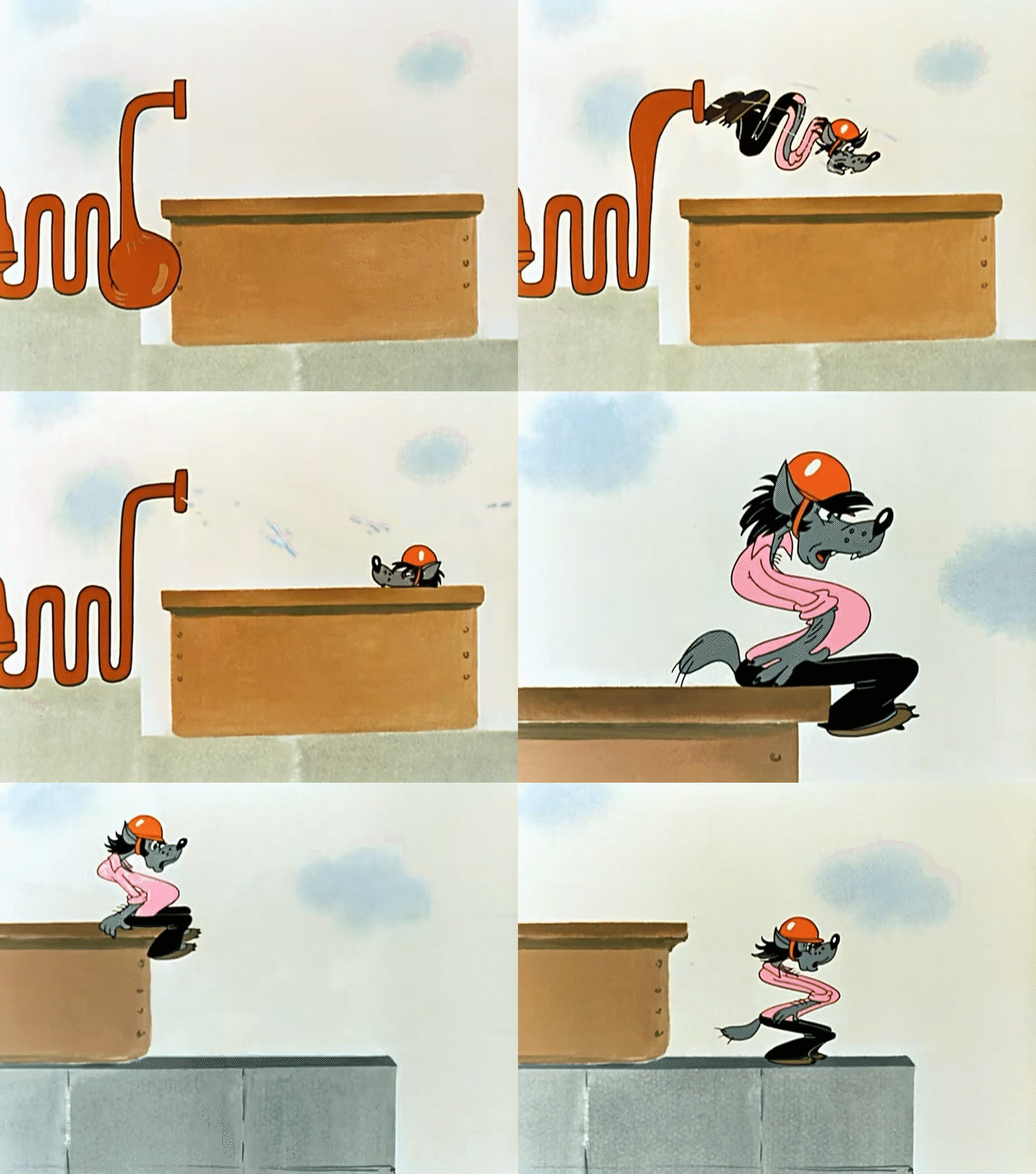
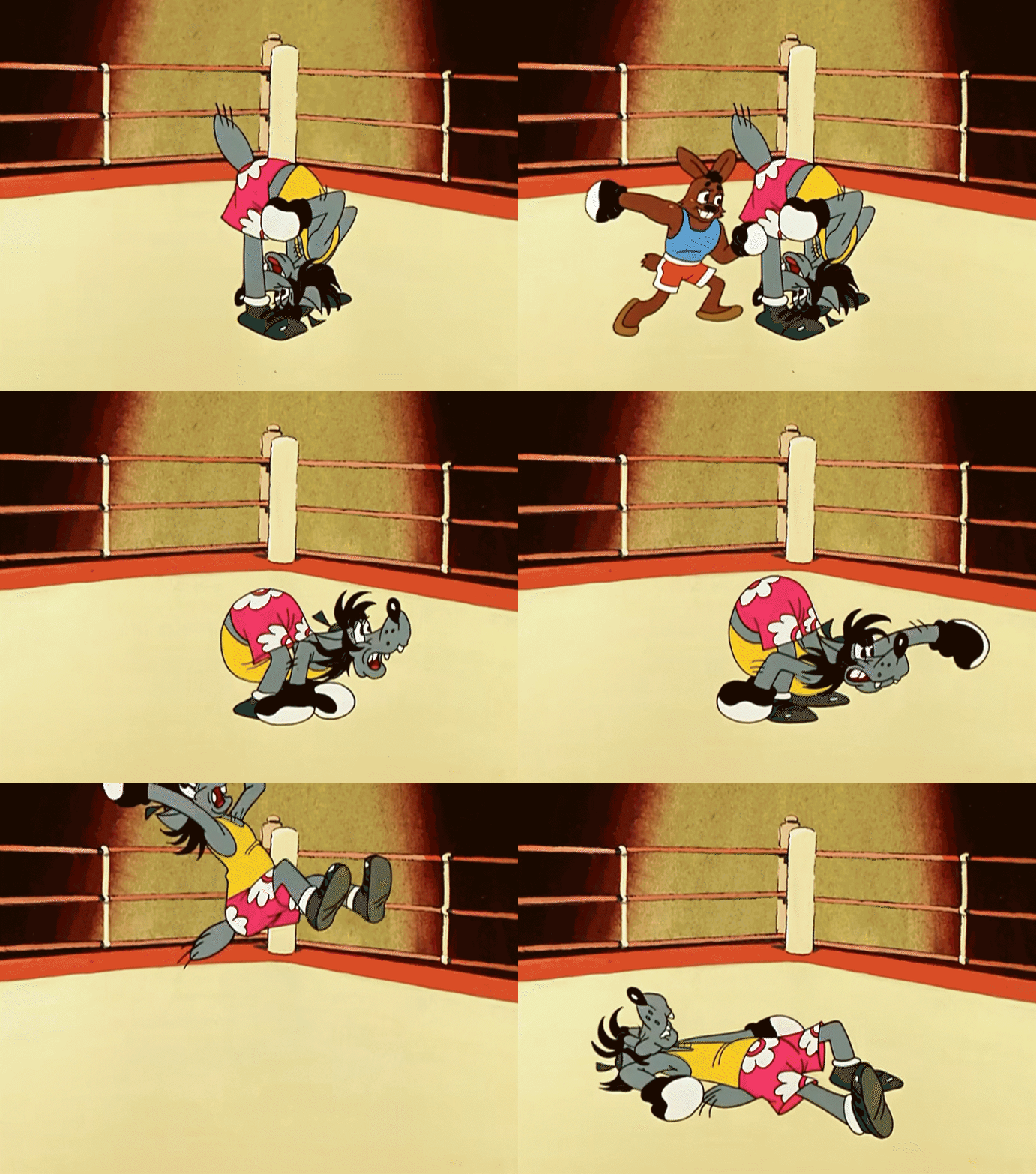
«On the Construction Site, ” *Nu, Pogodi! * Vol. 10, 1976 „Olympics-80“ *Nu, Pogodi! * Vol. 13, 1980
A predator that can flatten into a pancake or stretch into a string is not perceived as fatally dangerous, no matter how aggressive its intentions may be.
The same principle applies to Wolf’s facial expressions. This is neither a realistic depiction of an animal’s expression nor a restrained portrayal of a «good» character—it is an exaggerated, grotesque grimace that makes emotions legible from the very first frame while simultaneously deflating the pathos of any threat. Wolf’s face instantly switches between aggression, confusion, indignation, and triumph, and each of these states is amplified to such an extent that the viewer doesn’t have time to perceive it as «real» anger.
«In the Museum, ” 12th installment of „Nu, Pogodi!“, 1978
But the most recognizable element of Volka’s physicality—his gait—is relaxed, slightly «streetwise,» characterized by a distinct swaying motion. Director Vyacheslav Kotyonochkin, according to sources, «modeled» Volka after Moscow street kids: «A careless stride of a hoodlum, a cigarette in the corner of his mouth, rough manners.» Thus, the gait is not just an animated flourish, but a deliberately transposed social gesture that the audience instantly registers.
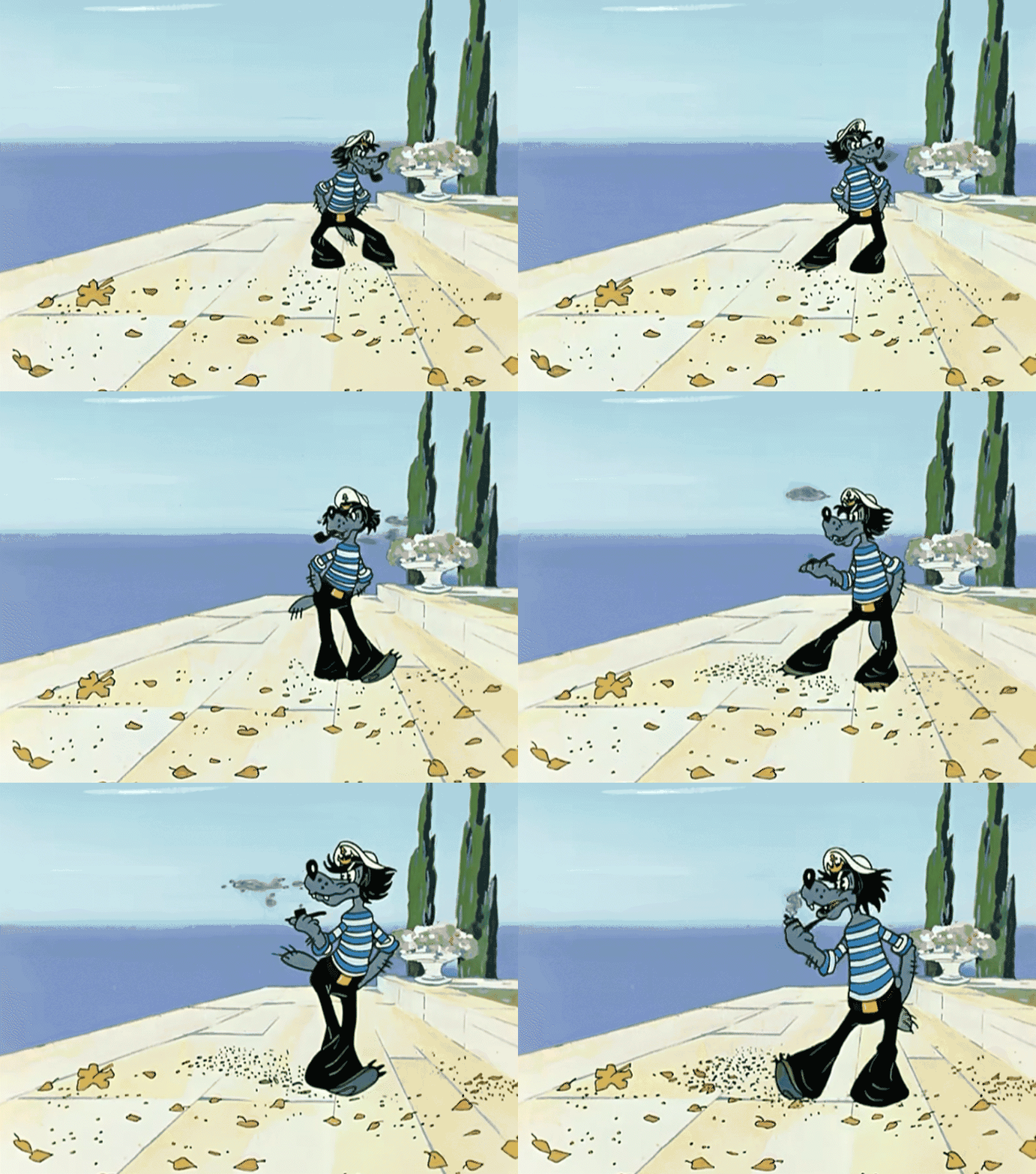
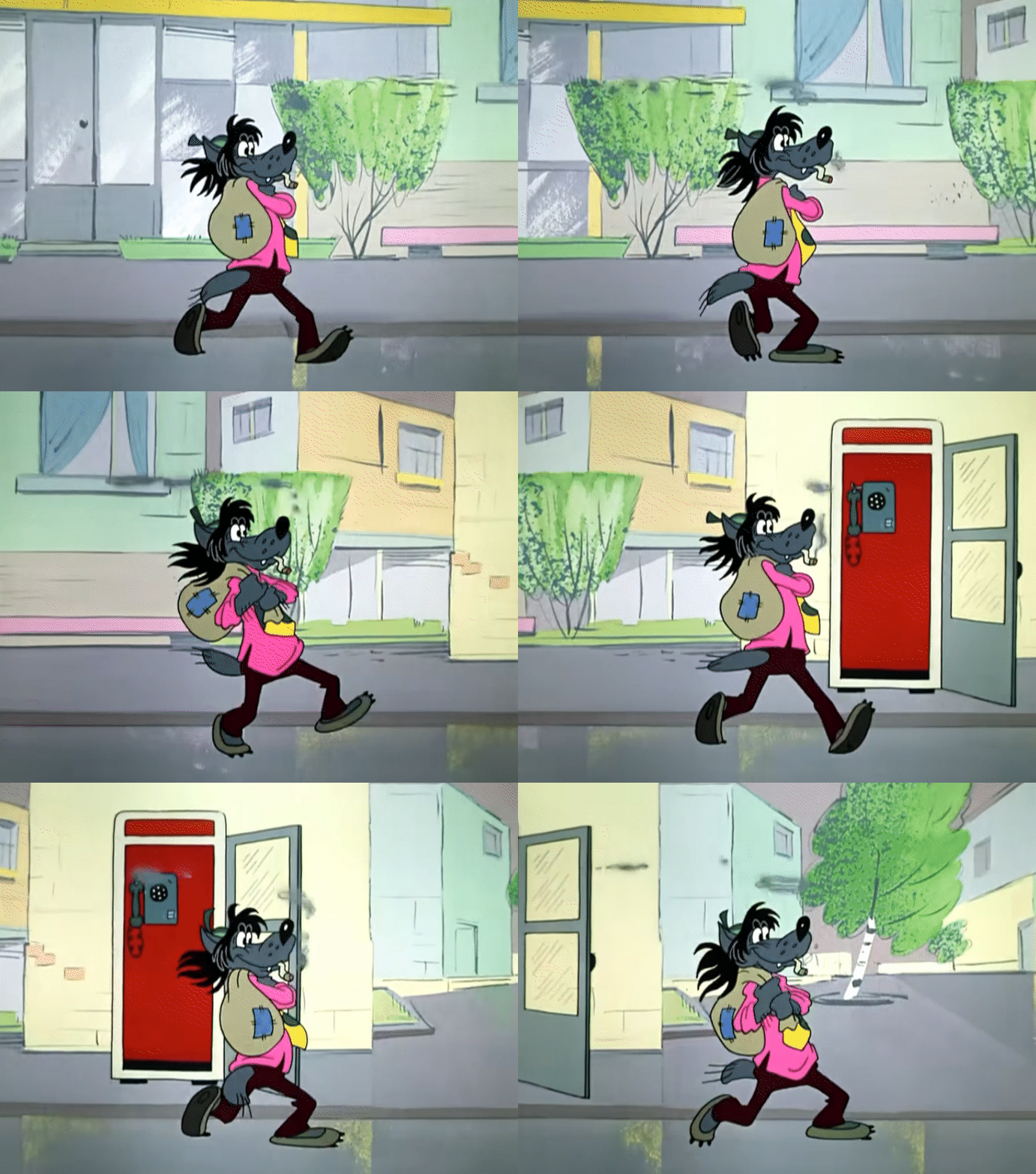
«On the Ship, ” *Nu, Pogodi! *, 7th Episode, 1973 „In the City, ” *Nu, Pogodi! *, 5th Episode, 1972
Another mechanism is the systematic «punishment» of the Wolf through animation. He constantly finds himself in situations where his body suffers defeats: he falls, gets stuck, stretches, or loses his clothes. For example, throughout the entire 3rd episode, the Wolf gradually loses his clothing, and in the 6th episode, he loses his underwear entirely.
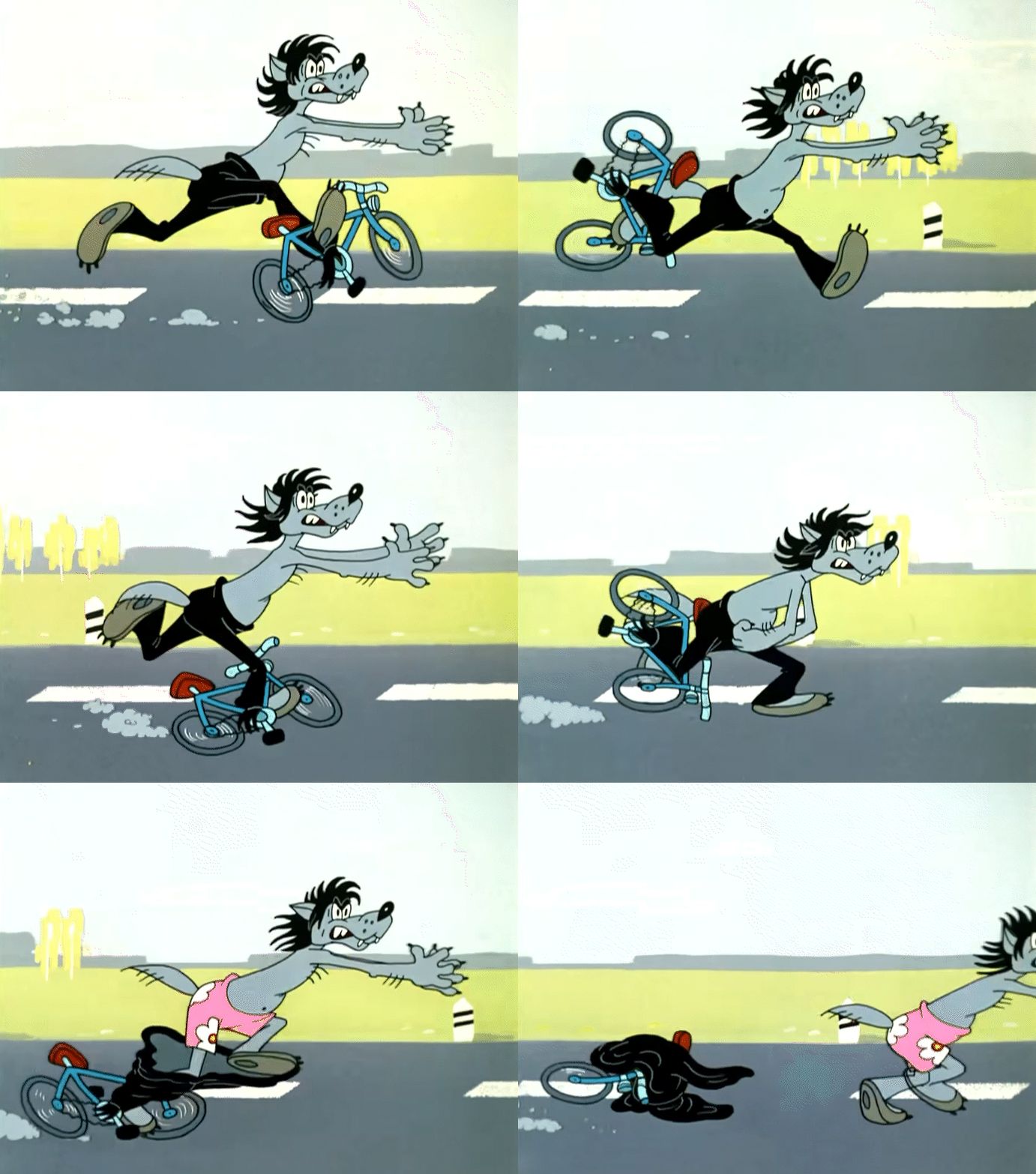
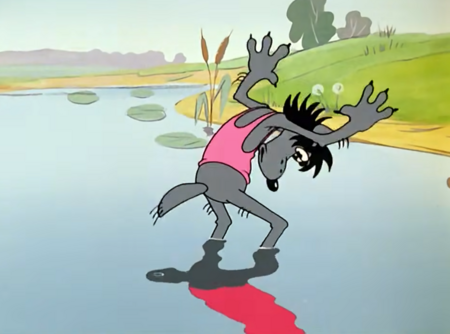
«On the Road, ” *Nu, Pogodi! * Vol. 3, 1971 „In the Village, ” *Nu, Pogodi! * Vol. 6, 1973