Introduction
Etruscan funerary painting features scenes that initially seem unusual for a space associated with death. Instead of depicting sorrow or loss, the walls of some tombs are filled with figures of people reclining on couches, musicians, dancers, and servants attending to the symposium participants.
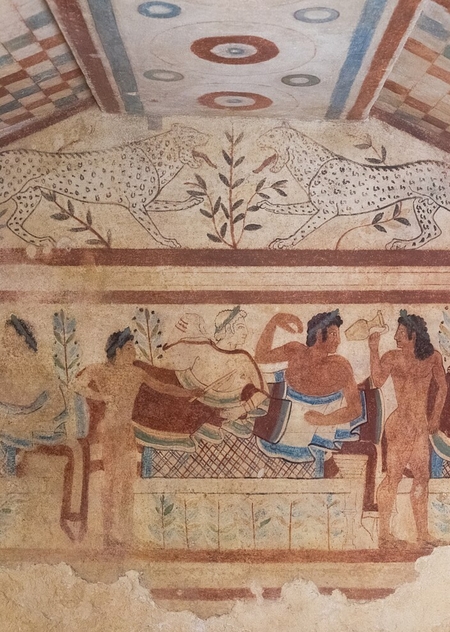
These kinds of scenes are particularly vividly presented in the Monterozzi Necropolis in Tarquinia. In the Leopards Tomb and the Triclinium Tomb, a banquet takes a prominent place in the decoration of the burial chamber, and music and dance complement the central feasting compositions. This raises a contradiction: why is the image of a celebratory life created in a space intended for the deceased?
Research Concept
Etruscan funerary painting presents a particular interest for study because it allows researchers to explore both the ancient society’s relationship with death and its perceptions of daily life, social standing, and human interaction. Unlike many other sources, the murals depict characters directly inside a specially arranged funerary space. This allows one to examine not only the depicted scenes but also how they relate to the tomb’s architecture.Special attention in the research is paid to scenes of banquets, music, and dance. At first glance, these might seem unusual for a burial site: instead of mourning and depictions of death, the artists created images of celebration, but it is precisely this contradiction that raises the research question regarding the significance of banquet scenes and their connection to Etruscan concepts of life and death.
The subject of this study is the funerary painting from the Etruscan necropolis of Monte Rosci in Tarquinia from the 5th century BCE. The focus of the study is the visual representation of feasting, music, and dance, as well as the methods used to organize festive scenes within the burial chambers. The Leopard Tomb and the Triclinium Tomb were selected as the main artifacts for analysis. Both tombs contain depictions of people feasting on special couches, as well as additional scenes featuring musicians and dancers. This allows for a comparison based on a unified set of visual characteristics.
The selection of two main tombs is due to the fact that they allow us to examine a burial composition type that is closely related in time and subject matter. In both monuments, a feast occupies an important place in the decoration of the back wall, while the side walls are complemented by images of other participants in the celebration.
However, the tombs differ in the details and the way the surrounding space is organized. The Leopards' Tomb features servants, a procession with offerings, musicians, and dancers. The Triclinium Tomb’s banquet scene is supplemented by animals, depictions of plants, and dancing characters. These similarities and differences allow for an investigation not only of the repetition of a single motif but also of the individual artistic decisions of the sculptors/artists.
To expand the comparative material, the Burial Couch Tomb is also examined. It was chosen because its fresco depicts the feast alongside the image of the burial couch and a scene of mourning. This monument allows us to examine how the celebratory imagery interacted with images directly related to the funeral.
The research is structured around the principle of a gradual transition from a general visual phenomenon to the analysis of individual works. Initially, the main elements of banqueting scenes are examined: the dais, participants, objects, servants, music, and dance. This is necessary to form an overall understanding of how artists depicted festivity.
Next, the primary scholarly interpretations of the meaning of the feast in funerary art are considered. These interpretations help define a problem that cannot be solved solely based on the general historical context. Following this, the Leopard Tomb and the Triclinium Tomb are analyzed, and their comparison helps reveal the common and distinct features of the compositions. The final section introduces an additional example—the Funerary Dais Tomb—after which a general conclusion is formulated.
Several types of textual sources are utilized for this study. The first group comprises scholarly works concerning the significance of funerary feasts, the social role of communal meals, and the specifics of Etruscan visual culture. These are essential for comparing various interpretations and developing our own hypothesis. The second group consists of research dedicated to specific monuments—their architecture, composition, and dating. Stephanie Anne Layton’s doctoral dissertation, Performance and Visual Culture in Etruria, is used as an additional source because it provides a detailed examination of music, dance, and other forms of presentation in Etruscan art. The third group includes museum and state catalogs, along with monument descriptions published by organizations dedicated to the heritage of Tarquinia. These are used to verify names, dates, image placement, and the preservation history of the frescoes. Importantly, descriptive information is separated from scholarly hypotheses: the mere presence of an image does not mean its symbolic meaning is definitively established.
Why did scenes of feasts, dances, and entertainment occupy such a significant place in the decoration of Etruscan tombs?To answer this question, we must determine what visual means the artists employed to depict festive actions and why these particular subjects were deemed appropriate for a burial chamber.
It is suggested that scenes of feasts, music, and dances created an image of an idealized space of social interaction, well-being, and unity. In a funerary context, this image may have related to the memory of the deceased’s earthly life, the performance of burial rites, or beliefs about continued existence after death.
However, the significance of individual depictions was not necessarily uniform. To test this hypothesis, it is necessary to compare the visual elements of the two main tombs while considering various scholarly interpretations, without accepting any single one as the only possible truth.
The primary method employed is comparative visual analysis. Attention is given to the arrangement of figures, their postures and gestures, the interaction among participants, the items on the table, the musical instruments, the direction of the characters' movement, and the compositional relationship between the walls.The interaction between the images and the architecture of the burial chamber is examined separately. It is important to establish the role of the central banquet scene, how the side walls supplement it, and whether the impression of a unified celebratory space is created.
I. Feasting as a Lifestyle: Constructing the Celebration Scene. The Structure of the Etruscan Banquet
To understand why scenes of banquets held such an important place in funerary art, one must first examine how artists depicted the feast itself. In Etruscan art, a banquet is not merely people consuming food. Around it, an entire system of characters and actions takes shape: some participants are seated on couches, others serve drinks, and a third group plays musical instruments or dances.Thus, the banquet scene unites several types of imagery, each complementing the overall narrative.
One of the most recognizable elements of Etruscan banquets is the special couches—the kline. Participants are depicted reclining on them, usually propped up by pillows. This posture becomes a characteristic feature of the feasting scene, allowing artists to arrange several characters close to one another.In the tombs examined, pairs of participants are shown on the couches. Their arrangement creates a sequential horizontal rhythm: the repeating figures unite into a single composition, yet each pair retains its own distinct space within the banquet.
Feast Composition from the Tomb of the Leopards. Tarquinia. Sailko.
In Etruscan funerary paintings, feasting figures are depicted not as randomly gathered individuals, but as participants in an organized social event. Their placement on platforms, clothing, and interaction with one another create an image of a specific social milieu.The presence of both men and women in a single scene is particularly noticeable in the paintings from the Triclinium Tomb. Here, three pairs are shown seated on separate platforms. This arrangement allows the feast to be viewed as a communal event involving several pairs of people united by a shared meal.
Service staff form an important part of the banquet scene. They are depicted standing near those feasting and serving drinks. Their presence suggests that the feast is portrayed as an event requiring a certain level of organization. Furthermore, processions with offerings appear in some tombs. This expands the scene: the image shows not only the immediate participants in the banquet but also people journeying to them carrying celebratory items.
The feast is accompanied by music, which becomes one of the primary means of creating a festive atmosphere. Performers playing wind and string instruments are found in burial art. Among them, the aulos and barbiton can be noted.Musicians are often situated near dancers, forming distinct scenes on the side walls of the tombs. Because of this, the banquet is perceived not only as a meal but also as an event accompanied by entertainment.
Musicians and Dancers, Leopard’s Tomb. Yann Forget.
Dance differs from the banquet scene in its dynamic quality. If the diners are depicted in relatively stable poses, the dancers are shown in motion—with raised arms, an extended torso, and weight shifted across their bodies.This contrast between stillness and movement allows artists to create a more complex depiction of a celebration. Dance does not merely complement the feast; it becomes an autonomous action that visually connects different parts of the composition.
Two dancers, a fragment of the Triklinios Tomb frescoes. The Yorck Project.
Lions Tomb, in the Necropolis of Tarquinia, fresco of musicians and dancers. Reproduction from Etruscan Murals.
Feasting in Etruscan funerary art represents a complex composition that unites dining, service, music, dance, and offerings. Through the combination of these elements, the image transforms into a depiction of an entire celebration.
It is particularly important that the artists do not limit themselves to a single scene. Instead, they distribute participants and actions across different sections of the walls, creating the impression of a space where the celebration continues simultaneously in multiple directions.
This very principle of image organization will form the basis for the subsequent comparison of the Leopard Tomb and the Triclinium Tomb.
II. The Feast Between Life and Death: How Funeral Images Were Interpreted. Why the Meaning of the Feast is Debated
The appearance of festive scenes inside a burial chamber raises questions about their significance. If an image is located within a tomb, it can be assumed to be related to conceptions of death and existence after it. However, this does not mean that every participant at the feast is necessarily depicted as deceased, nor that every banquet scene represents the afterlife.
Researchers propose several explanations for this motif. Their differences stem not only from the interpretation of individual images but also from how the funerary frescoes themselves are perceived—as a reflection of life, as part of the burial ritual, or as a representation of the world of the dead.
First interpretation: the feast as part of a funerary rite.
One interpretation connects the images of feasts with actual funeral banquets. It is hypothesized that after a person’s death, relatives and other participants in the burial might have gathered for a shared meal and drinks.In support of this explanation, researchers refer to archaeological findings: vessels and other items associated with banqueting have been discovered in some tombs. Their presence suggests that a communal meal could have been part of the funerary rites.However, it must be considered that items placed in a grave were not necessarily used at a real feast. Some of them might have been specifically crafted for the burial. Therefore, the presence of tableware cannot automatically be taken as proof that a banquet was held immediately before interment.
Second Interpretation: The feast as an image of aristocratic life.
Another interpretation connects the depicted scenes to the social life of Etruscan nobility. The communal feast served as a form of social interaction where the participants' social relationships, standing, and group etiquette were evident.
This explanation is supported by depictions of banquets found not only in tombs but also in other contexts. For instance, banquet scenes appear on decorative terracotta reliefs from Acquarossa and Podjo Civitate. Their similarity to funerary imagery suggests that feasting was part of a broader Etruscan visual culture.
Therefore, artists could translate recognizable aspects of public life—life associated with prosperity, social connection, and an individual’s status—into funerary art.