Concept
In medieval painting, Satan appears either as a colossal devourer, overthrown by an archangel, or as a static witness to the salvation of souls. Horns and wings alone are insufficient to grasp his role. One must observe what he is doing and who is in his proximity. I am comparing European fresco and altarpiece painting from the 10th–15th centuries. The chapters are structured around three criteria: body and scale, gestures, and relationships with other figures. Early depictions of demons and Florentine mosaics have been included for comparison with the primary material.
How do artists depict the power and limits of Satan?My hypothesis is that his appearance emphasizes Satan’s strength, while his pose and placement within the composition reveal his limitations. He towers over the damned, but before Christ and Michael, he loses his ability to act.
To Gothic
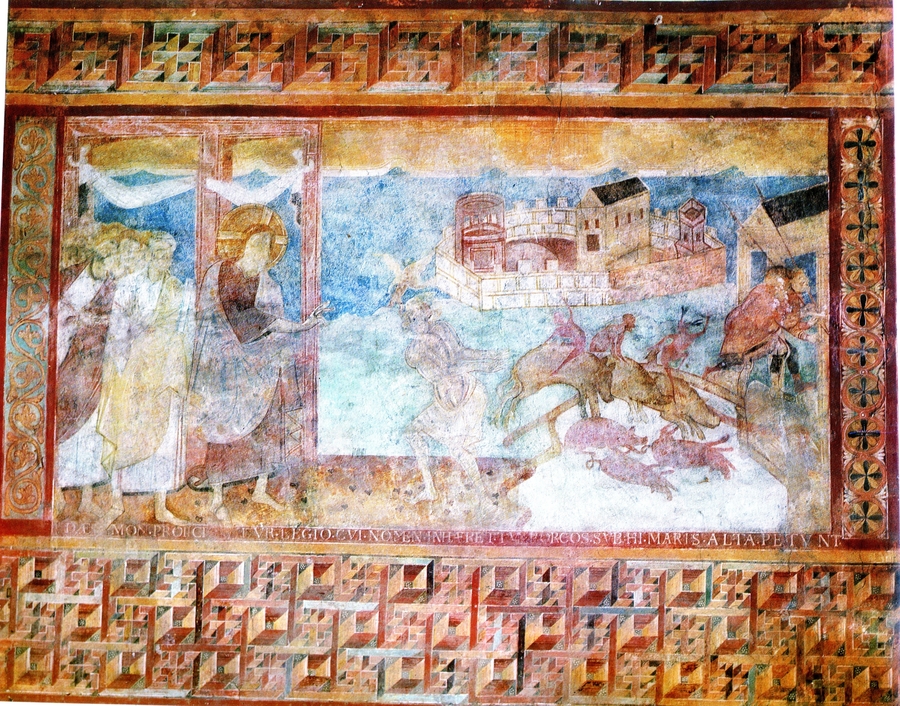
Unknown Master. Healing of the Leper of Gerasa. Late 10th Century. Mural Painting. Church of St. George, Obercell, Reichenau. Comparative Example.
The demons are depicted as small participants in the healing scene. They leave the person, and the main action belongs to Christ. Their size and movement illustrate their dependent status. Satan’s separate figure is not emphasized here.
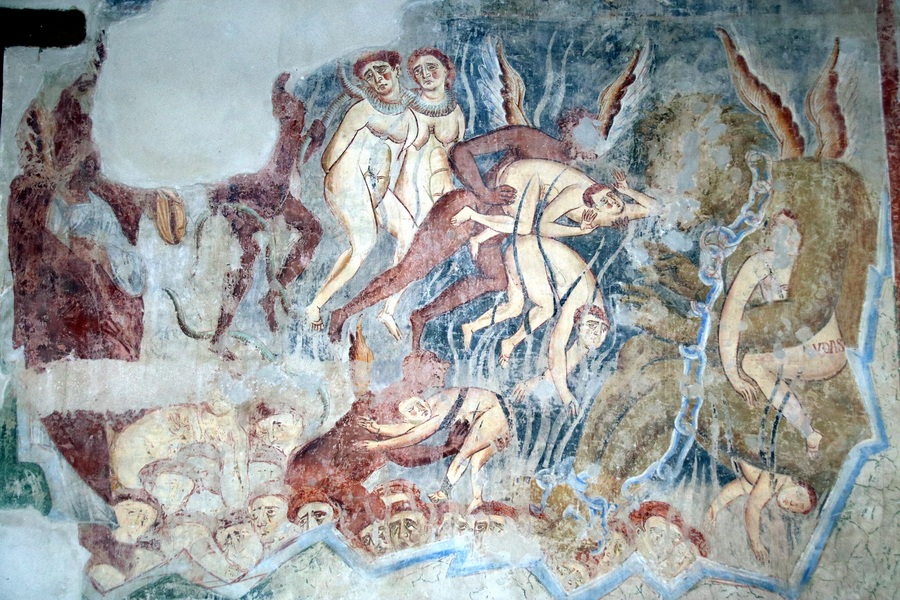
Unknown masters. Last Judgment, infernal section. Late 11th century. Mural painting. San Angelo in Fornimos, near Capua.
Lucifer retains human contours. A small figure, associated with Judas, rests on his lap. Meanwhile, he himself is bound by chains. This seated posture merges two states: the ruler of the condemned simultaneously remains a prisoner.
Tuscan Masters. The Last Judgment, Satan. c. 1260–1275. Mosaic. Baptistery of San Giovanni, Florence. Comparative material for painting.
The human figure near the mouth appears quite small. This difference in scale emphasizes Satan’s power, and his body itself becomes an instrument of punishment. A similar motif of devouring can be found in the frescoes of Giotto and Buffalmacco.
Body and Scale
Giotto. Last Judgment, general view. Early 14th century. Fresco. Cappella Scrovegni, Padua.
Giotto. The Last Judgment, infernal portion. Early 14th century. Fresco. Scrovegni Chapel, Padua.
Christ occupies the central position above the participants in the court. Lucifer is placed in the lower right section of the wall. Inside hell, he is massive compared to the people, but within the scale of the entire fresco, he occupies a limited space. The large figure does not equate him with Christ.
Buffalmacco. The Last Judgment and Hell. Late 1330s–early 1340s. Fresco. Camposanto, Pisa.
Lucifer sits motionless amidst the scenes of torment. Small figures around him fragment the image, while his large body collects them into a single composition. Compared to Giotto, the structure of hell as a spatial area with distinct levels is more evident here.
Giovanni da Modena. c. 1410s. Fresco. Cappella Bolognini, San Petronio, Bologna.
Satan’s dark, hairy body stands out against the smooth human figures. The people are near its maw and alongside other parts of its body. Much like in a Florentine mosaic, the punishment is inflicted by the monster itself. Its frontal pose makes it highly visible among the other torturers.
Taddeo di Bartolo. Ad, detail of Lucifer. Early 15th century; cycle dating is under discussion. Fresco. Collegiata, San Gimignano.
Facial features appear both on Lucifer’s head and his body. The body loses its familiar human structure. Giovanni da Modena exhibits a similar convergence of multiple faces. In both paintings, this complexity enhances Satan’s figure and links different parts of the body to punishment.
Gesture and Defeat
Andrea di Bonaiuto. Descent into Hell, Demons. Circa 1366–1367. Fresco. Spanish Chapel, Santa Maria Novella, Florence. Comparative example.
The demons are grouped in a tight space. Their hands are held to their chests and faces, rather than toward the victim. These gestures can be compared to the pose of Satan in Bermejo. Therefore, it is not possible to definitively identify one of the demons as Satan.
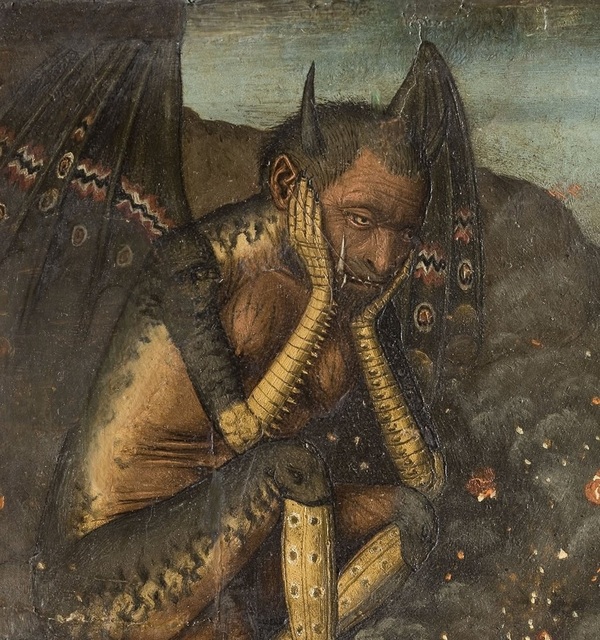
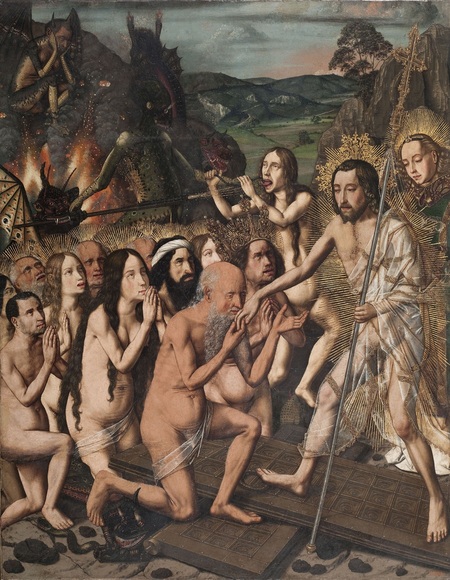
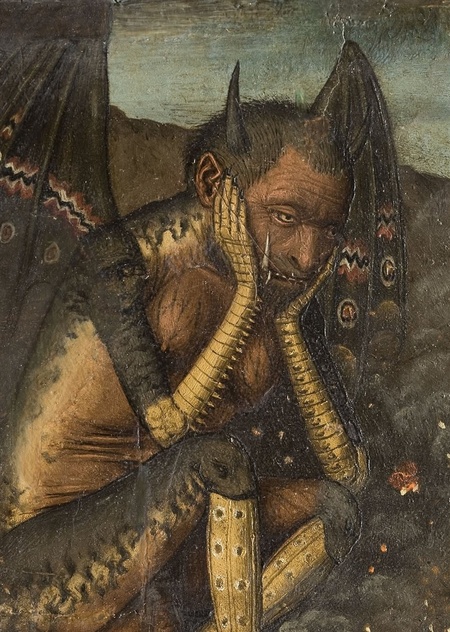
Bartolomé Bermejo. The Descent of Christ into Limbo. Circa 1474–1479. Oil and gold leaf on wood. National Museum of Catalan Art, Barcelona. On the left is a detail featuring Satan; on the right is the complete painting.
Satan holds his hands to his face, watching the people emerging from the limbo. His figure is pushed into the upper left corner. The overall view connects this pose with defeat—he does not intervene in the liberation of the souls. In one close-up, the reason for his immobility would be unclear.
Bartolomé Bermeho. Saint Michael Defeating the Devil. 1468. Oil on wood. National Gallery, London.
Michael stands over the devil, holding him down with his foot. The jaws, wings, and serpentine protrusions of the monster complicate its form, but they do not change the outcome of the fight. The straight figure of the archangel is juxtaposed against the twisted body of his opponent.
Joos Lerinkes. Saint Michael Treading the Demon. 15th Century. Wood. Musée de Pitié-Palais, Avignon; Calve Institute Collection.
The Devil continues to hold the thorny switch, even though Michael has already stepped on him. Like Bermekh, weapons and a fearsome appearance do not give him an advantage. In both paintings, the position of the bodies explains the outcome of the struggle more clearly than individual animalistic traits.
The Devil Next to Humanity