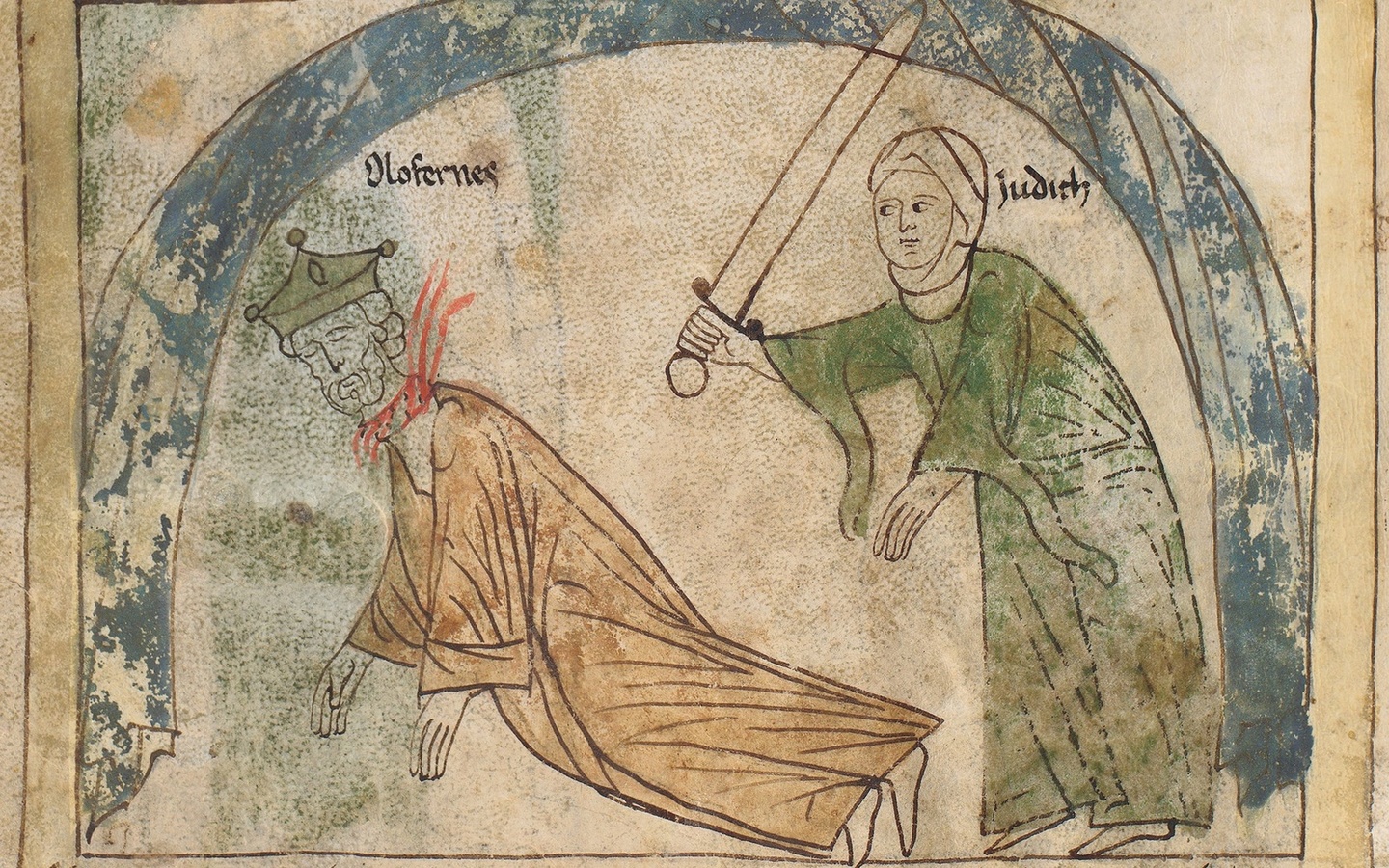
Judith is often recognized by her sword and the severed head of Holofernes. But if we look only at these objects, the heroine becomes a static collection of traits. In medieval depictions, she speaks, waits, approaches, acts, and interacts with people. I am interested in how these states relate to one another. In which scenes does Judith control what happens, even if her position appears subordinate? And does the artist absolutely need to show the strike to make her the central figure?
Research Question: By what visual means do the representations of the 12th–14th centuries convey the shift of initiative from Oliferus to Judith? By «initiative,» I mean the visible control over action: who sets the direction of movement, whom the others are addressing, and who is holding the object or the opponent’s head. The hypothesis is that this transition is expressed primarily through the relationships between the figures. Differences in standing versus reclining poses, the open or confined space between characters, and the reaction of the surroundings can establish Judith as active even before the sword appears or after the killing itself.
The main collection focuses on works from before 1400. For direct comparison, miniatures from the 12th–14th centuries and a 13th-century stained glass window have been selected. This is not an exhaustive list of all early depictions of Judith; the conclusions are based on the available visual material. The collection includes the Pampleon Bible from the Augsburg collection, the Bible of Étienne Harding, a manuscript from Acre, French biblical miniatures, the «Mirror of Human Salvation, ” and a late French cycle from around 1390. These pieces illustrate different approaches to narrative: ranging from a rare initial image to several sequential episodes.
The material was chosen not only for its recognition. For every important juxtaposition, it is necessary to see the positioning of the figures, the direction of the weaponry, and the boundaries of the space. Therefore, I use horizontal frames of individual scenes within handwritten pages. The rectangular frame preserves the original proportions—it does not distort the figures. Details may follow the overall composition. These are captioned separately and are not considered new works. It is especially important to maintain the connection to the neighboring image where Judith is juxtaposed with the Madonna or with the fall of Lucifer. Without this context, the meaning of the page changes.
The five chapters are structured around what the image accomplishes. First, the antagonist’s power is examined, followed by encounters and anticipation, and then the action at the couch. The fourth chapter focuses on who receives the victory. The final chapter investigates how neighboring religious images alter the reading of the narrative. Chronology remains a guideline, but it does not become a rigid schema of progression: a later miniature might preserve conventional space, while an earlier one may already depict complex interaction. I compare individual solutions rather than classifying works on a scale from «simple» to «developed.»
Dates and titles have been cross-referenced with library and museum catalogs. The original Psalter dates to 1197; the illustrated Augsburg version shown dates to around 1200, and these manuscripts are distinct. [5] The New York Public Library catalog helps maintain the later boundary around 1390. [6] Research by Monica Walker Wade, Madeline Caviness, Serge Cheruti, and Stefan Lozhkin is used for historical and religious context. [1, 2, 4] Furthermore, personal observation is not substituted for borrowed interpretation: one can observe the body’s posture, but the supposed feelings, the artist’s intention, and the reaction of medieval viewers to a single scene cannot be proven.
Contents
1. Who Holds the Power
2. Judith Before the Sword
3. Who Acts by the Dais
4. Who Needs the Victory
5. Image Within Another Image
Conclusions
Who is in charge?
Olofern’s power is first evident in his surroundings: the horse, the armed men, the crown, and the city walls. These elements establish the initial imbalance of power. Next, it is important to trace what happens to them when they meet Judith.
Master not installed. «The Host of Oloferna Crosses the Euphrates.» 1246–1248. Colored glass, painting, lead soldering. Philadelphia Museum of Art.
In the circular field, the cavalry advances in a dense formation. Raised spears and repeating heads amplify the impression of organized power. Judith is not shown here—this is an auxiliary example of how the cycle denotes an enemy’s might. The rhythm of the spears creates a unified front. Later, we will see the opposite situation: one woman positioned next to a stationary commander. The contrast between public military strength and the vulnerable body is crucial for developing the narrative.
Master is not identified. «Olofern before Vetiluia.» Circa 1200. Miniature on parchment. University Library of Augsburg, Ettingen-Wallerstein Collection.
Master is not identified. «Olofern before Vetiluia.» Circa 1200. Miniature on parchment. University Library of Augsburg, Ettingen-Wallerstein Collection.
The general is depicted riding before a wall. The horse and armor set him apart from the cycle’s characters. The city is reduced to a few towers; the image signifies the confrontation between two sides rather than showing a detailed panorama of the siege. The crown and mail are combined into a single figure. These are symbols of power and military force that the viewer instantly reads. In subsequent scenes of the same cycle, the crown will remain, but the body posture will change.
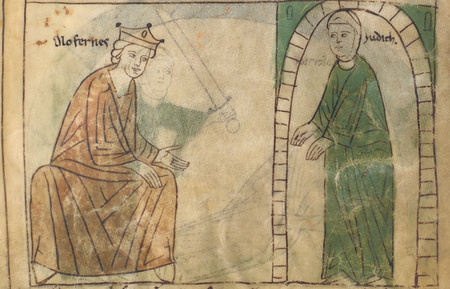
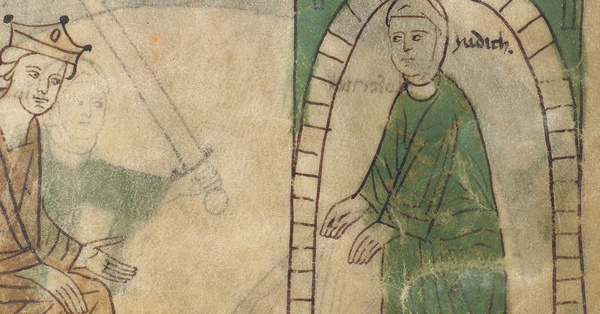
Master is unknown. «Judith before Holofernes.» Circa 1200. Parchment miniature. University Library of Augsburg, Ettingen-Wallerstein Collection.
Olofren is seated on the left, and Judith stands on the right within the arched opening. There is open space between them. While the seated ruler outwardly holds authority, the reciprocal gestures show that the heroine is already participating in the action. The arch separates Judith from Olofren. Their hands are directed toward each other across this boundary. Here, the heroine is not presented solely with a sword—her recognizable action currently lies in conversation.
Master not identified. «Judith in the Tent of Holofernes.» Circa 1260–1270. Miniature on parchment. Dijon Municipal Library.
In the miniature from Akra, tents gather several figures into a close group. It is perceived as a space for reception and communion. Compared to the Pamplona Bible, the distance between participants is smaller, and the surroundings are more detailed.
2. Judith still without a sword
Not every episode revolves around weaponry. The feast, the conversation, and the anticipation allow us to see how the heroine engages with the action. Her standing next to the general is not static throughout the story.
Master not identified. «The Feast of Olofern.» Early 12th century. Miniaturization on parchment. Dijon Municipal Library.
The long table arranges the participants along a single horizontal line. Gestures, tableware, and bowed heads distribute attention among several figures. The heroine is integrated into a public scene rather than isolated as a triumphant figure.
Master not identified. «Drunken Olophron and Judith.» Circa 1200. Miniaturized on parchment. University Library of Augsburg, Ettingen-Wallenstein Collection.
Master not installed. «Vessels above the scene participants (detail).» Circa 1200. Miniature on parchment. University Library of Augsburg, Ettingen-Wallerstein Collection.
The body of Olofern is tilted diagonally, while Judith remains vertical. The vessels are shown separately above them. The external strength of the commander gives way to instability, even though the crown continues to signify his status. The goblet and the vessel are placed in open space. Their placement does not depict the actual arrangement of objects, but rather draws attention to the theme of drinking. The objects help connect adjacent images into a sequence.
Master unknown. «Judith by Olephorn (detail).» Circa 1200. Miniature on parchment. University Library of Augsburg, Ettingen-Wallerstein collection.
The woman’s hands are lowered, while the commander makes an open gesture. We have not yet seen the strike. The artist holds a pause, in which the distinction of the poses communicates more than the expression of the faces.
Master not identified. «Judith and Holofernes. Dialogue.» Circa 1390. Parchment miniature. New York Public Library.
Master not identified. «Conversation. Space Between Figures (Detail).» c. 1390. Miniature on parchment. New York Public Library.