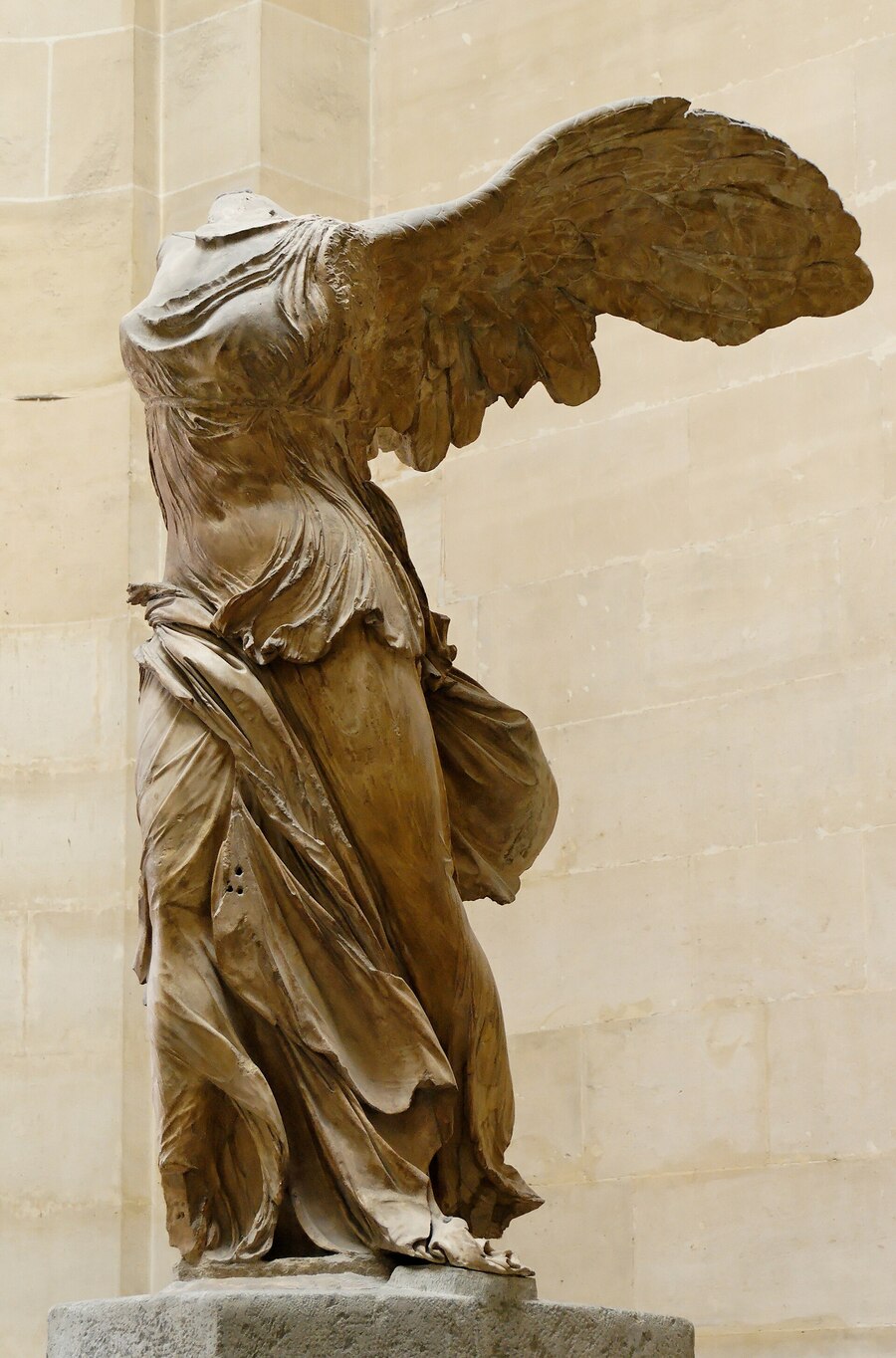
Fig. 1. Nika Samofrakian. c. 190 BCE. Marble. Louvre, Paris
Concept
In sculpture, the human figure is almost always clothed, which means the artist must constantly depict fabric. Executing this in stone or bronze is not simple: cloth is soft and fluid, while the material is hard. How the sculptor solves this problem says a great deal about how form and the human body were understood in their time.
Textbooks typically mention drapery in passing, as one characteristic of a style. I wanted to examine it more closely and compare how it has been interpreted across different eras. I am not focusing on clothing as costume—the cut, the fashion, or the types of fabrics. I am interested in how the fold relates to the body beneath it: does it repeat its form, reveal it, conceal it, or completely replace it?
How did the portrayal of the fold on the human body in sculpture evolve from the Archaic period to the Quattrocento, and what do these changes reveal about the understanding of the human figure across different eras?
Thesis: The fold allows the sculptor to convey something absent in the material itself. In this work, I identify six ways of interpreting drapery: the fold as a pattern, as a means of depicting the body, as a sign of movement, as a conventional graphic element, as an independent mass, and as a way to construct a figure in space. These interpretations do not strictly succeed one another; rather, they coexist, recur, and reappear across different periods. However, in each era, one of these approaches becomes particularly prominent and receives the most vivid realization. Comparing similar techniques across different eras reveals that the same form of a fold can serve various artistic purposes.
Six Roles of the Fold
1. Ornamental Fold — Archaic
2. Figural Fold — High Classicism
3. Kinetic Fold — Hellenism
4. Spiritual Fold — Romanesque
5. Mass Fold — Gothic
6. Structural Fold — Quattrocento
The principle of rubrication is typological: chapters are organized by the role the fold plays in relation to the body. Each chapter is built around the era in which this type was most vividly expressed, but the type is not considered exclusive to that period. Therefore, each chapter includes a comparative spread: next to the main example is a work from a different time period where a similar technique functions differently. The chapters conclude with a brief summary.
Material: Round sculptures and reliefs from Ancient Greece and Rome (6th–1st centuries BCE), Romanesque portals from France (12th century), Gothic sculpture from France, Germany, and Burgundy (12th–15th centuries), and 15th-century Italian sculpture and drawing.
Introduction
Nikki Samofrakis’s figure lacks a head and arms; most of the statue is dominated by drapery. Yet, even from the fabric, it is clear that a living body lies beneath the clothes, that the figure is stepping forward, and that the wind is blowing towards her. I believe this is an excellent example of how much a single drapery can convey. The task of rendering fabric in stone has challenged sculptors of all eras, and they have approached it in vastly different ways. These differences—I intend to trace them.
Chapter 1. Fold Motif
Fig. 2. Hera Samossia (statue dedicated to Hera). Circa 570–560 BCE. Marble. Louvre, Paris
The lower section of the statue resembles a smooth cylinder covered with frequent parallel grooves. These evoke the fluting of a column and are completely unrelated to the body: no legs show beneath the drapery, and the figure and clothing merge into a single mass. Only on the torso do the grooves change direction, slightly outlining the chest. Essentially, the folds here have been scratched onto the surface of the volume, like a drawing.
Fig. 3. Kore 682. Circa 525 BCE. Marble. Acropolis Museum, Athens
The chiton draped over the Athenian Acropolis falls diagonally, its folds forming a symmetrical zigzag, and the fabric edge descends in steps. This creates a rhythmic pattern that invites closer inspection, independent of the figure. It is almost unattached to the pose; the fabric would drape the same regardless of the figure’s stance.
Fig. 4. Charioteer from Delphi. c. 475 BCE. Bronze. Archaeological Museum of Delphi
The tunic from Delf was created in the early classical period, and this is noticeable. The lower folds of the chiton remain strictly vertical, lending the figure a columnar quality. However, the fabric behaves more freely around the waist and shoulders—it gathers, drapes, and follows the movement of the arms. Here, the fold begins to respond to the body for the first time.
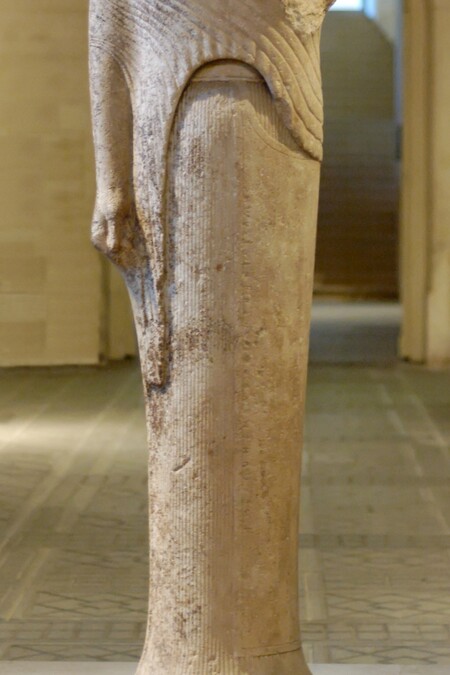
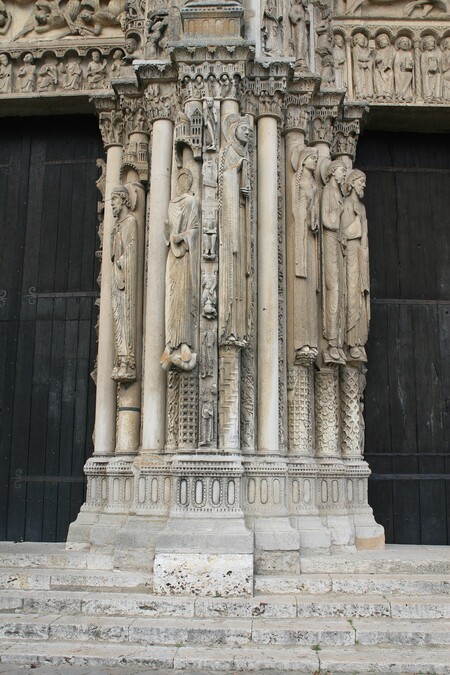
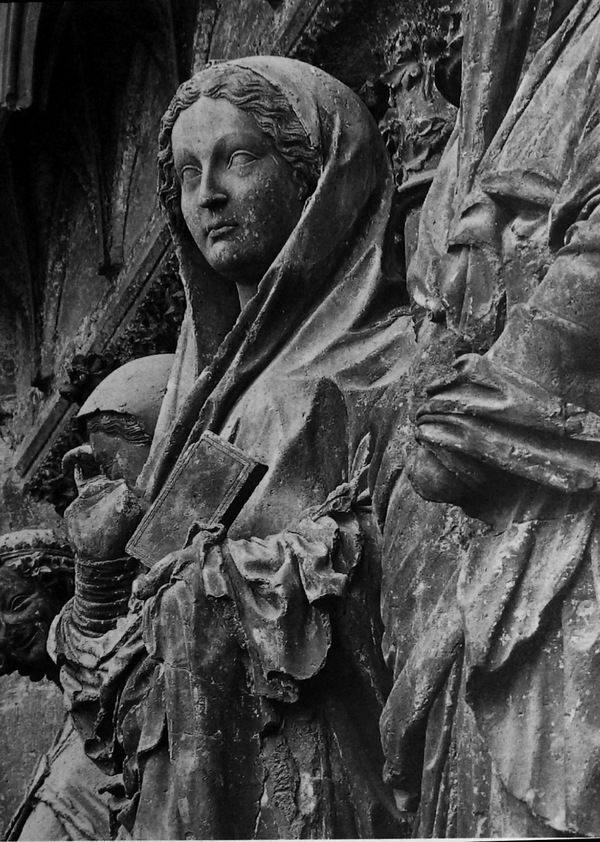
Comparison 1. On the left is Hera Samossai, circa 570–560 BCE (Fig. 2); on the right are the column-statues of the Royal Portal of Chartres Cathedral, circa 1145–1155 (Fig. 13). In both cases, vertical folds transform the figure into a column-like structure, and the body beneath the drapery is barely discernible. However, in Hera, this technique emphasizes the self-contained nature and stability of the freestanding statue, whereas at Chartres, the figures are literally merged with the portal columns, becoming an integral part of the cathedral’s architecture.
The patterned, geometric fold is most pronounced in the archaic style: the body and the fabric form a single mass, and the fold speaks more of order and symmetry than of the body itself. However, this technique does not disappear with the archaic style; similar vertical folds appear in Gothic column-statues, though there they serve a different purpose.
Chapter 2. Fold-Body
Fig. 5. Three goddesses from the eastern pediment of the Parthenon (figures K, L, M). c. 438–432 BCE. Marble. British Museum, London.
In high classical art, the drapery begins to articulate the body. The goddesses' fabric is thin and appears damp—it clings to the chest, abdomen, and knees of the reclining figure, allowing the body to be clearly perceived beneath it. In the areas between the legs and beneath the arms, where the body is absent, the fabric gathers into deep folds that create shadow. This technique is called «wet drapery.» Due to the contrast between light and shadow, the convex parts of the body appear especially voluminous.
Fig. 6. Nika untying a sandal. Relief of the balustrade of the Temple of Nika at Apetros. Circa 420–410 BCE. Marble. Acropolis Museum, Athens.
On the relief from the balcony of St. Nick’s church, the fabric appears nearly transparent. Delicate folds stream down the figure, outlining her form. Nick bends down to untie her sandal, and the garment follows the movement: it pulls taut on her thigh while falling freely from her shoulder.
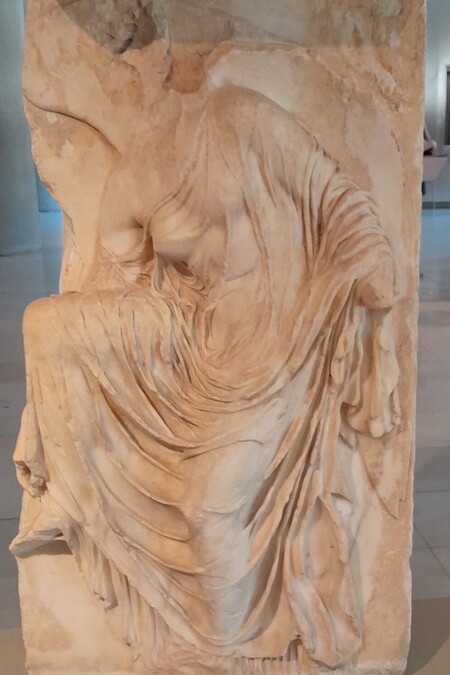
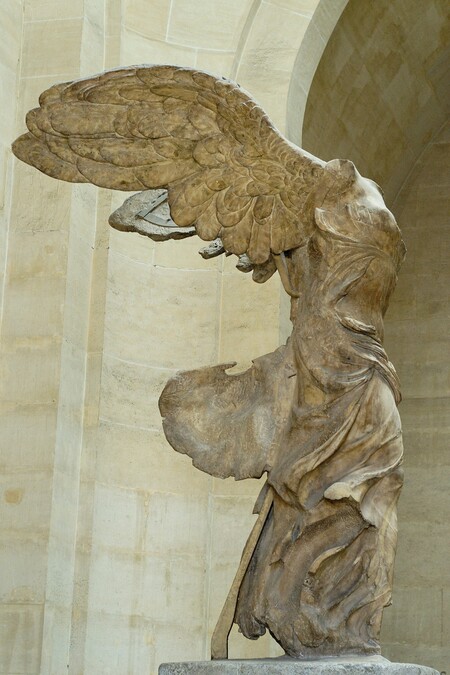
Comparison 2. On the left is Nike untying her sandal, circa 420–410 BCE (Fig. 6); on the right is Nike of Samothrace, circa 190 BCE (Fig. 7). In both images, the thin drapery clings to the body, revealing its form. However, in Nike from the balustrade, the folds calmly follow the figure’s incline, whereas in Nike of Samothrace, the «wet» fabric across the chest and abdomen contrasts with the heavy masses whipped by the wind. The classical approach is maintained in Hellenism, but it evolves into a more dramatic figure.
The most consistent solution of this type was provided by High Classicism: where the body is absent, the fabric gathers into dense shadows, and where it is present, it thinly drapes over it. Furthermore, «wet» folds appear later, for example in works by Nike Samofrakis, where they neighbor folds that convey movement.
Chapter 3. Fold-Movement