Categories
- Concept
- The Space of a Courtly Banquet
- The Image of the Host.
- Guests and Social Hierarchies
- Interaction of Banquet Participants
- Conclusion
- Bibliography
- Image Sources
1. Concept
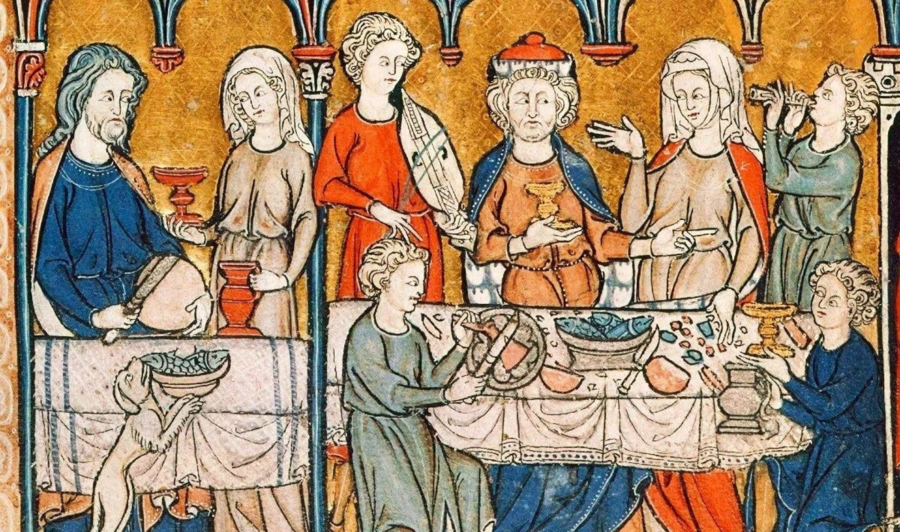
«Medieval Feast, ” unknown artist, France, 1290–1300
This visual study examines the court banquet in 13th–14th-century Western European painting not as a slice-of-life or genre scene, but as a visual model of social order—one where the feast itself organizes space and delineates a specific hierarchy, power, and ritual. It is crucial to consider that medieval society was a highly dynamic phenomenon.
For a long time, even the royal court of a Western European monarch lacked a permanent location. A person from a noble family, possessing valuable property, was inherently hospitable; this was dictated by a custom that formed a vital element of the identity of the class elite. This is precisely why the depiction of banquets allows us to see how Western European society presented itself through the ceremony of a shared meal.
In those days, a banquet was not merely a meal but a complex ritual that solidified social ties, displayed the host’s wealth and status, affirmed the place, postures, and gestures of the guests, and defined the actions of the servants. Through this collection of subject matter, artists constructed the image of the court and its values.
The central thesis of the research is that the depiction of a courtly feast constitutes a ceremonial composition, where each element indicates the participant’s social status and the nature of their relationships with others. The feasting space is divided into zones of those in authority and those in subordination (servants), and this boundary is visually emphasized through the scale of the figures, their postures, costumes, and attributes.
The host of the feast serves as the compositional and semantic center of the scene: he is presented not through individual traits, but through a collection of spatial and ritual characteristics—elevation, rich attire, the directed movements of servants toward him, and the gazes of the guests. The guests, in turn, are distributed around the host according to rank, and the distinctions in their placement, clothing, and role at the banquet are masterfully conveyed through an established hierarchy that the viewer perceives without textual explanation.
Special attention is paid to the interaction among the participants of the rite: gestures of offering, receiving, serving, and contemplation form a unique communication wherein each person fulfills a prescribed role.
The research material consists of preserved, dated depictions of feasts from the 13th–14th centuries in Western European painting, such as illuminated manuscripts, frescoes, and panel paintings.
Comparing different media allows for the identification of both general principles of scene organization and variations stemming from the image’s function. Visual analysis is built upon comparing the spatial structure of the scene, the placement of participants, and their gestures—a method that allows one to test the thesis regarding the ceremonial nature of the imagery within a specific material.At the same time, it must be considered that the composition of each image is subservient to its specific objective; therefore, conclusions are formulated based on comparing several pictures. As a result, this research should demonstrate that the Western European depiction of a feast is not a mere documentation of daily life, but a ceremony—a tool for representing the court and its values—and that the visual analysis of such a scene reveals the mechanisms of constructing power and social order in medieval culture.
2. The Courtly Banquet Space
The spatial organization of banquets in 13th–14th century painting serves as a key instrument for visually constructing social order. The table is almost always the foundation of the composition, becoming the center that organizes the figures of guests and servants around it. However, the space of the feast is rarely uniform; it is often divided into distinct semantic zones.
«The Feast of Bacchus», Giotto di Bondone, Italy, circa 1315.
In Giotto’s monumental frescoes, this division is expressed particularly clearly. In the «Feast of Herod, ” the hall is organized around the figure of the king, and the dramatic tension is created by the juxtaposition of the festive atmosphere and the cruelty with which the executioner presents the severed head of John the Baptist like a dish—in this gesture, the plate, the hands, and the gazes merge into a single whole.
«The Marriage in Cana, ” Giotto di Bondone, Italy, 1303–1305.
Fragments of the fresco «The Wedding at Cana, ” by Giotto di Bondone, Italy, 1303–1305.
In Giotto’s «The Marriage at Cana, ” he structures the space quite rigidly: Christ, the groom, the Virgin Mary, and the bride sit at a long table, while servants and large stone water vessels are positioned on the periphery. The artist pays close attention to tablecloths, tableware, and drapery, making the scene convincing and tangible.
The Gospel scene, «The Wedding at Cana in Galilee,» from a 14th-century English manuscript—the «Psalter of Queen Mary,» unknown artist, England, c. 1310–1320.
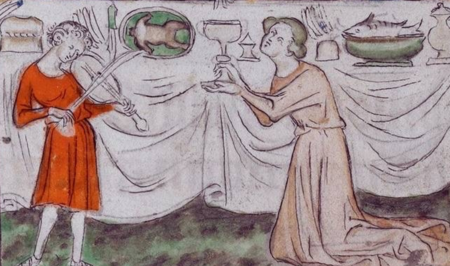
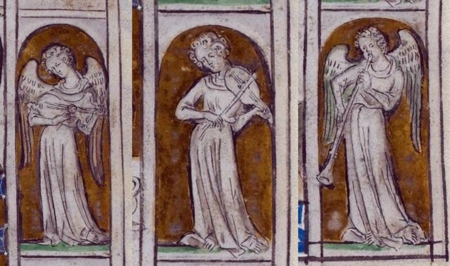
Fragments from the illuminated miniature «Marriage in Cana» from an 14th-century English manuscript—the «Psalter of Queen Mary» Unknown master, England, circa 1310–1320
In miniature book illustrations, the rules for spatial organization remain consistent, even as the setting becomes more conventional. In the «Marriage at Cana» from the «Psalter of Queen Mary, ” the table also unites the participants, while servants serve drinks; the space is further enriched by musicians positioned in specialized niches.
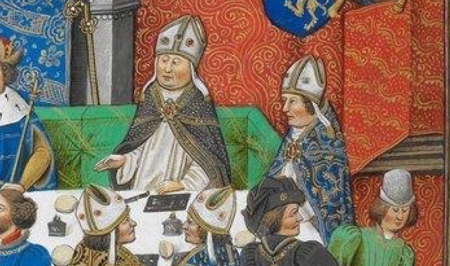
«The Royal Feast» — Queste du Saint Graal, France, early 14th century.
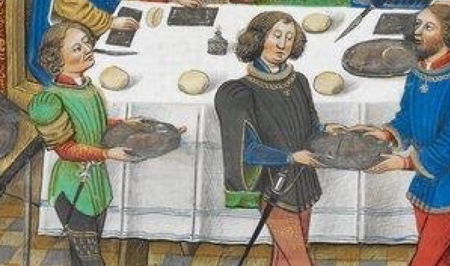
«The Wedding Feast» — Book of Regnault de Montauban, unknown author, France, 1300–1320.
In «The Royal Feast, ” the composition centers on the figures of the king and queen, while the presence of the harpist and the servants holding goblets underscores the ceremonial nature of the event. Where the Gospel narrative evokes a sense of miracle, the secular scenes demonstrate the feast as a social ceremony. In the novel Book of Regnault de Montauban („Feast in Honor of the Bride“), the space becomes more complex, featuring multiple tables, a musical gallery above, and servants moving back and forth—the distance from the bride and the seating arrangement of guests at different tables immediately establish a hierarchy.
Fragment from the illuminated manuscript «Feast in Honor of the Bride» — Book of Regnault de Montauban, unknown artist, France, 1300–1320.
Fragments from the book miniature «Feast in Honor of the Bride» — Book of Regnault de Montauban, unknown author, France, 1300–1320.
The domestic dimension of the feast is of particular interest in «Lattrell’s Psalter.» In the scene with Sir Geoffrey, the table space is strictly centered (the host in the middle, the family and monks on the sides), but the composition is supplemented by an image of the kitchen below, where a cook carves poultry and a piglet. This demonstrates that the space of the medieval feast was not confined to the banquet hall but also encompassed the preparation for the meal, allowing the viewer to witness the entire ritual.
«The Psalter of Lattrell, ” Sir Geoffrey Lattrell at a table, England, c. 1325–1335.
Fragment from the illuminated manuscript «Psalter of Lattrell,» Sir Geoffrey Lattrell at a table, England, c. 1325–1335.
3. The Figure of the Host