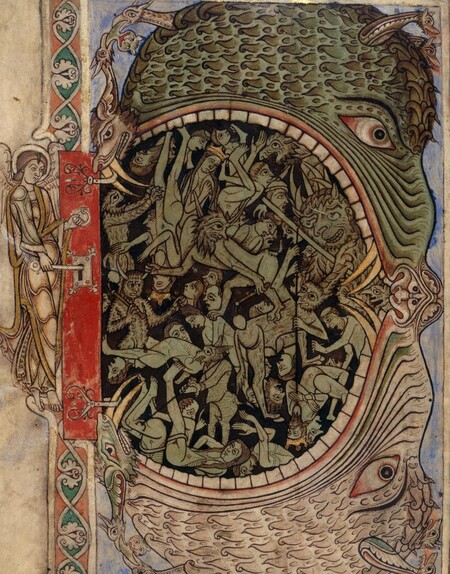
«…and everyone judged by their own deeds.»
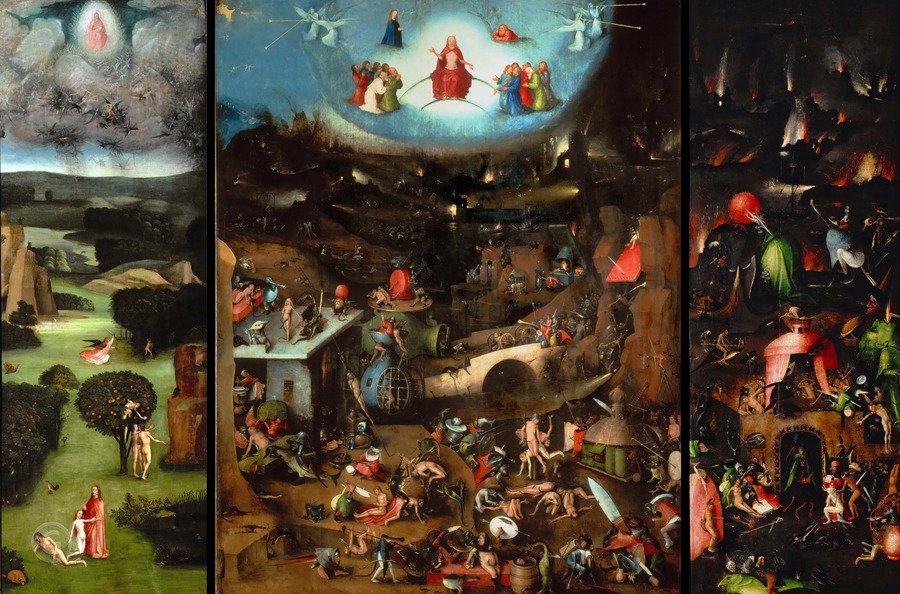
Hieronymus Bosch. Triptych «The Last Judgment.» 1490–1505.
Concept and Theme Selection
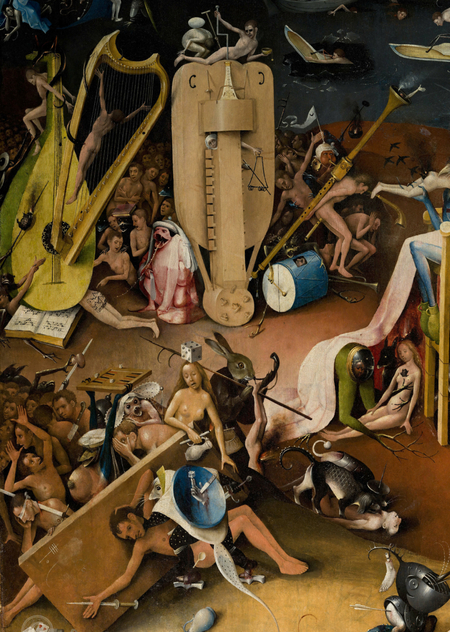
In the right panel of Hieronymus Bosch’s triptych, «The Garden of Earthly Delights, ” amidst numerous scenes of hellish torment, one can see a giant lute to which a human figure is tied to the neck. Nearby is a harp whose strings pass through the body of a sinner. Both instruments retain their recognizable form, yet their function has been altered—objects intended for making music are transformed into instruments of torture. A similar reimagining of familiar objects can be found in the Viennese „Last Judgment, ” where demons use kitchenware and blacksmithing tools to punish human figures.
«Who can describe all the strange and unusual ideas that arose in Hieronymus Bosch’s mind?»
These images served as the starting point for my investigation. I was fascinated by why ordinary objects hold such significant space in Bosch’s fantastic worlds. The artist’s hellish scenes are populated by hybrid creatures, feature unusual architectural structures, and depict events impossible in reality. Yet, the instruments of torment often resemble items an ordinary person might encounter in daily life. Because of this recognizability, even the most unusual actions of the demons retain a connection to the earthly world.
For this study, two triptychs were selected: «The Garden of Earthly Delights» (c. 1490–1500) from the Prado Museum collection and «The Last Judgment» (c. 1490–1505), held in the Academy of Fine Arts in Vienna. Both works share the theme of human sin and its consequences, yet they differ in their compositional structure. In «The Garden of Earthly Delights, ” the hell is situated on the right wing, sharply contrasting the bright space of the central panel. In „The Last Judgment, ” the punishments occupy almost the entire central composition and extend onto the right wing, forming a unified space of torment.
«As you sow, so shall you reap.»
Material selection is determined not only by thematic proximity of the works. In both triptychs, Bosch addresses objects that retain their external form but are used contrary to their original purpose. This allows for a comparison of specific modes of representation: scaling up, changing the object’s function, and transforming a human figure from an agent into an object of influence. The study examines musical instruments, cooking and eating implements, as well as tools of craft labor. These groups were selected because the corresponding scenes are sufficiently distinct and supported by museum and art historical descriptions.The primary focus is on the formal characteristics of the works: the arrangement of figures, the ratio of sizes, the constructive details of the objects, and the actions of the characters. Furthermore, the symbolic meaning of individual scenes is considered separately from their visual structure. Such a distinction is necessary because Bosch’s iconography allows for various interpretations, and directly correlating every object with a specific sin is not always possible.The key question of the study is: how does the alteration of scale, function, and manner of use of familiar objects shape the images of punishment in Bosch’s infernal scenes?
The research hypothesis is that Bosch portrays hellish torment through the disruption of familiar human relationships with everyday objects. In «The Garden of Earthly Delights» and «The Last Judgment, ” the artist alters the scale, function, and positioning of objects in relation to the human body. Musical instruments, kitchenware, and artisanal tools retain their recognizable form but are used for torture instead of their usual purposes. It is posited that it is the combination of an object’s external recognizability and its uncharacteristic use that becomes one way of creating the terrifying image of hell.
To test this hypothesis, the study is divided into three main sections. The first examines musical instruments whose unusual proportions alter the relationship between the object and the human figure. The second focuses on kitchen utensils and food processes, in which the human becomes an object of preparation or consumption. The third analyzes the use of artisan tools that transform the human body into material for processing.
This approach allows one to move from the most obvious visual technique—scaling an object—to more complex methods of altering its function. In the concluding section, the identified characteristics are compared to determine the unifying principle among the analyzed scenes.
The primary method of research is comparative visual analysis. Each example is examined within the context of the overall triptych composition before being analyzed through individual fragments. Special attention is paid to how specific details substantiate the research hypothesis.
Sources include the Prado Museum catalogs, materials from the Vienna Academy of Fine Arts, and iconographic studies of Bosch. Historical information helps establish the meaning of the subjects, but the features of the images themselves serve as the primary evidence for the hypothesis presented.
Thus, the objective of this work is to identify a single artistic principle: transforming an ordinary object into an instrument of torment by altering its relationship with the human being.
Scale Distortion: Musical Instruments in the «Garden of Earthly Delights»
Hieronymus Bosch. «The Garden of Earthly Delights.» c. 1490–1500
«In hell, the familiar order of the world is turned upside down.»
Hieronymus Bosch. «The Garden of Earthly Delights.» c. 1490–1500. Right panel. Fragment
The right wing of «The Garden of Earthly Delights» depicts a space of hell, where human figures surround demons, fantastic structures, and disproportionately large objects. In contrast to the central part of the triptych, where figures are freely positioned among animals and plants, most characters here are in constrained positions. People are found bound, pressed against objects, or confined within unusual constructions.
Hieronymus Bosch. «The Garden of Earthly Delights.» c. 1490–1500. Fragment
The most striking example of the changing relationship between humanity and object is found in the lower section of the composition, where musical instruments are concentrated. A large lute dominates a significant portion of the space. Its body and neck remain easily recognizable, yet the instrument’s dimensions vastly exceed human height. The nude figure is tethered to the neck, causing the human’s position relative to the object to completely transform. The lute can no longer be held by a musician; instead, the person becomes attached to its very structure.Nearby, a harp is depicted, its strings passing through the body of another human figure. Here, Bosch uses not only scaling but also the intrinsic features of the instrument’s design. The strings necessary for producing sound become part of the torment itself.
The difference between the two tools is significant. In the lute scene, the person is supported on the object’s surface, whereas in the harp scene, their body is directly intersected by the strings. In both cases, the artistic technique is based on maintaining the recognizable structure of the instrument while altering the manner of interaction with it.
This principle establishes a contradiction between the original purpose of the object and the action taking place. A musical instrument presupposes the active role of a performer who controls the sound through touch. In the hellish scene, the activity belongs to something other than the human: the instrument’s construction dictates the position of the body.
In Lindsay Cook’s study of medieval musical imagery, it is noted that this group of images reinterprets the associations between musical instruments and pleasant sound and harmony [3]. Furthermore, in Bosch’s paintings, such a reinterpretation occurs not only on a symbolic level but also directly through the composition.
Hieronymus Bosch. «Garden of Earthly Delights.» c. 1490–1500. Fragment
«…instruments that torture sinners who dedicated their time to worldly music.»
Another example is located nearby. A nude figure carries a massive wind instrument on its back. Its body is hunched under the weight of the object, whose size far exceeds the capacity of an ordinary musician.Unlike the lute and the harp, in this piece the person is not tied to the instrument, nor is it pierced by its parts. However, the sheer scale of the object makes the familiar act impossible. Instead of playing music, the figure is forced to bear the weight.Thus, Bosch proposes several ways to subvert established relationships with the musical instrument. It can constrain the person, directly wound them, or become an unbearable burden. All three images share the feature that the object retains its original form but acquires a contrary function.
Function Change: Kitchen Utensils and Food Processes
If the primary means of depicting punishment in musical scenes is the magnification of objects, Bosch, in imagery related to the preparation and consumption of food, more frequently preserves the recognizable character of the action itself. Primarily, the object is what changes.On the right panel of «The Garden of Earthly Delights, ” a large figure of a bird-headed demon sits on a high chair. The creature swallows naked human figures, which then fall into a vessel-like space situated beneath it.
Hieronymus Bosch. «The Garden of Earthly Delights.» c. 1490–1500. Fragment
The scene is constructed upon a stark contrast in the characters' scale. The demon occupies significantly more space than the human figures, resulting in the latter appearing commensurate with small objects of consumption. In contrast to depictions of torment using implements, the object directly inflicting pain is absent here. The familiar act of eating is transposed into the dynamic between the demon and the human. The person is placed in a position typically reserved for food. The Prado Museum primarily connects this scene with punishment for greed, rather than solely with gluttony [1]. Therefore, its meaning should not be reduced to a simple assertion that the sinner is punished for excessive eating. For the purposes of this study, the organization of the action itself is more important: the human is transformed into an object of consumption.
Hieronymus Bosch. «The Last Judgment.» c. 1490–1505. Fragment
In the Viennese «Last Judgment,» the reimagining of food processes takes on a more domestic form. In the left section of the central composition, a fully sinful figure is depicted being forced by demons to drink from a barrel. Above this figure is another figure engaged in extracting human bodies using a device resembling a press.
These scenes are unified by their placement within a single group of hellish punishments and the repetition of actions related to food and drink. In the first scene, a person is coerced into consuming a liquid; in the second, human bodies become the material from which this liquid is obtained.
These scenes are unified by their placement within a single group of hellish punishments and the repetition of actions related to food and drink. In the first scene, a person is coerced into consuming a liquid; in the second, human bodies become the material from which this liquid is obtained.