Concept
This paper examines how the youth of the USSR are depicted through various activities. We observe which spheres of life, based on the available resources to the successor, were most important to the young Soviet person.
The sixties—the height of the Thaw era.
Following the rigid Stalinist regime, which impacted many aspects of life, an era of greater sensitivity and attention to the individual dawns. The cult of personality surrounding Stalin is dismantled; changes in political life also affect numerous other spheres. The horrors of the Great Patriotic War have passed, and the time when a citizen, even if not performing feats for the Motherland, knew they must be ready to do so, is gradually fading. The fervor and heroism are gradually giving way to an interest in everyday life and in the individual as a person. The person is increasingly no longer viewed as a part of the system responsible for building communism. They look less and less like someone who should be stably, «mechanically» developing one industry or another. During this time, the person begins to be regarded as an individual with a spectrum of emotional experiences—a flexible, changeable personality.
Youth is viewed in the research as a symbol of the thaw era.
— She is the engine of change. Young people show a heightened interest in new ideas, new ways of thinking, and new ideologies. Their attention is also drawn to culture and the freedom of self-expression.
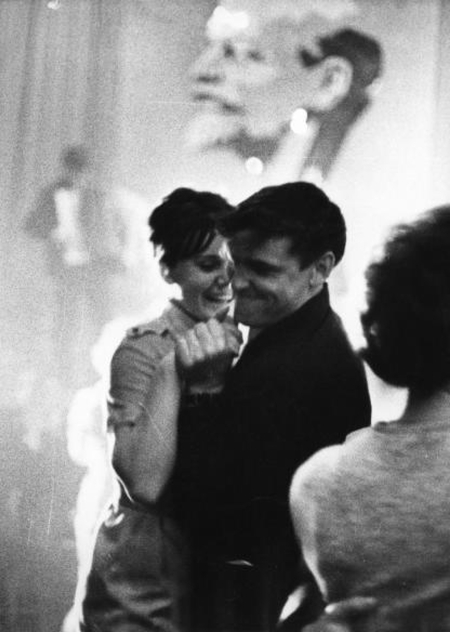
The objective of the research is to examine 1960s photographs as a reflection of the time, observing the differences between that era and earlier periods of history.
Additionally, since a photograph can be considered an imprint of what is interesting to the «average» contemporary, it is compelling to understand which areas of life were significant to the individual. Considering the social context, we wish to examine how much of the propaganda system inherent to the Soviet regime was present in the 1960s and how much it receded with the advent of a new era.
A further objective of this research is to analyze the specific purpose of each type of photograph.
If a photograph is considered a propaganda tool, it is important to determine precisely which techniques and through what lens the agitation is taking place. If, conversely, the photograph clearly diverges from works produced during the Stalinist era, the interest lies in examining what constitutes that difference—why it manifests, and what it suggests about the prevailing societal mood of that time. Regarding the research hypothesis, the following idea is posited. It can be assumed that despite transformations in numerous aspects of social life and evolving views on the individual as a person, certain characteristics inherent to the Stalinist regime will not disappear entirely or will change only minimally.
Community Life
Dmitry Baltermants. VI World Festival of Youth and Students in Moscow, 1957
As is well known, propaganda has been prevalent throughout the Soviet Union. This applied to the promotion of active political life. Works of art also served as instruments of propaganda, meaning that photography became not only a historical document capturing the surrounding reality for future generations but also a disseminator of ideas about the ideal citizen. The emotions displayed in photographs—vivid and joyous—were perfect for inspiring people to resemble the heroes in those images.
Evgeny Umnov. VI World Festival of Youth and Students in Moscow, 1957
«Contact with citizens in the field was supposed to be achieved by improving work with authorial assets, strengthening ties with workers and rural correspondents, and publishing reports on workers' meetings […]» (Ponomaryova, 2019, 72)
Allsvolod Tarasevich. Students at the demonstration, 1963–1964
Student Life
The university was considered the forge of Marxist-Leninist thought and a place where individuals continue to be shaped as citizens. Furthermore, the university symbolized scientific progress—a place where those who would further develop the country from an industrialization perspective were educated. However, since the focus is on the Thaw period, the student as an individual and their daily life are equally important: a close-up is used, depicting scenes from everyday life.
Allsvolod Tarasevich. In the studio, 1963–1964
Allsvolod Tarasevich. Admission to the Komsomol, 1963–1969
Vladimir Lagrange. Moscow State University Dormitory, 1963–1964
All-Volod Tarasevich. In the studio, 1963–1964
Evgeny Khaldey. MSU. Students in a classroom, 1960s
Vsevolod Tarasevich. Pioneer Leader, 1965
Vsevolod Tarasevich. «At the Lecture (Zubras)» from the «Moscow University» series, 1963.
Sports
Lev Borodulin. Swallow, 1960
Sports were also an important component of the Soviet person’s life and were clearly promoted. However, during the Thaw, the representation of sport transitioned from bombastic heroic glorification to an artistic contemplation of the athlete. Photographs illustrate the mass appeal and aestheticization of sports.
Lev Borodulin. Bicycle Race, 1964
V.I. Lenin Central Stadium («Luzhniki»). Physical Education classes in the «Health» group, 1966