Concept
A Gothic stained glass window unites two modes of perception that appear contradictory at first glance. On one hand, it presents an image containing characters, symbols, and sequences of narrative scenes. On the other, the window is an integral part of the architecture, often placed at a height that prevents the viewer from closely examining all the compositional elements.
This contradiction becomes the starting point for the research. If the window is intended to convey specific content, why are some images so small and distant from the viewer? How does the perception of the work change when, instead of viewing individual characters, the person primarily perceives geometric structures, blocks of color, and light passing through the glass?
Hypothesis: Gothic stained glass exists simultaneously as a narrative image and as a cohesive visual structure. Geometry, color, and scale determine which elements the viewer can discern from a specific distance, and the window’s architectural placement influences the relationship between these modes of perception.
1. Scale and Distance
1.1. Narrative Stained Glass
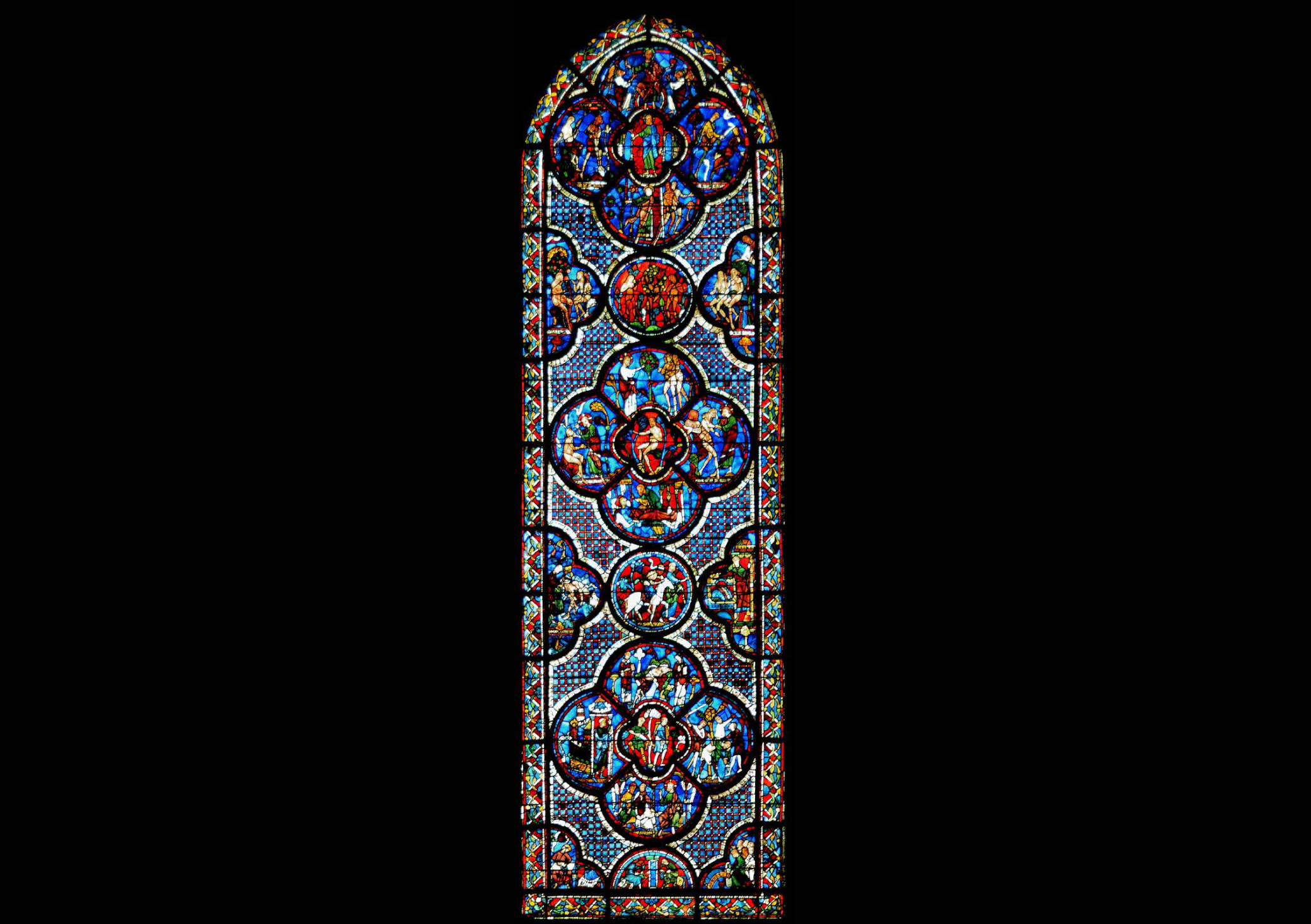
Unknown masters. «The Parable of the Good Samaritan.» Circa 1205–1215. Chartres Cathedral, France. Stained glass, painted decoration, lead binding.
The stained glass composition is made up of multiple small narrative scenes enclosed within geometric frames. Each scene depicts a distinct action, and all the images coalesce into a complex narrative structure. When viewing the window as a whole, the spectator first perceives the repeating forms and the overall color organization. To discern the individual scenes, one must approach the image closely or examine an enlarged section. This creates two levels of perception: the unified geometric structure and the separate narrative scenes.
1.2. Enlarging a specific medallion
Unknown Masters. Fragment of the stained glass window, «The Parable of the Good Samaritan.» Circa 1205–1215. Chartres Cathedral, France.
As the image enlarges, individual characters, their gestures, and objects become discernible. These elements are what allow one to determine the depicted event. The geometric frame confines the scene’s space. The figures are placed compactly, and their movements adhere to the small format of a medallion. Thus, the narrative function of a stained-glass window depends on the ability to distinguish fine details. As the image shrinks, the narrative information gradually gives way to the overall compositional rhythm.
1.3. Monumental Figure
Unknown masters. Stained glass of the upper tier of Chartres Cathedral. Early thirteenth century. France.
Unlike medallion stained glass, large figures occupy most of the window surface here.Their composition is built upon expressive silhouette, the vertical positioning of the body, and a limited number of large elements.These images can be perceived from a greater distance, as discerning the overall figure does not require examining numerous small scenes.
1.4. Window Placement in Architecture
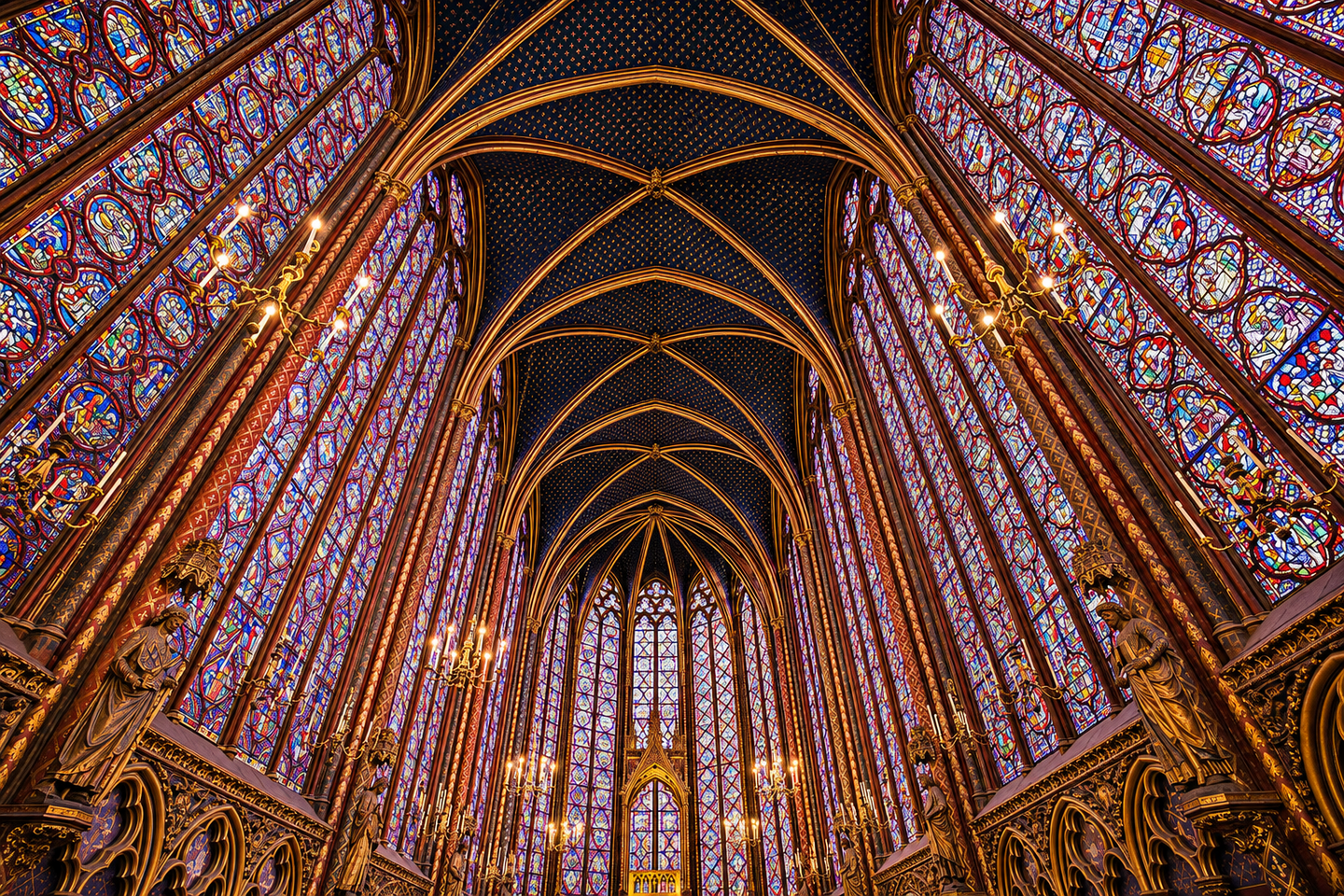
Chartres Cathedral. Interior with stained glass on the lower and upper levels. 12th–13th centuries. Chartres, France.
Comparing the lower and upper windows reveals that compositional differences are linked to the architectural placement of the stained glass. The lower windows are situated closer to the viewer and often feature small narrative scenes. The upper windows are placed at a significant height, so they frequently use larger images. However, the relationship between height and scale is not absolute. Complex compositions can appear high up, so this is a trend, not a strict rule.
2. Narrative Geometry
2.1. Overall Window Structure
Unknown Masters. «The Parable of the Good Samaritan.» c. 1205–1215. Chartres Cathedral, France. General view.
The composition is built upon the repetition of geometric frames. Within these frames are independent scenes, and between them are small decorative fields. When viewing the entire window, the structure becomes apparent first, rather than individual events. Large four-petaled forms and smaller medallions establish a rhythm that repeats throughout the height of the stained glass. This means that geometry serves two purposes: it separates individual images while simultaneously unifying them into a single system.
2.2. The Medallion as a Self-Contained Scene
Unknown Masters. Fragment of the medallion composition from the stained glass window «The Parable of the Good Samaritan.» Early 13th century. Chartres Cathedral.
The medallion functions as a boundary for a single event. Its form separates one scene from another, preventing the images from visually merging.
However, the characters within the medallion are bound by its geometry. Since the composition must fit into a limited space, the artists employ compact arrangements of figures, expressive gestures, and a condensed representation of the surrounding environment.
It is interesting that the frame’s form is repeated even as the scene’s content changes. This creates a juxtaposition of the permanent and the transient: the geometry remains stable while the narrative develops.
2.3. How to Read History
Unknown Masters. «The Parable of the Good Samaritan.» Circa 1205–1215. Chartres Cathedral, France. General view.
Unlike a modern webpage, a stained-glass window does not require reading exclusively from top-to-bottom and left-to-right.
In Chartres, narrative windows are typically read from the lower scenes to the upper scenes, with transitions between adjacent panels. The specific viewing path depends on the placement of the medallions and the iconographic program.
Therefore, to understand the stained glass, it is necessary not only to examine the images but also to establish their sequence.
Here, the geometry serves another function: the arrangement of the medallions helps organize the transitions between episodes, although the narrative itself is determined by the depicted actions and knowledge of biblical text.
2.4. Two Narratives in One Stained Glass Window
Unknown Masters. Scenes of the Creation and Fall of Man. Circa 1205–1215. Upper narrative section of the «Parable of the Good Samaritan» stained glass window. Chartres Cathedral.
The stained glass merges the New Testament parable of the Good Samaritan with Old Testament scenes relating to the story of Adam and Eve.The meaning of this composition cannot be explained by the sequence of events alone. The two narratives originate from different parts of the Bible but are placed within a single structure.Their connection is rooted in typology—the interpretation where Old Testament events correlate with the New Testament history of salvation.Thus, the geometric organization serves not only to tell a story but also to juxtapose events separated by biblical time.