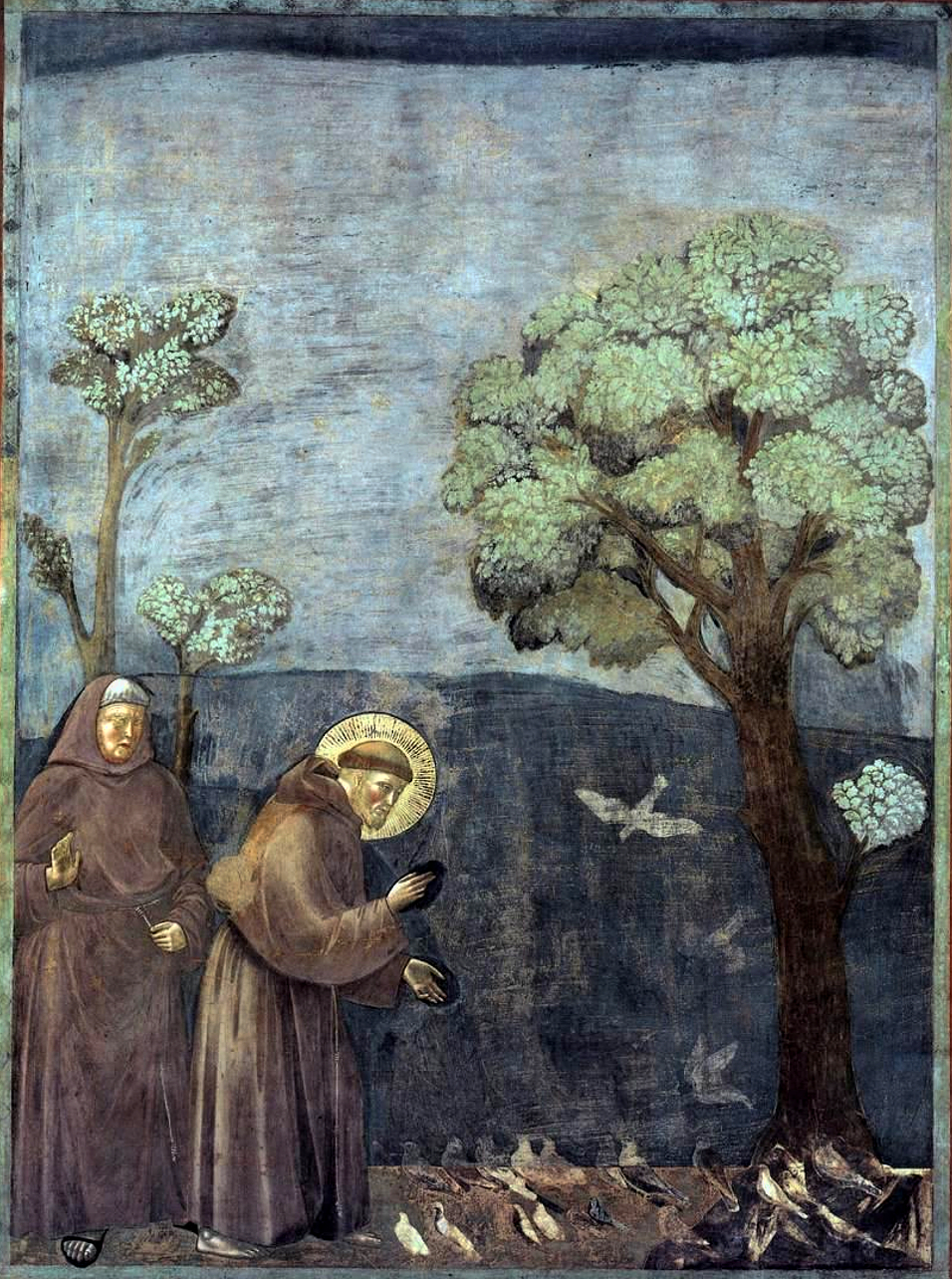
The image of the bird is extremely important in many European cultures, functioning as both a religious and philosophical symbol. Since ancient times, birds have occupied the human imagination, existing as both terrestrial and aerial creatures, which led to them being endowed with numerous, almost mystical qualities. In European theistic art spanning from early Christianity to the 14th century, depictions of birds are found in a wide variety of artistic forms: mosaics, frescoes, sculpture, liturgical objects, textiles, and illuminated manuscripts. Traditionally, the bird, as a generalized motif, is interpreted as freedom, spirituality, immortality, and divinity; however, in religious art, the specific meaning of the symbol depends on the species of the depicted bird and the surrounding context. For instance, the dove most often becomes a symbol of the Holy Spirit and divine presence, the peacock is associated with resurrection and eternal life, the phoenix with rebirth, and the pelican with sacrifice, love, and atonement; the eagle, in turn, is linked to spiritual elevation, divine knowledge, and the figure of the evangelist John. Many of these concepts existed even before the spread of Christianity, building upon pre-existing cultural associations with these animals. With the development of Christian culture, familiar symbols acquired new meanings, becoming an integral part of religious tradition.
The objective of this visual study is to examine the symbolic significance of various birds in European religious imagery before the 14th century, as well as to identify the reasons and characteristics behind the use of these motifs. In my visual investigation, I hypothesize that the depiction of birds in European theistic art before the 14th century was not arbitrary. They functioned as a medium for conveying religious ideas, and their symbolic meanings were shaped by the influence of ancient concepts and the Christian worldview. When studying this topic, attention is paid to their iconographic meanings, historical origins, visual characteristics, and role within the artwork, since the bird did not always serve merely as an abstract symbol: its image could point to a specific religious narrative, denote the presence of a divine principle, or complement the work’s semantic structure. I have identified several primary avian motifs possessing stable symbolic meanings. Examining them will allow for a more detailed study of the origin, development, and specific uses of bird symbolism in European theistic art.
Dove
The dove appears in the story of the Great Flood when Noah releases it to see if the water has receded. The bird returns with an olive branch, and from that moment on, the image begins to feature in the representation of the global world. However, the dove here also serves as a mediator between humanity and God: it brings the news that the catastrophe has ended and that new life is possible. This narrative has numerous illustrations in Christian art; in these depictions, the dove acts as one of the protagonists while simultaneously foreshadowing the establishment of the image.
However, the dove is not only a messenger between humanity and God, but it can also embody the Holy Spirit itself. In the mosaic «The Annunciations to the Virgin Mary and to St. Joseph, ” a dove—an embodiment of the Holy Spirit—is depicted above the figure of Mary. The Gospel of Luke states that the Holy Spirit will descend upon Mary and the power of the Almighty will overshadow her. The image of the dove allows the artist to materialize an invisible divine action.
Another depiction of the dove as the Holy Spirit can be found on the mosaic «The Baptism of Jesus, ” located in the Arian Baptistery. This image illustrates the narrative from Matthew 3:13–17, in which Jesus is baptized. On the mosaic, a soaring dove is depicted above the figures: the bird is positioned directly above Christ and serves as a visual testament to the divine presence. The compositional structure itself is significant: Christ is in the water, John the Baptist touches his head, and the dove connects the earthly action with the heavenly source of grace.
A dove serves a similar purpose in the image from the Gospel of Trapezus, folio W.531.59V. The Holy Spirit is depicted as a dove descending over Christ. Angels wait nearby for the baptism to be completed, and the personification of the Jordan River is shown in the lower part of the composition.
Peacock
If the dove is primarily associated with the presence of the Holy Spirit, divine revelation, peace, and salvation, then in early Christian culture, the peacock primarily becomes a symbol of immortality, resurrection, and incorruptibility. Its symbolism, however, has deep pre-Christian roots. In ancient culture, the peacock was associated with the goddess Hera (Juno), royalty, beauty, and luxury. There was also a belief that peacock meat did not decompose. It was this last myth that proved particularly important for the Christian interpretation of the bird.
«Two Peacocks by a Kantharos» is one of the earliest and most illustrative examples of the peacock’s use in early Christian funerary art. In a hypogeum on the Via Latina, two peacocks are depicted drinking from a kantharos—an ancient two-handled vase. Above them is an image of Tellus, the personification of Earth. It is particularly interesting that the motif of two peacocks by a vessel existed even in pre-Christian art. It appeared in ancient funerary painting and decorative compositions connected to ideas of fertility and the afterlife. The Christian tradition reinterprets this image: the peacock begins to be associated with immortality precisely because of the widespread ancient belief in the incorruptibility of its flesh. St. Augustine also mentioned this belief in his work, City of God.
The sarcophagus of Archbishop Theodore presents an especially fine example of combining the image of a peacock with the central symbol of Christianity—the Christogram. On the front side of the sarcophagus is the Christogram—a monogram of the name of Christ enclosed in a medallion. The side panels feature peacocks, grapevines, and bunches of grapes. Here, the peacock ceases to be merely a decorative element of a heavenly garden. Its presence in close proximity to the Christogram allows it to be interpreted as a sign of immortality, which Christian tradition associates with Christ.
Peacocks, due to their association with immortality, frequently appear in settings related to burial. However, this is not a strict rule; sometimes the peacock can also function as a symbol of exquisite divine creation—its plumage and spread tail become a visual expression of the beauty of the created world. The bird is incorporated into the imagery of a paradise setting, where nature exists in harmony with the divine order.
Eagle
The eagle is rarely referenced in the context of Christian culture, yet it is an image as significant as the dove—it is associated not only with immortality and salvation but also with the ascension, spiritual sight, divine wisdom, the Gospel word, and the image of Christ.
The Lindisfarne Gospels, from which this illustration is taken, are one of the most important artifacts of early medieval insular art. The manuscript was created by the monk Eadfrith in the early 8th century and stands as a remarkable example of the interplay between Christian book culture and Anglo-Saxon, Celtic, and Mediterranean artistic traditions.
The eagle in Christian iconography is associated with the evangelist John. This tradition traces back to the vision of four living creatures in the book of the prophet Ezekiel (Ezek. 1:5–10) and the Book of Revelation (Rev. 4:6–8). Four creatures—man, lion, ox, and eagle—eventually became associated with the four evangelists. The eagle became linked to John because his Gospel begins with the sublime phrase, «In the beginning was the Word.» In medieval interpretation, the eagle is capable of flying higher than other birds and looking directly at the sun. This became a metaphor for John’s ability to see into the depths of divine truth.
Thus, the eagle often appears near John, sometimes serving as a metaphor for the theologian’s elevated discourse.
However, the eagle appears independently as well. I have mentioned that in medieval bestiaries, the eagle was attributed the ability to look directly at the sun without damaging its sight. This story received a Christian allegorical interpretation. The sun began to be understood as an image of Christ or divine truth, and the eagle’s ability to look at it represented the capacity of a spiritually prepared person to perceive divine glory. Thus, the eagle became a high symbol.