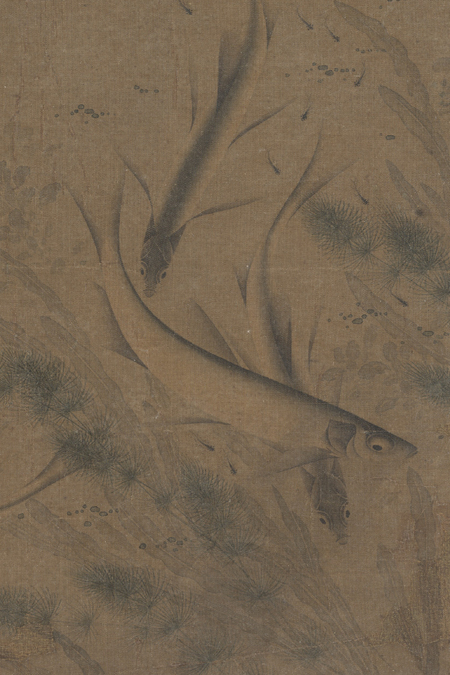
Invisible water is a technique in Chinese art from the 12th to 14th centuries where the aquatic environment is conveyed not through depictions of waves, shores, or colored backgrounds, but through indirect signs: fish, algae, lotus blossoms, and the texture of the material.
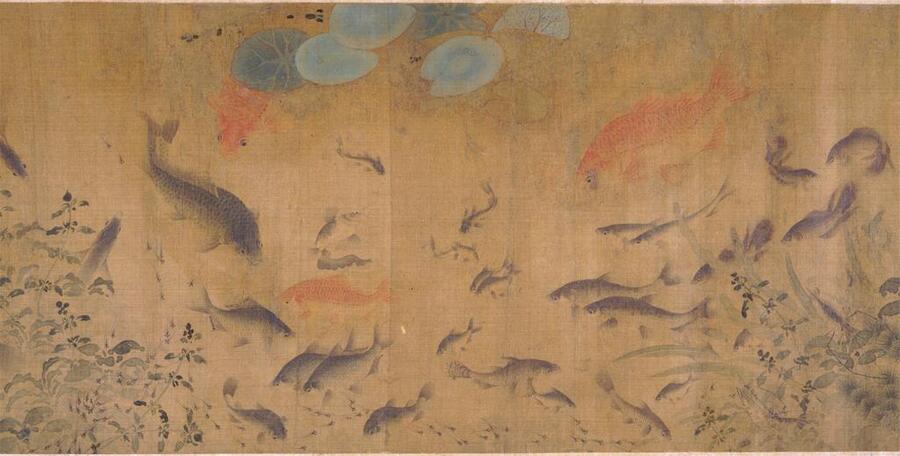
Liu Zai (attributed), «Fish Swimming Among Falling Flowers» (12th Century), fragment with a goldfish. Saint Louis Art Museum. Reproduction: Wikimedia Commons, public domain.
Navigation
Concept — Rationale for Topic Selection — Material Selection Criteria — Research Structure — Source Work — Research Question and Hypothesis Main Body — Chapter 1. Emptiness as Water. Song Dynasty Painting, 12th–13th Centuries — Chapter 2. Glaze as Water. Lunцюan Ceramics, 13th–14th Centuries — Chapter 3. Seaweed as a Symbol of Water. Yuan Porcelain, 14th Century Conclusion Bibliography Image Source List
Rationale for Topic Selection
In Chinese depictions of fish, the aquatic environment is typically unrendered—lacking waves, a shoreline, or a colored background. Nevertheless, the viewer can invariably perceive that the fish are swimming. This contradiction—between the absence of an image of water and the obviousness of its presence—is the subject of this study. The technique of signifying an environment through the objects contained within it is described in contemporary design using the concept of negative space; in Chinese art of the 12th–14th centuries, it existed long before this term emerged and was consistently applied across several media. The interest in this topic stems from the ability to trace a single visual principle across painting, ceramics, and painted porcelain without resorting to the analysis of Chinese texts: the research relies on formal characteristics and museum descriptions.
Material Selection Criteria
The first principle is narrative unity: the selection includes only works depicting fish in a pond. The second principle is the comparability of forms: the scroll is presented whole and in fragments, the bowl shows a general view and macro-fragments of the relief, while the jar and plate display a general view and a fragment of the painting. The third principle is the relevance of each fragment: every illustrative element answers the question of how the aquatic environment is conveyed. The chronological boundaries are the 12th–14th centuries, the Song and Yuan dynasties. A mandatory condition is the absence of a direct depiction of water: items featuring drawn waves, shorelines, or colored water backgrounds are excluded from the selection.
Research Structure
The structure of the work reflects a progression from painting to object, corresponding to three modes of environmental representation: Song dynasty fish paintings—void as water (12th–13th centuries); Lunцюань ceramics—glaze as water (13th–14th centuries); Yuan blue-and-white porcelain—environmental signs and cobalt tonal gradation as water (14th century). Each chapter is dedicated to one mode; the conclusion summarizes the three modes in a comparative table and formulates a general conclusion.
Working with Sources
The first principle is prioritizing museum descriptions: dates, attributions, titles, and materials are listed according to museum collection cards; the phrasing «attributed to» is maintained where specified by the museum. The second principle is verifying every assertion that goes beyond reference data and personal observations using two independent sources. Symbolic meanings of motifs are provided only with a source citation and are not subject to independent interpretation; puns based on Chinese homophones are not analyzed in the work. Quotes are presented in quotation marks with a footnote according to GOST standards; paraphrasing original ideas must be accompanied by a citation; reference data for sources are not required.
Research Question and Hypothesis
Core research question: How is the aquatic environment conveyed in Chinese art from the 12th to the 14th centuries without being depicted directly? The hypothesis posits that invisible water functions as a deliberate visual device, rather than a consequence of technical limitations or happenstance. In the three media under review, the environment is formed by a collection of indirect indicators—negative space, the thickness of the glaze over the relief, environmental signs, and tonal gradation—and is completed by the viewer. The consistency of this principle across varied materials allows us to identify a unified visual logic traceable over three centuries.
Chapter 1. Void as Water
The history of invisible water begins in painting. In Song dynasty scrolls, fish are depicted on silk that illustrates nothing—no waves, no shores, no seabed. The environment is absent as an image—yet it is present as an effect.
Sun painting of fish exists in two formats. The horizontal scroll unrolls from right to left in small segments: the viewer does not see the composition all at once. The album sheet, conversely, is designed for close and prolonged examination. Both formats are used in the chapter: the scroll is shown in full and in fragments, while the sheet is shown whole.
Liu Cai (attributed), «Fish Swimming Among Falling Flowers» (12th Century). St. Louis Art Museum.
The scroll is unrolled from right to left, so the fragments below are presented in the viewing order: from the blooming branch to the large fish. The horizontal format adds a sense of time: the fish appear in groups, and the pauses between them function like a current.
Liu Cai (attributed), «Fish Swimming Amidst Falling Flowers» (12th Century). Saint Louis Art Museum. Fragment 1.
Petals drift down from above: the water surface remains outside the frame. The viewer’s perspective is underwater. A school of slender fish dictates the current’s direction; their elongated bodies are angled diagonally, and the space between them suggests the movement of water. A flowering branch enters the frame from the upper right—like the pond’s surface, visible from beneath the water. (see Fragment 1)
Liu Zai (attributed), «Fish Swimming Among Falling Flowers» (12th century). St. Louis Art Museum. Fragment 2.
At the center of the fragment is unrippled silk, devoid of shores or colored background: the water is conveyed through the emptiness between the fish. The lotus leaves along the upper edge function as a secondary indicator of the surface—they are floating on top, meaning the water ends above them. (See Fragment 2)
Liu Cai (attributed), «Fish Swimming Among Falling Flowers» (12th century). St. Louis Art Museum. Fragment 3.
The larger fish are rendered darker and sharper, while the smaller ones are lighter and more diffused. The difference in size and tone replaces linear perspective: dark and large reads as close, light and small as distant. Depth emerges without a horizon line. (see Fragment 3)
Luo Tsai (attributed), «Fish Swimming Amidst Falling Flowers» (12th century). Saint Louis Art Museum. Fragment 4.
The bodies of the large fish overlap each other: where one body recedes behind another, a sense of volume is created. The red stamps on the left are collector’s marks from a later time; they are not part of the original composition. (See Fragment 4)
Water is not depicted directly in any segment. It is assembled from four elements: void, scale and tone, overlap, and surface markers—the petals and leaves of the lotus.
Zhao Kesun (attributed), «Playing Fish» (12th–late 13th century). The Metropolitan Museum of Art.
The album sheet employs the same technique: the fish are gathered into a group, and the background is left unfilled. The smaller format shifts the scale of perception—the void functions not as a distance, but as the immediate environment surrounding the fish. The two formats, unified by this principle, confirm that this is a robust visual solution.