Grounded intellect ascends to truth through the material, and seeing this light, it is resurrected from previous torpor.
Suger, Abbey of Saint-Denis. Inscription on the bronze gates of the basilica, circa 1140.
Why this topic
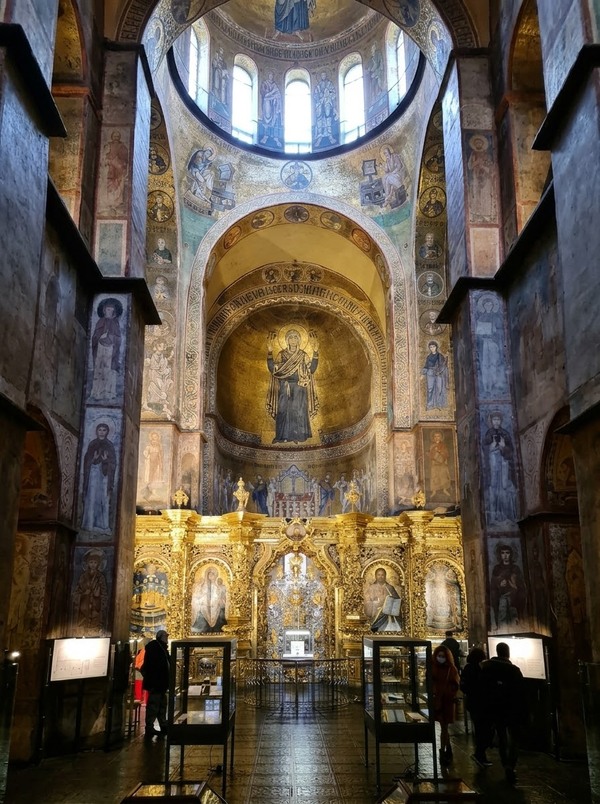
The theme arose from a simple observation. In St. Sophia’s Cathedral in Kyiv and in the Gothic cathedrals of France, the same images appear: the Theotokos, the Annunciation, Christ in Glory. The narratives are recognizable, and the iconography is almost identical, yet they are experienced differently. In Kyiv, the mosaic responds to light itself: the gold tesserae catch the rays and reflect them, causing the image to function as a radiant surface. In Saint-Denis and Chartres, everything is different: the image only exists while the sun shines through it, and the viewer stands not before the image, but inside the colored light. It struck me that this distinction was not invented by historians, but was built into the material itself. Smalti reflects; glass transmits. This accounts for the difference in experience: in one case, we observe the radiance; in the other, we bathe within it. This is an exploration of how technique transforms into a mode of seeing.
Selection and Categorization Principles
Principle of Material Selection. The work incorporates three figures present in both ensembles: the Mother of God, the Annunciation, and Christ. The Kyiv line is represented by Sophia of Kyiv: the foundation date of 1037 according to the chronicles, and the mosaics were completed by invited Byzantine masters in the 1030s and 1040s. The French line is led by the Basilica of Saint-Denis, where, by the commission of Abbot Suger around 1144, the first Gothic choir with a stained-glass window program appeared, and the Cathedral of Chartres, where the most complete stained-glass ensemble in Europe took shape after the fire of 1194.
Key Question and Hypothesis
The central question of the research is this: what happens to the same sacred image when the physics of its luminescence changes? The hypothesis is that the image remains the same, but the manner of its luminescence changes radically. In a mosaic, the image itself reflects light, and the viewer looks at it as a self-illuminated surface. In a stained-glass window, the image only exists while light passes through it, and the viewer finds themselves inside that light, enveloped by color. This can be tested visually by comparing the material (smalti and colored glass), the placement of the image relative to the light sources, and the position of the viewer. This is precisely what the visual narrative of the work addresses. If the hypothesis is correct, the difference in techniques must correspond to a difference in the experience of the image: contemplating a surface versus being immersed in light.
Navigation
I. Concept and Theme Selection II. The Theotokos: The Orant and the Prespas Window III. The Annunciation: Dialogue by the Arch and Light Through Glass IV. Christ: The Pantocrator and the Analogous Window V. Conclusion VI. Bibliography and Image Sources
The Theotokos: Orant and the Splendid Window
In Kyiv, this is the Oranta, the «Immovable Wall, ” located in the apse’s main conch of St. Sophia. In Chartres, it is the famous „Beautiful Window, ” depicting the Virgin Mary and Child enthroned. Both figures are frontal and monumental, and both reside in the most illuminated spaces of their respective churches. However, one glows intrinsically, while the other is made visible by the sun. Let’s explore exactly how.
«The Immovable Wall»
A surface that responds to light
The Oranta stands in the concave shell of the apse, the figure measuring about 5.5 meters high. Her arms are raised, and her gaze is directed toward Christ in the dome: Mary prays for humanity, and for centuries, the inhabitants of Kyiv called this mosaic the «Immovable Wall.» The primary material here is gold. The gold smalt tesserae are arranged ingeniously: the finest gold foil is sealed between two layers of glass. The masters pressed the tesserae into wet plaster at various angles, which is why the background does not shine uniformly but shimmers—each tessera captures a ray of light at its own moment. The palette of the mosaics of Sophia includes 177 shades, 25 of which are gold tones.
Among enamels, gold is the most luminous material, as it transforms into a light source itself when it shimmers.