Concept
Core Concept of this research is to trace how perceptions of female beauty in China evolved from ancient times through the 14th century and how these changes were reflected in women’s costumes, hairstyles, and artistic representations.
The focus is on the female silhouette as a reflection of the aesthetic ideals, cultural traditions, and societal views of its era. The study examines not only the characteristics of a woman’s appearance but also how clothing shaped body proportions and created a specific visual image.
Visual Concept is based on a systematic comparison of images of women from different periods. The primary analytical tools include figure proportions, clothing volume, waistline, sleeve shape, garment length, hairstyles, and decorative elements.
Research Objective — to trace the evolution of the female silhouette and the aesthetic ideal of beauty in China up to the 14th century, identify the main characteristics of each historical period, and determine how artistic representations reflected societal perceptions of femininity.
Textual sources for the research were selected based on the principles of historical accuracy, thematic relevance, and chronological sequence. Primary focus was placed on scholarly publications, museum materials, and studies dedicated to the history of Chinese costume, aesthetic conceptions of female beauty, and the visual arts of China prior to the 14th century.
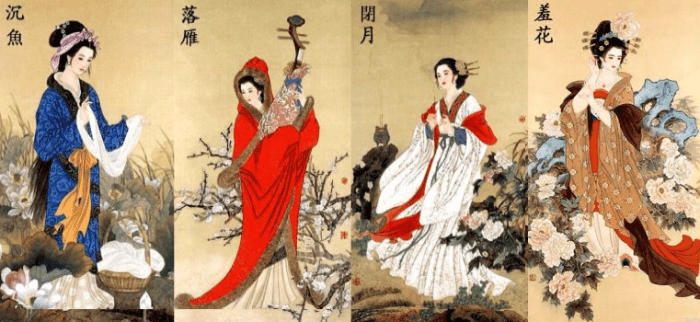
Четыре великие красавицы Китая: Сиши, Ван Чжаоцзюнь, Дяочань и Ян Гуйфэй. (Public Domain)
Портрет поэтессы Ду Цюньян времён династии Тан. (Public Domain)
Source selection is aimed at creating a coherent and well-substantiated study, where historical information is augmented by the analysis of visual materials.
Chapter I. The Formation of the Female Silhouette: From Antiquity to the 6th Century
Question for the Chapter: How was the concept of female beauty formed in ancient China, and what role did clothing play in creating the female silhouette?
1.1 The Female Image in Ancient China: Beauty as a Reflection of Social Status
In early Chinese culture, the female image was shaped by concepts of order, domestic responsibilities, and social status. Confucian ideas about feminine virtue, modesty, and adherence to social norms played a significant role. The visual depiction of women in art was not always tied to showcasing physical attributes. On the contrary, clothing often obscured natural body contours, creating a vertical, elongated silhouette.
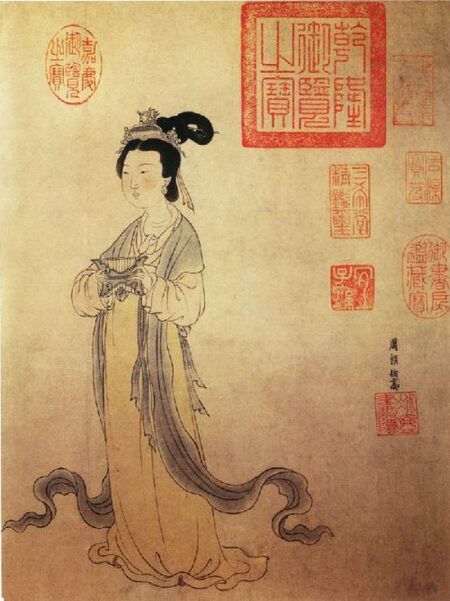
Gu Kaizhi, «Instructions of the Court Advisor» (Fragment), 4th–5th Century
Long robes, wide sleeves, and loose fabric lines created a sense of calm and restraint. Consequently, femininity was conveyed primarily through posture, hand placement, clothing, and hairstyle. Burial figurines are especially important resources for studying the female image, as they allow us to see what the clothing and hairstyles of women from different social groups might have looked like.
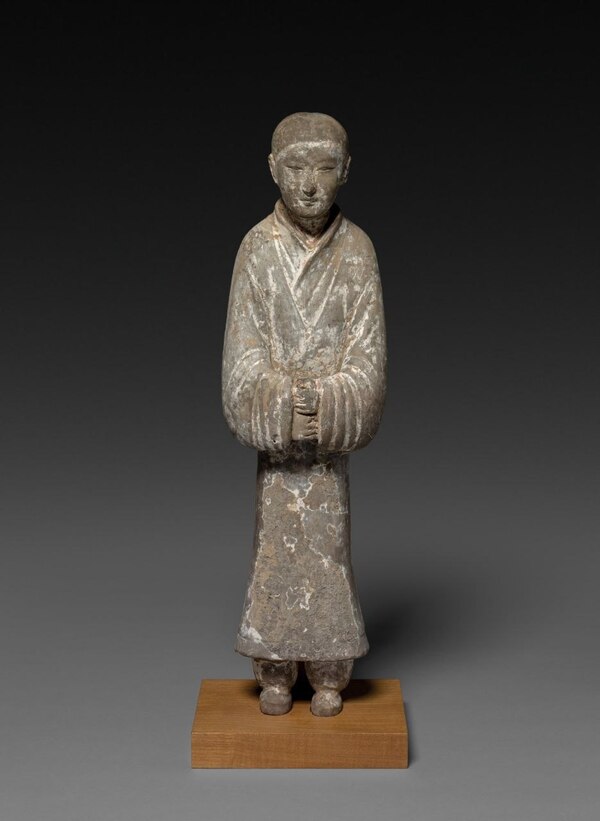
Female Attendant (Tomb Figurine) Western Han, 2nd–1st century BCE
1.2. Clothing as the Foundation of the Feminine Silhouette
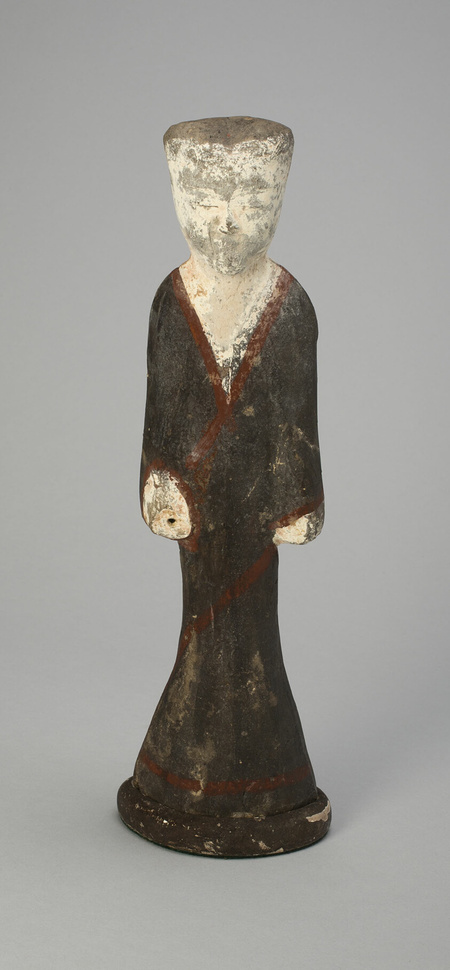
During the Han Dynasty, clothing became a paramount element of a woman’s outward appearance. One characteristic type of traditional costume was the wrap garment, where the front panels of the fabric crossed over the chest.
The visual perception of this costume was based on vertical lines and the loose drape of the fabric. While a sash might accentuate the waistline, the overall silhouette remained relatively modest.
The clothing served not so much to display the figure’s contours as to construct a unified image. The quality of the fabric, the color, decorative elements, and the costume’s congruence with the woman’s social status held great significance.
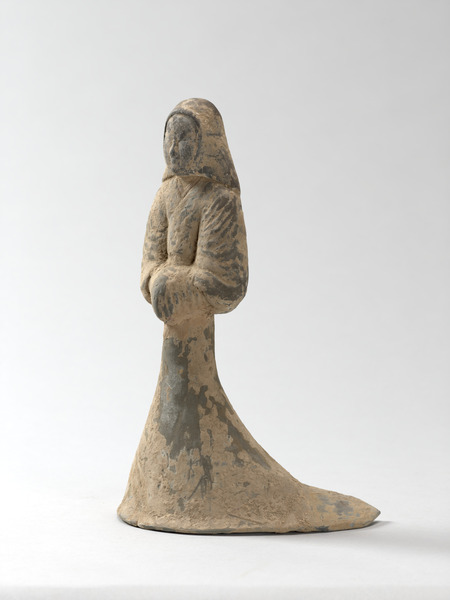
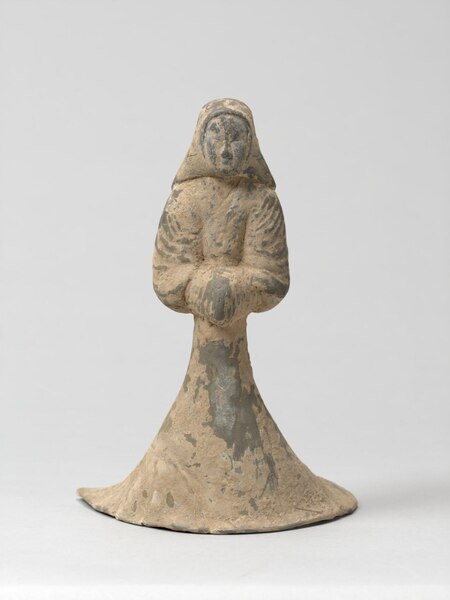
Figurine of Standing Woman in Gray Earthenware. Han Dynasty
1.3. The Female Image During the Six Dynasties Period: The Influence of New Cultural Traditions
Following the fall of the Han Dynasty, China endured a prolonged period of political fragmentation. Between 220 and 589 CE, various states existed, population migrations occurred, and Chinese culture actively interacted with cultures from Central Asia.
These processes were also reflected in the art. Female figures gradually became more diverse. The visual culture incorporated both traditional Chinese forms of dress and elements related to cultural exchange with other peoples.
During this period, Buddhist art gained significant importance. Female figures appear in religious imagery as well as in funerary sculpture. However, it is necessary to distinguish between representations of real women, idealized figures, and religious characters.
Painting of Three Nuns, 892
Summary
In ancient China, the female silhouette was primarily shaped by clothing rather than by emphasizing the natural proportions of the body. Female beauty, meanwhile, was closely linked to social status, notions of virtue, and societal norms. Funerary sculptures and religious paintings demonstrate that there was no single visual standard.
In response to the question posed at the beginning of the chapter, I can state that in ancient China, the concept of female beauty was shaped by a combination of social role and cultural norms. The silhouette served not so much as a means of displaying the body as it did as a medium for expressing status, restraint, and belonging to a specific social stratum.
Chapter II. The Tang Dynasty: The Flourishing of the Voluminous Feminine Silhouette (618–907)
Chapter Question: Why did a voluptuous figure become the ideal of female beauty during the Tang Dynasty, and how did this influence the visual image of Chinese women?
2.1. The Tang Dynasty: A New Perspective on Female Beauty
The Tang Dynasty is considered one of the most brilliant periods in the development of Chinese culture. It was a time of economic prosperity, active international trade, and intense cultural exchange.
Unlike earlier depictions, which favored closed and elongated silhouettes, the Tang Dynasty saw a particular rise in popularity for images of women with round faces and voluptuous figures.
It is important to note that this refers primarily to the idealized image of a court lady, rather than a uniform standard of appearance for all Chinese women.
Tomb figurine of a court lady, 618 AD
Kang D.-H. A Study on the Image of Women by Ancient Chinese Aesthetic Views (Part I): Focusing on the Tang–Song Dynasty // Journal of the Korean Society of Costume Design. — 2022. — Vol. 24, No. 3. — pp. 127–144. — DOI: 10.30751/kfcda.2022.24.3.127. — URL: Scholarly Article (Accessed: November 10, 2026)