Introduction.
The cult of productivity and resistance to action.
In modern society, productivity is gradually transforming from a characteristic of labor into a criterion for assessing the individual. Work, learning, self-development, and even leisure are increasingly viewed through the lens of efficiency. People are expected to constantly improve, achieve goals, acquire new skills, and use their time to the fullest. This forms a cult of productivity—a system of beliefs in which a person’s self-worth is closely tied to the number of tasks completed and the results achieved. Success is defined not only by those who work extensively but also by those who know how to organize every minute of their lives effectively.
Over time, closer to the 60th decade, art historians began to observe how everyday labor was changing the viewer, leading to the emergence of the theme of productivity—a subject with significant potential for representation in contemporary exhibitions and performances. For instance, Walter Benjamin’s art history, particularly his work «Conceptual Art 1962–1969: From the Aesthetics of Administration to the Critique of Institutions, ” examines how conceptual art began employing administrative procedures, documentation, accounting systems, and organizational structures as artistic material.
Demonstrating productivity among contemporary artists always leads to pushback and criticism.
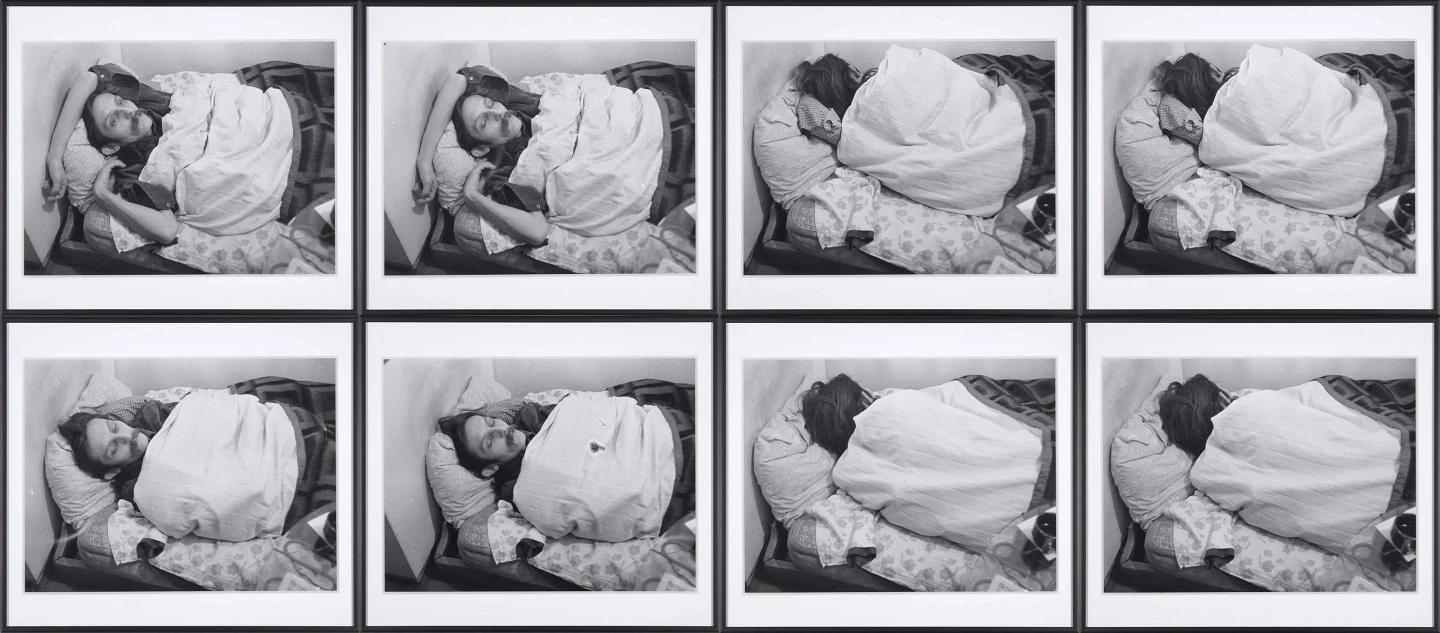
Mladen Stilinović — «Artist at Work, ” 1978
For instance, the work «Artist at Work.» In a series of eight black-and-white photographs, the Croatian artist Mladen Stilinović depicts himself lying in bed. The title, «Artist at Work,» creates an ironic contradiction between the expected creative effort and the apparent inaction.The visual technique relies on the repetition of nearly identical frames. Instead of seeing the process of creation, the viewer sees rest and stillness. The artist challenges the notion that creativity must always be accompanied by active engagement.
«Practice Paradox 1»
For nine hours, the artist Francis Alÿs pushed a large block of ice through the streets of Mexico City until it completely melted. The entire physical labor culminated in the disappearance of the object, leaving no material trace. The project questions the notion that expended effort must necessarily result in a tangible outcome. Here, the process itself becomes more significant than the final goal.
Part 1.
Techin Se. Time Clock Piece, 1980–1981
КОНТРОЛЬ ВРЕМЕНИ · ПОВТОРЕНИЕ · ТЕЛЕСНАЯ ДИСЦИПЛИНА
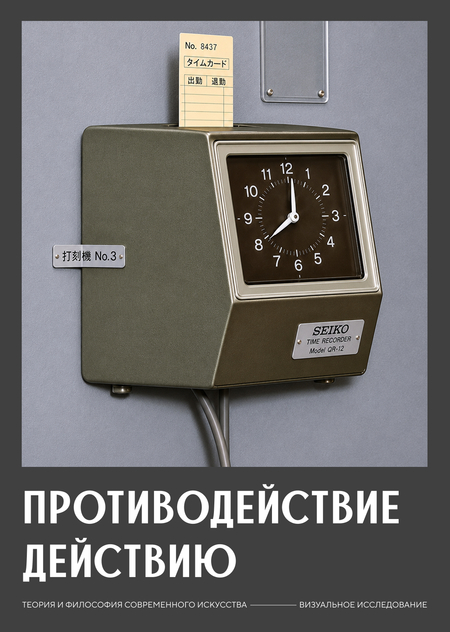
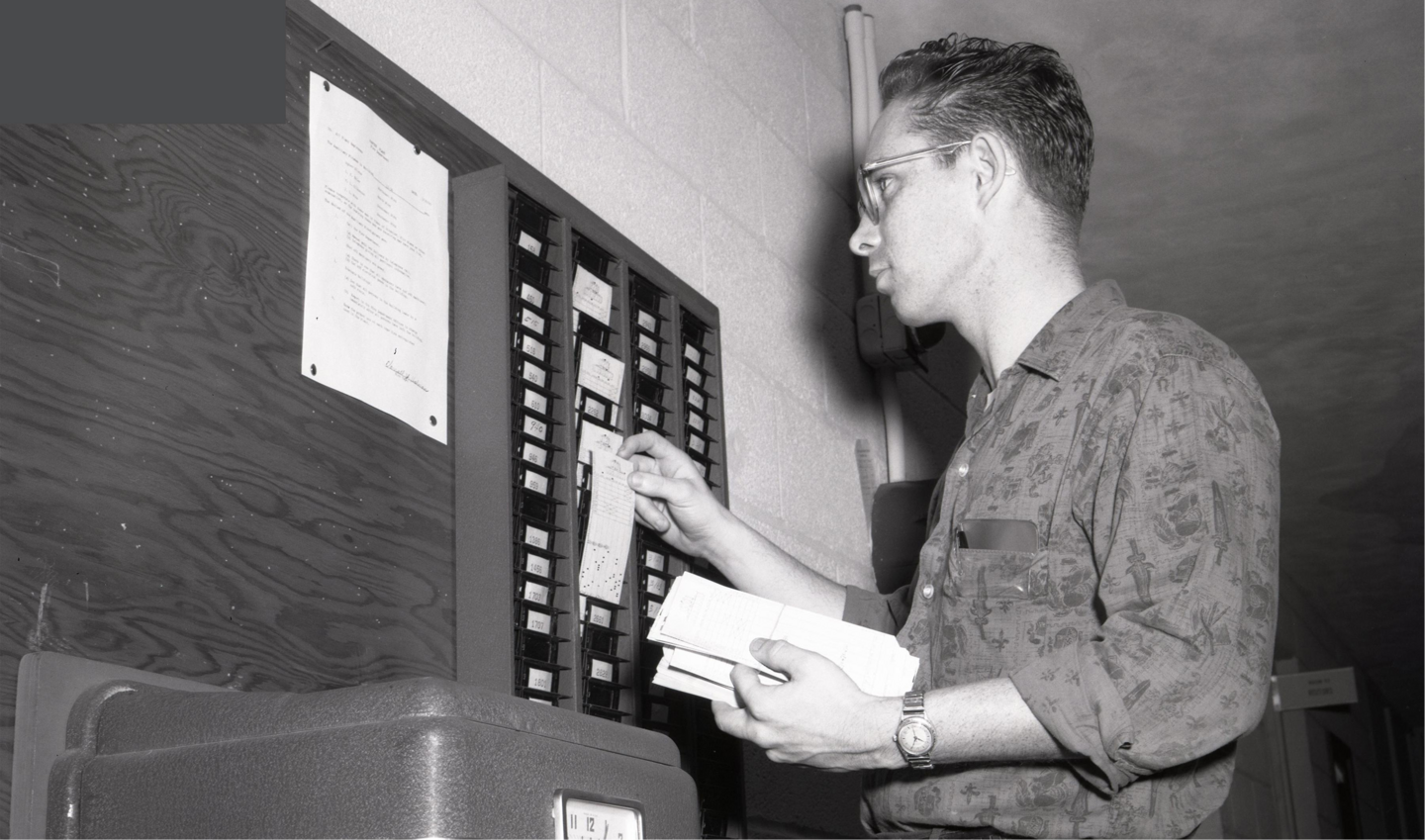
Techin Se is a Taiwanese-American artist known for his long-duration performances, in which art virtually ceases to separate from daily life. In his work One Year Performance 1980–1981, also known as Time Clock Piece, the artist installed a mechanical time clock in his New York studio. From April 11, 1980, to April 11, 1981, he was scheduled to clock in every hour on this device, regardless of the time of day.
«When I clocked in, people would say, ‘You aren’t working, ’ but I was.»
интервью The Believer, 2019.
This phrase reveals the contradiction inherent in the project. The artist undertook an extremely complex task, requiring constant attention and physical stamina, yet their actions yielded no useful result in the conventional economic sense.
Each registration was accompanied by a photograph. Throughout the year, 8,760 hourly timestamps were required. To meet this requirement, the artist had to constantly stay near the device, interrupt sleep, and tailor every daily activity to the schedule. As a result, the very process of existence turned into a continuous sequence of obligations. The artwork here is not reducible to a single photograph, object, or video recording. Its foundation becomes an entire year of human life, organized according to one artificially imposed rule.
Sequence of performance photographs.
The visual language of the work is built on strictness and repetition. The space barely changes; the artist’s figure occupies a stable position, and mechanical clocks become a constant element of the composition. The uniform is particularly significant. The work uniform visually aligns Cé with a person performing a professional duty. It strips the image of individual expression and emphasizes submission to an established system.
However, Se’s performance cannot be viewed solely as a protest against labor relations. The artist explores a broader question about the passage of life: time moves regardless of whether we consider it well spent. This compels a reevaluation of the very notion of productivity. If an activity demands effort but yields no measurable benefit, does it cease to be labor? Se shows that a person’s time cannot always be quantified by the sheer volume of output. His performance makes visible what usually disappears behind the numbers on a schedule: fatigue, waiting, monotony, and the inability to freely command one’s own life.
Jonathan Carr and the Society of Continuous Activity
In his book, «24/7: Late Capitalism and the End of Sleep» (2013), Jonathan Crary examines a society where production and consumption aim to become continuous. In such a system, leisure time is reduced, and constant availability and activity are expected of the individual. Crary places particular emphasis on sleep, which remains one of the boundaries of the economic use of human time. Sleep requires a cessation of activity and a temporary exit from the production system.
This concept allows for a different perspective on Time Clock Piece. Throughout the year, Techen Se was forced to mark his presence every hour on the mechanical clock, interrupting his sleep and subjecting his body’s natural needs to an artificial schedule. Visually, this contradiction manifests through the unchanging clock and the gradual changes in the artist’s appearance. The mechanical system maintains its rhythm, while the body experiences the consequences of constant control. The performance becomes a limit to society’s continuous activity.
2. Part.
Pilvi Takala. The Trainee, 2008
СОЦИАЛЬНЫЕ НОРМЫ · ВИДИМОСТЬ ТРУДА · ПРАВО НА БЕЗДЕЙСТВИЕ
Pilvi Takala is a Finnish artist who works with performance, video, and the exploration of social relationships. In her projects, she often places herself within conventional public settings and disrupts their unspoken rules of conduct. In 2008, the artist realized the project The Trainee in collaboration with the international consulting firm Deloitte. For one month, she worked in the marketing department as an intern. Only a few people knew that her presence was part of the artistic work.
The key feature was that the artist did not commit obviously confrontational acts. She did not directly interfere with other employees or oppose management. Instead, she simply refused to display her usual signs of being occupied. This behavior gradually began to cause confusion, irritation, and attempts by those around her to explain what was happening. The result of the project was a video installation, which included three video recordings, a presentation, and documents related to the artist’s time at the company.
Society often evaluates work based on its external appearance.
A person looking at a monitor, typing text, or constantly moving between workstations is automatically perceived as busy. However, visible activity does not always equate to productive work. On the contrary, reflection, observation, or the attempt to formulate an idea may not involve noticeable actions. In such cases, the activity becomes virtually invisible to observers. Takala uncovers this contradiction: it is not the content of the work that becomes important, but the person’s ability to appear to be working. It is particularly interesting that the pressure does not only come from management. The intern’s behavior begins to concern other employees because it disrupts the established collective order.